


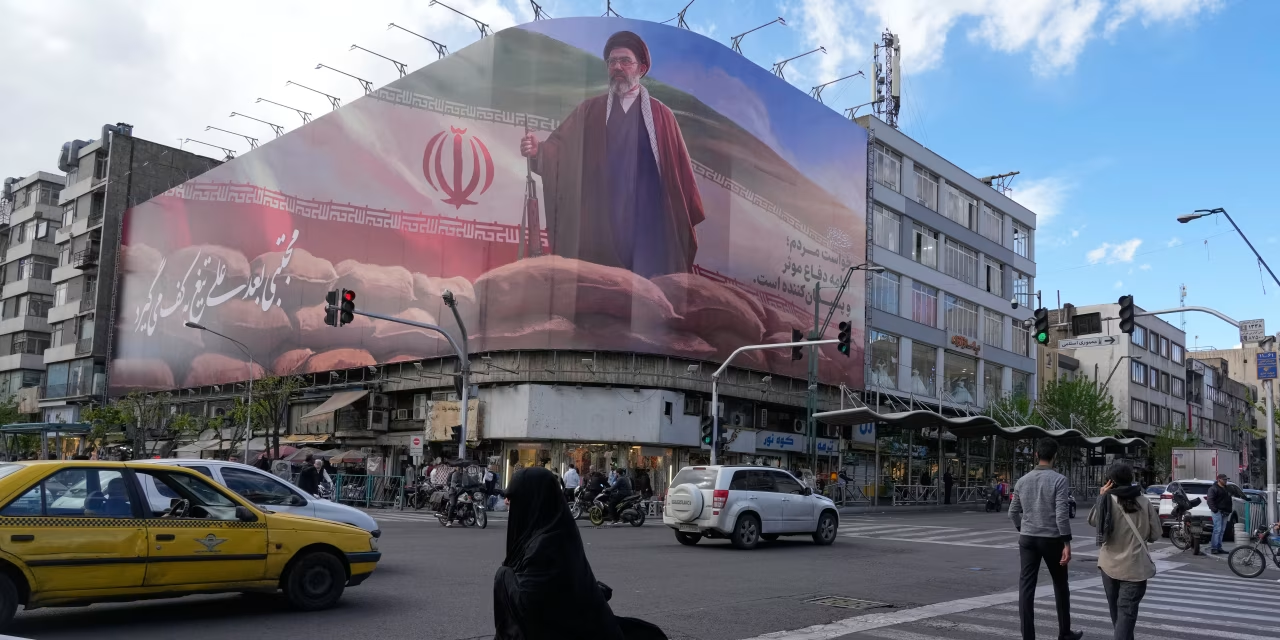
Iran leadership and state media are increasingly signalling that they have little interest in fresh negotiations with the United States if those talks move beyond Tehran’s stated limits, especially after mediated discussions in Pakistan failed to take shape.
Foreign Minister Abbas Araghchi met senior Pakistani officials in Islamabad on Saturday before leaving for Oman and then heading onwards to Russia. Unlike an earlier round of diplomacy this month, he was not joined by Parliament Speaker Mohammad Bagher Ghalibaf. Araghchi said he was still not convinced that Washington was genuinely serious about diplomacy.
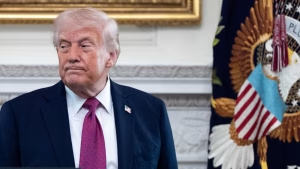
US envoys Steve Witkoff and Jared Kushner had been expected in Pakistan after the White House said Iran had requested a second round of direct negotiations. But President Donald Trump later cancelled the trip and returned to his familiar pressure campaign, writing online that the United States had all the cards while Iran had none. He again repeated his claim that infighting and confusion were spreading inside Iran’s leadership and said that if Tehran wanted talks, all it needed to do was call.
That language has once again placed responsibility for any diplomatic progress squarely on Iranian authorities, even as Tehran publicly rejects Washington’s narrative and appears determined to show a tougher face.
State Messaging Emphasises Discipline and Total Unity
Inside Iran, officials and supporters of the Islamic Republic have responded to Trump’s claims by flooding the public space with repeated messages of unity. According to the report, near-identical statements have been issued by military, security, judicial and government institutions, often using the same wording and matching visual formats across state media.
These coordinated messages insist that all factions in Iran are revolutionary and obedient to Supreme Leader Mojtaba Khamenei. They are clearly intended to reject the US claim that the leadership is fractured and to show that the country remains politically disciplined under pressure.
Officials have also said that more than 30 million people have joined a state-run campaign pledging readiness to sacrifice their lives if needed, although no evidence has been presented to verify that number.
This public campaign is unfolding during a near-total internet shutdown in Iran that has lasted close to two months. In that environment, the state appears to be working hard to control the narrative and reinforce the image of a country standing together against outside pressure.
Military Warnings and Public Rallies Reflect a Harder Mood
Iran’s more forceful stance is also being expressed through military messaging. The Khatam al-Anbiya Central Headquarters of the Islamic Revolutionary Guard Corps said on Saturday that Iranian forces would respond if the United States continues what it described as blockade, banditry and piracy in southern Iranian waters.
The statement said Iran is prepared to monitor enemy movements in the region, maintain control over the Strait of Hormuz and inflict even heavier damage on what it called the American-Zionist enemy if another attack takes place.
State television also aired footage of a presenter near two vessels seized days earlier in the strait, using the moment to reinforce the claim that Iran now holds total control over the waterway.
At the same time, the authorities have been urging supporters, including paramilitary groups, to return to the streets at night to help maintain public control. During a rally in central Tehran, a prominent religious singer with links to the supreme leader’s office warned that anyone who disrupted national unity, even in the name of revolutionary politics, would face public backlash.
Yet the article also points to signs that deeper ideological tensions have not disappeared. In Mashhad, some ultra-conservative voices were still attacking the idea of former moderate figures such as Hassan Rouhani and Mohammad Javad Zarif returning to influence, showing that even as unity is publicly stressed, some internal suspicion remains just beneath the surface.
Hardliners Push Back Against Any New Nuclear Negotiations
Iranian state media and hardline political voices are also increasingly arguing against allowing new nuclear negotiations with the United States. The report says outlets linked to the IRGC, including Tasnim and Fars, believe the US naval blockade of Iranian ports has already weakened the ceasefire extended by Trump and helped strengthen more hardline positions in Tehran.
According to Tasnim, any talks with Washington should focus only on ending the war, not on the nuclear issue itself. Iran has consistently said its nuclear programme is peaceful, though some officials inside the country have at times called for building a bomb. Hardline figures now appear determined to resist any broader bargaining that could place long-term limits on enrichment or require Iran to ship out its stockpile of highly enriched uranium.
One parliament representative said Khamenei opposes any extension of negotiations while threats from the US and Israel continue. Mahmoud Nabavian, a senior hardline lawmaker who took part in the first round of talks, went even further, saying it had been a strategic mistake to let the nuclear question onto the table at all. He argued that from this point onward, negotiations with Washington would only damage Iranian interests and bring no benefit to the nation.
That view reflects a wider shift in tone. Where diplomacy once seemed possible under controlled conditions, influential voices are now presenting talks as a trap rather than an opportunity.
Government Warns of Civilian Strain if War Continues
While hardliners speak more openly about confrontation, the government of President Masoud Pezeshkian has also shown concern about the practical cost of an extended conflict, especially the risk of broader attacks on civilian infrastructure.
Pezeshkian appealed to the public to reduce electricity and energy consumption, saying the country currently does not need people to sacrifice their lives, but does need help managing shortages. He said infrastructure had already been attacked and blockades were increasing pressure in ways that could fuel public dissatisfaction.
The head of the state-owned electricity development company also announced rewards for citizens who report illegal electricity use, underscoring how resource pressure is becoming part of daily governance. First Vice President Mohammadreza Aref said Iran would rebuild stronger through unity after earlier strikes damaged oil and gas facilities, industrial sites, airports, ports, bridges and rail networks.
Despite the ongoing risk of renewed fighting, the government also reopened Tehran’s Imam Khomeini Airport for limited outbound international flights on Saturday, including flights carrying pilgrims to Saudi Arabia for Hajj. That move suggested an effort to project resilience and normalcy even as the threat of escalation remains.
For now, Iran is trying to show two things at once: a leadership unwilling to bow to Trump’s pressure, and a state trying to hold itself together under sanctions, blockade fears and the possibility of another round of war.