


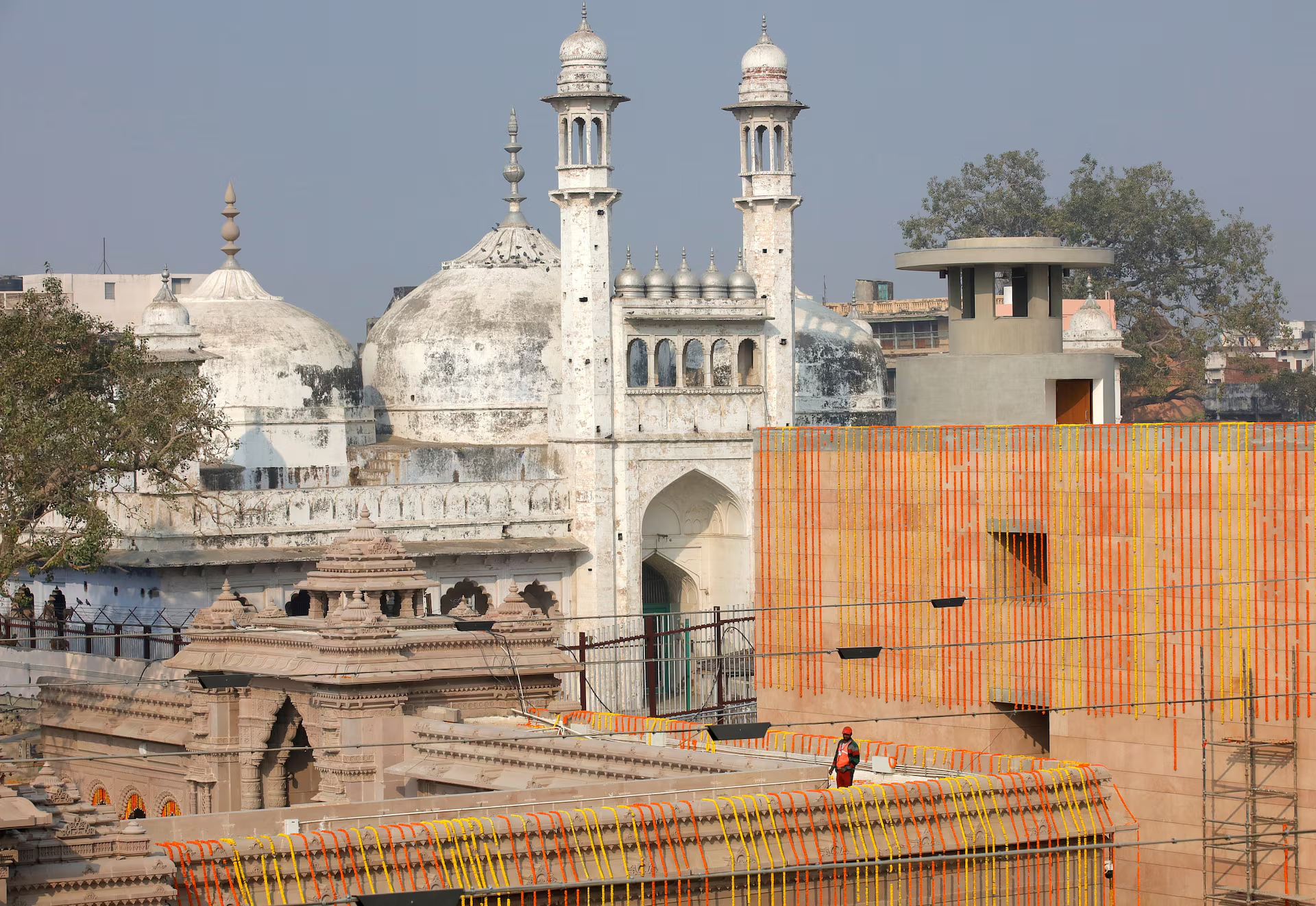
A court ruling in central India has turned the Kamal Maula mosque in Dhar, Madhya Pradesh, into the latest flashpoint in the country’s long-running disputes over religious sites.
The Madhya Pradesh High Court ruled that the medieval structure, located inside the protected Bhojshala complex, is a Hindu temple dedicated to Vagdevi, the Goddess of Speech. The decision has effectively restricted local Muslims from using the mosque, which many had treated as a place of worship for generations.
For 78-year-old Mohammad Rafiq, the ruling marks a painful break from family history. He has served as the mosque’s muezzin for five decades, while his grandfather led prayers there before India gained independence in 1947.
Hindu Worshippers Gather After Ruling
Following the court’s decision, the site was filled with saffron flags, a colour closely associated with the Hindutva movement. Hindu worshippers gathered in large numbers as activists installed a temporary idol of the goddess at the complex.
Police were heavily deployed around the area as religious rituals took place. For Hindu groups involved in the legal case, the ruling was seen as a historic victory. For local Muslims, it was viewed as the loss of a place they had prayed in for decades.
The Kamal Maula mosque is not the only Islamic-era monument facing such claims. Across India, several Hindu nationalist groups have argued that mosques and other Muslim-built sites were constructed over earlier temples.
Long-Running Dispute Over Bhojshala Complex
The Bhojshala complex has been contested for decades. Hindu nationalist claims over the site date back to the late 1950s.
Under a 2003 arrangement with the Archaeological Survey of India, Hindus were allowed to visit the site on Tuesdays, while Muslims were permitted to offer Friday prayers. That arrangement had allowed both communities limited access to the monument.
The latest court ruling, however, accepted the Hindu claim and dismissed the Muslim community’s argument over the mosque’s status. The court said Muslims could seek alternative land in the district to build another mosque.
Muslim representatives have said they will challenge the decision in India’s Supreme Court.
Critics Question the Court’s Reliance on Survey
The court relied heavily on a survey carried out by the Archaeological Survey of India. Critics of the ruling argue that such surveys are increasingly being used to support politically charged claims over religious monuments.
Historian Audrey Truschke said the growing trend of targeting mosques in India reflects deeper anti-Muslim sentiment within Hindu nationalist politics. She argued that politically motivated surveys do not carry the same weight as serious academic research.
Lawyers representing the Muslim side also questioned the ruling. They pointed to a 1935 official notice from the British colonial period, which described the complex as a mosque and said Muslim prayers should continue there.
However, the court rejected that document, saying it came before India’s current legal framework.
Debate Over Idol in British Museum
The court also asked the Indian government to consider bringing back an idol of Vagdevi from the British Museum in London. Hindu petitioners claim the idol belongs to the disputed site.
But Muslim-side lawyer Ashhar Warsi argued that historical records show the idol was found elsewhere in Dhar, not at the Kamal Maula mosque. He said the British Museum’s own description links the artefact to the City Palace ruins, which are marked separately from the mosque.
Warsi called the ruling legally flawed and said it violated the principle behind India’s Places of Worship Act, 1991.
Places of Worship Act Under Scrutiny
The Places of Worship Act was created to preserve the religious status of places of worship as they existed at the time of India’s independence in 1947. The law was meant to prevent new disputes aimed at changing the identity of religious sites.
Critics say the Dhar ruling weakens that principle and could encourage more claims against mosques across India.
Asaduddin Owaisi, a member of parliament from Hyderabad, criticised the decision and warned that it sends a worrying message to India’s Muslim minority. He said the ruling reflects a broader pattern of pressure on Muslim places of worship.
Babri Mosque Case Still Shapes Debate
Many observers have linked the Dhar case to the 2019 Supreme Court ruling on the Babri Mosque in Ayodhya.
The Babri Mosque, built in the 16th century, was demolished by Hindu nationalist mobs in 1992. The demolition triggered nationwide riots that killed more than 2,000 people, most of them Muslims.
In 2019, India’s Supreme Court awarded the disputed land to Hindus for the construction of a Ram temple, while Muslims were given alternative land for a mosque.
Prime Minister Narendra Modi attended the temple’s consecration ceremony in January 2024, a moment widely seen as a major victory for the Hindutva movement.
Critics argue that the Babri judgment opened the door for similar claims against other historic mosques.
Other Mosque-Temple Disputes Continue
The Dhar case is part of a wider pattern of disputes over Islamic-era monuments.
In Varanasi, a court allowed Hindu worship inside part of the Gyanvapi Mosque complex after claims that the 17th-century mosque contained signs of an earlier Hindu temple. Varanasi is also Modi’s parliamentary constituency.
In Mathura, Hindu groups have made similar claims over the Shahi Eidgah mosque, arguing it stands at the birthplace of Lord Krishna.
Even the Taj Mahal, a Mughal-era mausoleum and one of the world’s most famous monuments, has faced claims from some Hindu nationalist voices, despite historians rejecting such arguments.
A New Flashpoint in India’s Religious Politics
For Hindu activists in Dhar, the ruling is being celebrated as a restoration of religious pride. Some local leaders described the decision as part of a broader movement to reclaim what they believe are Hindu religious sites.
For Muslim residents, however, the decision has deepened fears over the future of their religious spaces and historical memory.
The case now appears headed for the Supreme Court, where Muslim petitioners are expected to challenge the High Court’s ruling.
The outcome could have wider consequences, not only for the Kamal Maula mosque, but also for the growing number of religious heritage disputes across India.