


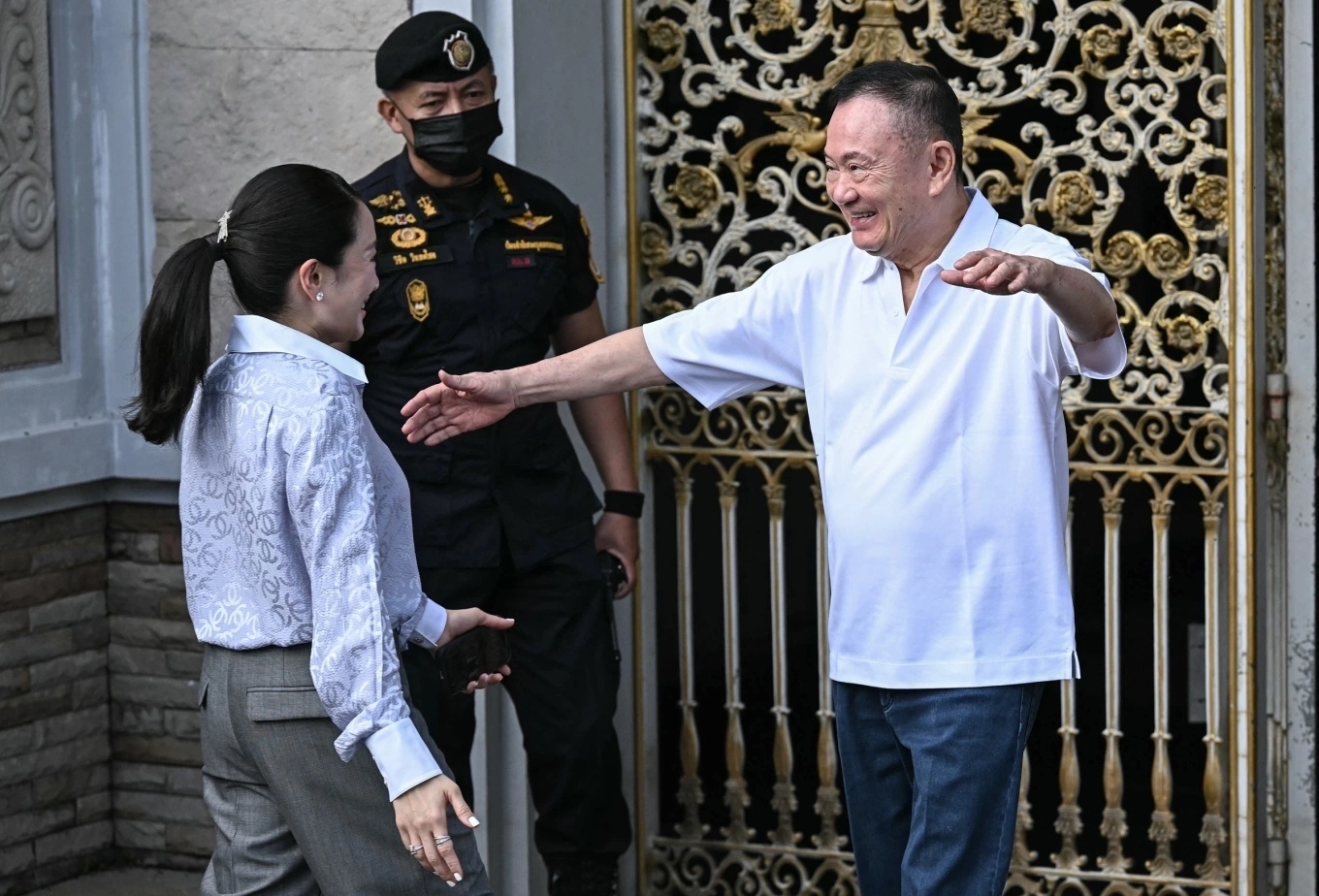
Thailand’s former Prime Minister Thaksin Shinawatra has been released from prison in Bangkok after serving eight months of a one-year sentence linked to a corruption-related case, marking another dramatic moment in the long political story of one of the country’s most influential figures.
Hundreds of supporters, relatives and political allies gathered on Monday morning outside Klong Prem Central Prison to welcome the 76-year-old billionaire as he walked free. Chants of support rang out as Thaksin emerged wearing a simple white shirt, his hair cut short, and smiling as he greeted those waiting for him.
He left the prison at around 7:40am local time and was quickly surrounded by family members, including his daughter Paetongtarn Shinawatra. Though clearly in good spirits, he did not stop to speak with reporters before leaving the area.
A political figure who shaped a generation
Thaksin remains one of the most important and controversial figures in modern Thai politics. He served as prime minister from 2001 until he was removed in a military coup in 2006 while he was overseas.
For years, he remained a dominant force in the country’s political life, even while living in self-exile. His influence stretched far beyond formal office, shaping party politics, public debate and power struggles in Thailand for nearly 25 years.
Yet his grip on politics has weakened in recent years. His imprisonment, combined with the poor electoral performance of his once-powerful Pheu Thai Party earlier this year, has added to the sense that his era of direct dominance may now be fading.
Return from exile led quickly to prison and hospital
After 15 years outside Thailand, Thaksin returned in 2023 to face legal punishment linked to conflicts of interest and abuse of power during his time in office. He had originally faced an eight-year sentence, but that was later reduced to one year by the king.
His time in prison, however, was brief at first. Just hours after returning to Thailand and entering prison, he complained of chest pains and heart trouble. He was then transferred to hospital, where he remained for six months in a VIP ward before eventually being released on parole.
That hospital stay later became the focus of legal scrutiny. In September last year, the Supreme Court ruled that Thaksin had to serve that period as prison time, finding that he and his doctors had deliberately extended his stay through minor procedures that were not medically necessary.
Parole granted after review
His release came after a Ministry of Justice panel reviewed the cases of more than 900 prisoners eligible for parole. Officials said Thaksin was approved because of his good behaviour, his age and the low likelihood that he would commit the same offence again.
Even though he has now left prison, restrictions still apply. According to the corrections department, he will have to wear an electronic ankle monitor for the rest of his sentence.
Later on Monday, video showed him arriving home in western Bangkok and briefly lowering the car window to greet a small group of supporters outside. When reporters shouted questions, he replied lightly that he had been in hibernation and could not remember anything now.
Family and party continue in a changed political landscape
The release comes at a complicated time for both Thaksin’s family and his political network. His daughter Paetongtarn, once seen as the rising face of the Shinawatra political legacy, became Thailand’s youngest prime minister in 2024. But she was later removed from office by the Constitutional Court after a recording surfaced of a sensitive phone conversation with former Cambodian leader Hun Sen.
At the same time, Pheu Thai has been weakened. The party slipped to third place in the February election, its worst result on record, before joining the governing coalition led by conservative Prime Minister Anutin Charnvirakul.
Even so, the Shinawatra name remains embedded in national politics. Thaksin’s nephew, Yodchanan Wongsawat, who led the party into the February election, was later appointed minister of higher education in Anutin’s cabinet.
A release loaded with political meaning
Thaksin’s release is more than the end of a prison term. It is also the return of a man whose rise, fall and continued influence have shaped Thailand’s modern political history.
Although his political power is no longer what it once was, his freedom is certain to spark fresh debate about the future of the Shinawatra family, the direction of Pheu Thai and the balance of power in Thailand’s still unsettled political scene.
For supporters, Monday was a moment of celebration. For the wider country, it may be the beginning of another chapter in a story that has never stayed quiet for long.