


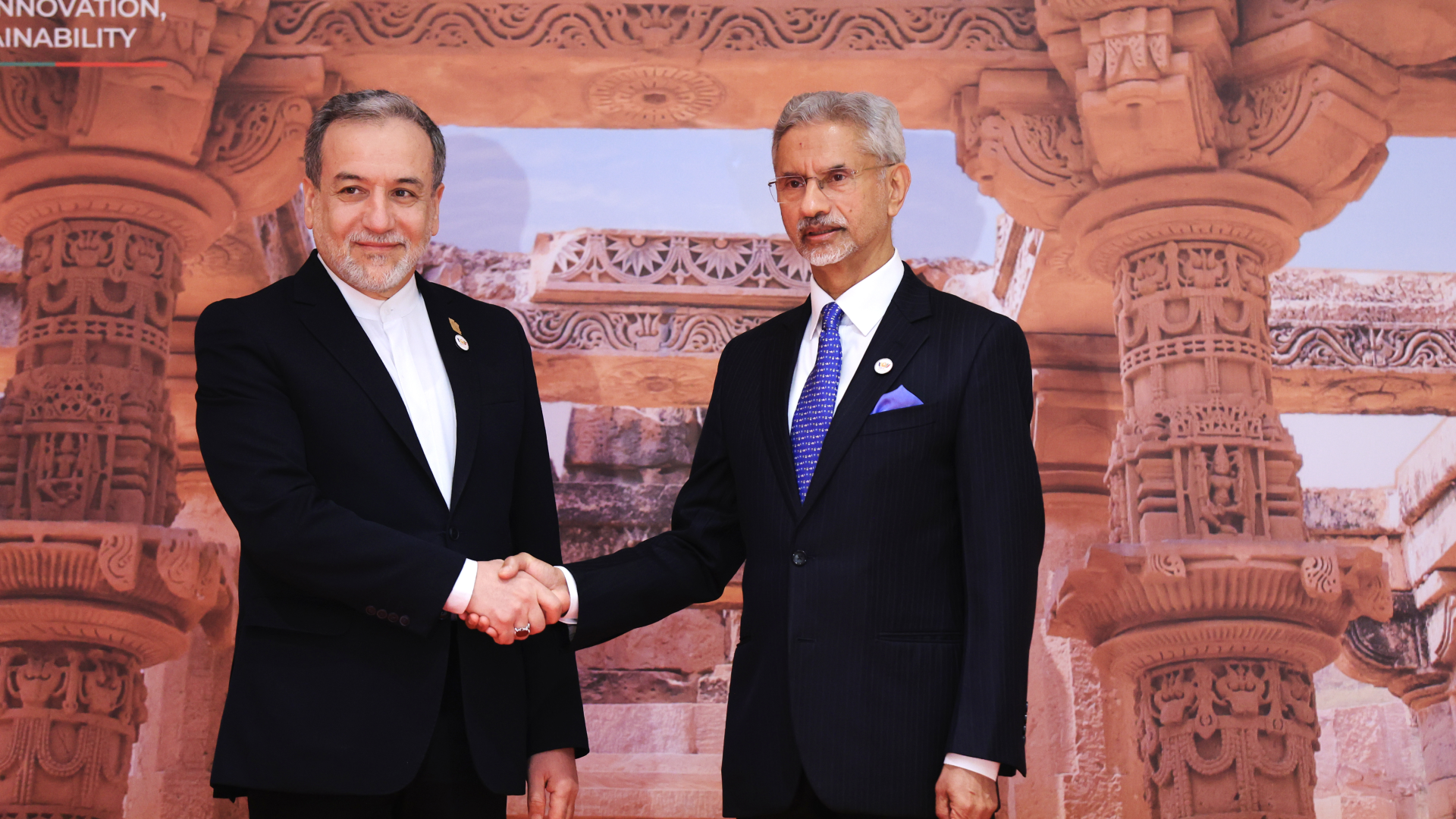
A meeting of BRICS foreign ministers opened in New Delhi on Thursday, with the ongoing war in Iran expected to dominate discussions among the world’s major emerging economies.
The two-day meeting comes at a sensitive moment, coinciding with US President Donald Trump’s state visit to China and growing international concern over the blockade of the Strait of Hormuz, one of the world’s most important energy routes.
In his opening remarks, Indian Foreign Minister Subrahmanyam Jaishankar called for safe and unrestricted maritime movement through international waters. His comments came as the Strait of Hormuz remains blocked, disrupting a route that normally carries a significant share of global oil and gas supplies.
Iranian Foreign Minister Abbas Araghchi also used the gathering to call on BRICS members to condemn the United States and Israel, accusing them of unlawful aggression against Tehran.
BRICS Faces Division Over Iran Conflict
The meeting highlights the difficult position facing BRICS as the bloc tries to maintain unity while its members hold different views on the Iran war.
India, as the host country, must carefully balance its relations with Iran, the United Arab Emirates, and Israel. The UAE, now a BRICS member, has its own tensions with Tehran, making it harder for the bloc to agree on a common position.
The Iran issue has already created problems for BRICS diplomacy. Earlier this year, a BRICS meeting on the Middle East and North Africa in New Delhi ended without a joint statement after Iran and the UAE disagreed over how to address the US-Israel war on Iran.
The war in Gaza has also caused tension inside the bloc. India, which has built closer ties with Israel, reportedly tried to soften criticism of Israel during earlier BRICS discussions, making consensus more difficult.
What Is BRICS?
BRICS is a group of major emerging economies that aims to increase the influence of the Global South in global politics, trade, security, and international institutions.
The original members were Brazil, Russia, India, China, and South Africa. The group has since expanded, with Egypt, Ethiopia, Iran, the United Arab Emirates, and Indonesia joining. Saudi Arabia has been invited but has not formally become a member.
BRICS holds annual summits, with each member taking turns to host. This year, India is hosting the main summit, while the foreign ministers’ meeting in New Delhi is expected to help prepare the agenda.
Who Is Attending the Meeting?
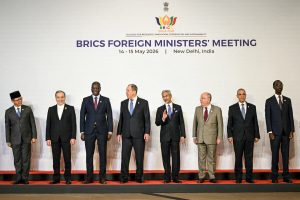
Several BRICS foreign ministers are attending the meeting in India, including Russia’s Sergey Lavrov, South Africa’s Ronald Lamola, Brazil’s Mauro Vieira, Iran’s Abbas Araghchi, and Indonesia’s Sugiono.
China’s Foreign Minister Wang Yi is not attending because of Trump’s visit to Beijing. China is instead represented by its ambassador to India, Xu Feihong.
The UAE’s representation remains unclear, even as tensions between Abu Dhabi and Tehran continue to rise during the conflict.
Official Agenda Focuses on Cooperation
India’s Ministry of External Affairs said the theme of the meeting is “Building for Resilience, Innovation, Cooperation and Sustainability.”
The official agenda includes cooperation on healthcare, development, and global challenges. However, observers believe the Iran war will take much of the attention because of its impact on diplomacy, energy markets, and BRICS unity.
The discussions are also expected to shape the agenda for the upcoming BRICS summit in September.
Trump-Xi Meeting Adds Another Layer
The BRICS meeting is taking place at the same time as Trump’s visit to China, where he is expected to meet President Xi Jinping.
Analysts believe Trump may try to persuade Xi to pressure Iran into accepting US demands, including reopening the Strait of Hormuz and easing tensions in the Gulf.
China has often avoided taking a central role in long-running international conflicts, but experts say Beijing could become more active if it sees strategic benefits. Some analysts believe Taiwan could become part of the wider diplomatic trade-off between Washington and Beijing.
Why the Meeting Matters
The BRICS foreign ministers’ meeting matters because the Iran war is not only a regional issue. It has become a global economic and diplomatic crisis.
The closure of the Strait of Hormuz has disrupted energy supplies, affecting several BRICS members directly. India and China depend heavily on Gulf oil. Saudi Arabia and the UAE use the strait to ship energy exports. Other members, including Brazil, Egypt, and South Africa, are also affected by rising fuel prices.
At the same time, Iran’s restrictions on shipping and the US naval blockade around Iranian ports have deepened concerns about global oil and gas stability.
BRICS May Struggle to Find a Common Voice
Despite the importance of the meeting, experts believe BRICS may struggle to produce a strong joint statement on Iran.
The bloc has often avoided taking sharp positions on conflicts involving member interests. Instead, it tends to use broad language about sovereignty, diplomacy, and respect for international law.
Because of disagreements between Iran and the UAE, India’s ties with Israel, and China’s own strategic calculations, BRICS may find it difficult to speak with one voice.
Still, the New Delhi meeting remains important. It shows how the Iran war is testing the strength, unity, and global influence of BRICS at a time when the bloc is trying to present itself as a stronger alternative voice in world affairs.