


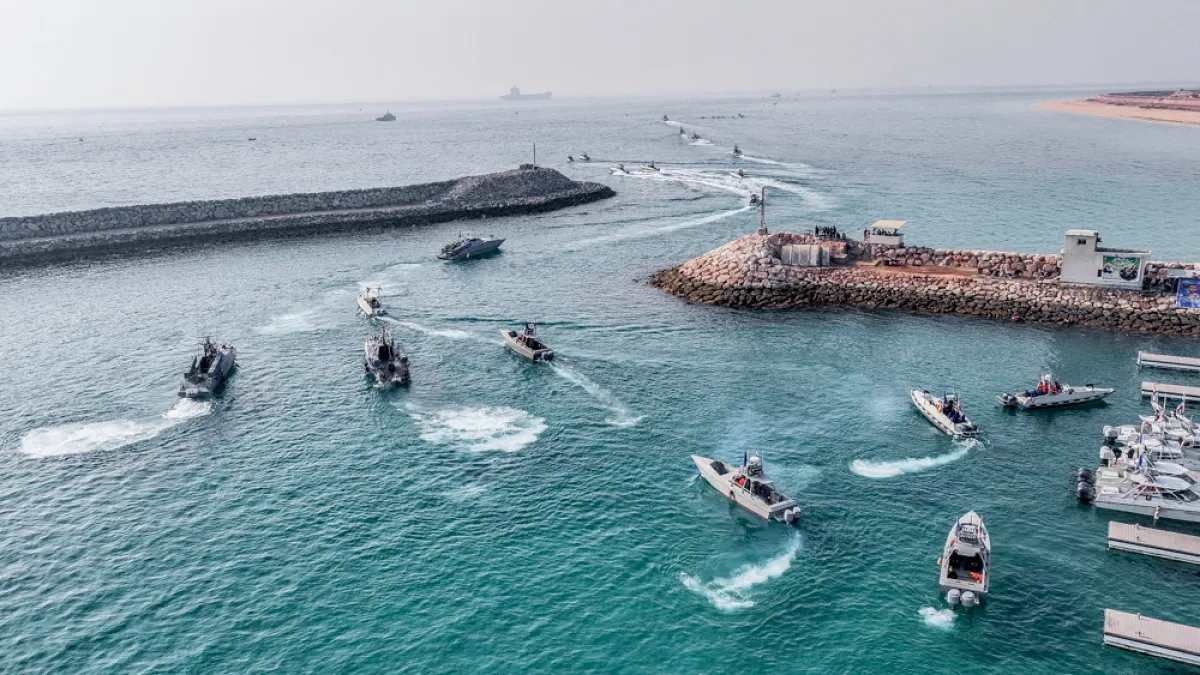
Iran says its Revolutionary Guard has seized an oil tanker in the Gulf of Oman, while the United States says it disabled two vessels trying to enter Iranian ports, marking another sharp escalation in the maritime confrontation between the two sides.
The competing announcements came only hours after US and Iranian forces exchanged fire in the Strait of Hormuz, deepening fears that the current pause in fighting could quickly unravel. Both countries are still publicly talking about diplomacy, but the latest events suggest the military standoff in the Gulf remains highly unstable.
According to a statement carried by Iran’s Fars news agency, the Islamic Revolutionary Guard Corps said its navy captured the tanker Ocean Koi during what it described as a special operation. Iran claimed the vessel had attempted to disrupt its oil exports and harm the interests of the Iranian nation. State media also released video showing Iranian forces boarding and detaining the ship. MarineTraffic data identified the vessel as registered in Barbados.
US says two tankers were disabled near Iranian ports
In a separate statement, US Central Command said American forces had disabled two Iranian-flagged tankers as they tried to reach Iranian ports in the Gulf of Oman. Admiral Bradley Cooper said US forces remain committed to fully enforcing the blockade on ships entering or leaving Iran.
That message reflects Washington’s harder maritime posture, which now goes beyond deterrence and into direct interference with shipping linked to Iran. The move is likely to further anger Tehran, which already accuses the US of using naval pressure to choke its economy and weaken its leverage in the Gulf.
Both sides blame each other for latest clash
The tanker incidents followed a new exchange of fire in the Strait of Hormuz, one of the most serious threats so far to the ongoing pause in the war. Donald Trump said Iran had attacked three US Navy destroyers in the strait. Iran’s top joint military command, however, accused the United States of violating the ceasefire first by targeting an Iranian oil tanker and another ship.
Iran said 10 sailors were wounded in the strike and five others were missing. It also accused the US of carrying out air attacks on civilian areas on Qeshm Island, a strategic location at the entrance to Hormuz, and said Iranian forces responded by striking US military vessels east of the strait and south of Chabahar.
Despite the exchange, Trump later tried to play down the incident, calling it a love tap and saying it did not amount to a collapse of the current truce. Secretary of State Marco Rubio also said the administration was still waiting for Iran’s response to the latest American proposal aimed at reaching a more lasting settlement.
Diplomacy continues, but military tension keeps rising
While the military pressure grows, diplomatic efforts are still moving in the background. Qatar said Vice President JD Vance met with Prime Minister and Foreign Minister Sheikh Mohammed bin Abdulrahman bin Jassim Al Thani in Washington to discuss Pakistan-led mediation aimed at reducing the conflict.
At the same time, Iranian Foreign Ministry spokesperson Esmaeil Baghaei said Tehran was still reviewing the latest US proposal and considering how to respond. He also condemned the newest attacks and said Iranian forces were fully prepared to answer any further aggression or adventurism.
Iran signals a broader shift in strategy
The seizure of the tanker appears to be part of a wider Iranian effort to reshape how shipping is controlled in and around the Strait of Hormuz. Reporting from Tehran, Al Jazeera’s Resul Serder said Iran sees the war as having changed the strategic environment and now believes the Gulf and its chokepoints are directly tied to national security.
According to the report, Iran is now introducing what it describes as a new maritime regime. A body called the Persian Gulf Strait Authority is expected to oversee movement through Hormuz, with ships required to seek Iranian clearance before passing in or out. Vessels would reportedly need to provide details including their country of origin, cargo and destination, after which Iran would assess the request and require toll payments.
That approach signals that Tehran is not stepping back from asserting control over one of the world’s most important energy routes. Instead, it is trying to formalise that control and use it as both a security tool and a source of leverage.
A power play at sea with wider consequences
Defence analyst Alex Alfirraz Scheers said Iran’s seizure of a ship in the Gulf of Oman shows that the IRGC is now trying to project power in a way it could not before. He said Tehran is using control of the strait to make the waterway more dangerous and uncertain, which in itself becomes a form of strategic and political influence.
He linked the move to the ongoing negotiations, arguing that if the United States refuses to compromise, this is exactly the kind of pressure tactic Iran is likely to use to shift the balance in its favour.
The result is a situation in which diplomacy remains alive, but every new incident at sea increases the risk that talks will be overtaken by events. The seizure of a tanker, the disabling of ships, and the recent exchange of fire all point to the same reality: the Gulf remains one of the most dangerous fronts in the wider conflict, and the ceasefire is holding only under heavy strain.