


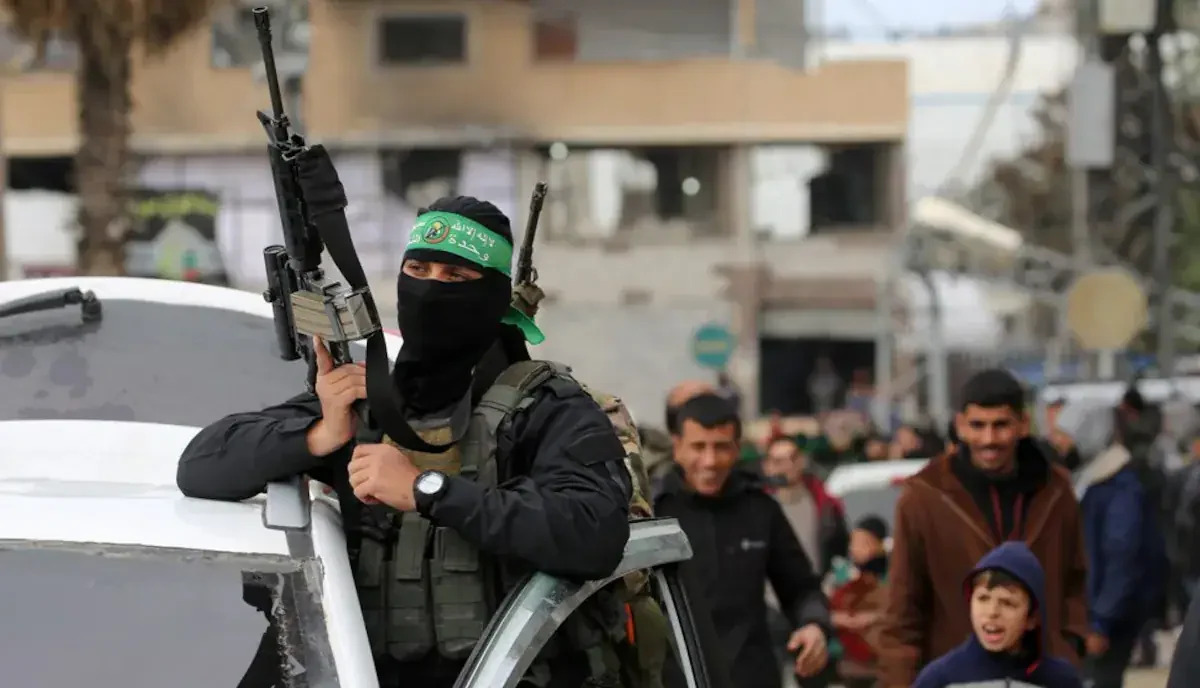
Hamas says it will not hand over its weapons at this stage, despite continued pressure for the group to disarm under the US-backed Gaza ceasefire plan.
In an interview with Al Jazeera, Hamas political bureau member Husam Badran said the future of the group’s weapons should be decided through wider talks with Palestinian factions. He said Hamas is not discussing a formal surrender of arms, but is open to a plan where weapons are no longer visible in Gaza’s streets.
According to Badran, once the National Committee for the Administration of Gaza takes control, only the official Palestinian police linked to that committee would carry weapons publicly.
Gaza Security Plan Discussed
Badran said Hamas wants to end the armed presence that had previously been common in Gaza’s streets and neighbourhoods. However, he made clear that this does not mean Hamas is agreeing to give its weapons to Israel or any outside party.
He said the details must be discussed within a national Palestinian framework.
The statement comes as Hamas prepares to send a delegation to Cairo for renewed talks. The group had briefly delayed its participation after demanding a halt to Israeli assassinations, including the recent killings of Hamas military figures Izz al-Din al-Haddad and Mohammed Odeh.
Disarmament Remains Main Obstacle
The issue of Hamas’s weapons remains one of the biggest barriers in the ceasefire process. Israel and US-backed mediators want armed groups in Gaza to disarm before moving into the next phase of the peace plan.
Hamas and other Palestinian factions argue that Israel has not fulfilled the first phase of the agreement. Badran said Israel has not even met a large part of its early commitments, including aid access, the Rafah crossing mechanism, infrastructure support, and a halt to assassinations.
He said Gaza is receiving far fewer aid trucks than agreed, while electricity, hospitals, fuel supplies, and basic services remain devastated.
Palestinian Factions to Meet in Cairo
The upcoming Cairo talks are expected to include several Palestinian factions, including Hamas, Palestinian Islamic Jihad, the Popular Front for the Liberation of Palestine, the Democratic Front for the Liberation of Palestine, the Popular Resistance Committees, and others.
The goal is to create a unified Palestinian position on the ceasefire plan and the future administration of Gaza.
Hamas says it is prepared to hand over governance and security responsibilities to the National Committee for the Administration of Gaza. The group says it has already prepared administrative and security files for that transfer.
Roadmap Faces Palestinian Doubts
Nickolay Mladenov, the high representative for Gaza on Trump’s “Board of Peace”, has presented a 15-point roadmap to move the ceasefire forward.
The plan calls for gradual, verified decommissioning of weapons. It also states that Palestinian armed groups would not be required to hand weapons to Israel. Instead, the weapons would be transferred through a Palestinian-led process to the Gaza administration committee.
The roadmap also links disarmament to a phased Israeli withdrawal and the deployment of an International Stabilization Force.
However, many Palestinians view the plan with suspicion. Critics say it focuses heavily on disarmament while offering few clear guarantees for Palestinian political rights, full Israeli withdrawal, or Gaza’s future.
Israel Accused of Expanding Control
Palestinian analyst Wissam Afifa told Al Jazeera that Israel is using negotiation time to expand its control in Gaza. He argued that the talks have shifted away from the original ceasefire plan and now focus mainly on disarmament.
Afifa said Palestinians are being asked to make major concessions without clear guarantees, while Israel continues strengthening its military position.
He also said Israeli Prime Minister Benjamin Netanyahu is using the talks to gain political advantage at home and expand Israel’s control over more of Gaza.
Gaza Committee Faces Major Barriers
The National Committee for the Administration of Gaza is expected to play a central role in any transition, but its work remains blocked by major obstacles.
A committee member told Al Jazeera that the body would not enter Gaza under current conditions. The source said the committee refuses to operate behind the Israeli-controlled “Yellow Line” or cooperate with Israeli-backed armed groups in the territory.
The committee also wants the International Stabilization Force deployed in buffer zones before it takes over.
Ceasefire Violations Continue
The political deadlock continues as the humanitarian situation worsens. Mladenov acknowledged that ceasefire violations are still killing civilians and blocking aid access.
Since the ceasefire began, Israeli military actions have killed 933 Palestinians and injured 2,868, according to the figures cited in the report. The total death toll since October 2023 has risen to 72,942, with 172,967 injured.
Gaza Talks Remain Stuck
Hamas’s latest position shows that the group is willing to discuss changes to public security in Gaza, but not immediate disarmament.
For now, the ceasefire process remains stuck between Israeli demands for disarmament, Palestinian demands for withdrawal and aid access, and uncertainty over who will govern Gaza after the war.
The Cairo talks may help build a common Palestinian position, but without agreement on weapons, withdrawal, and security guarantees, the next phase of the ceasefire remains difficult to reach.