


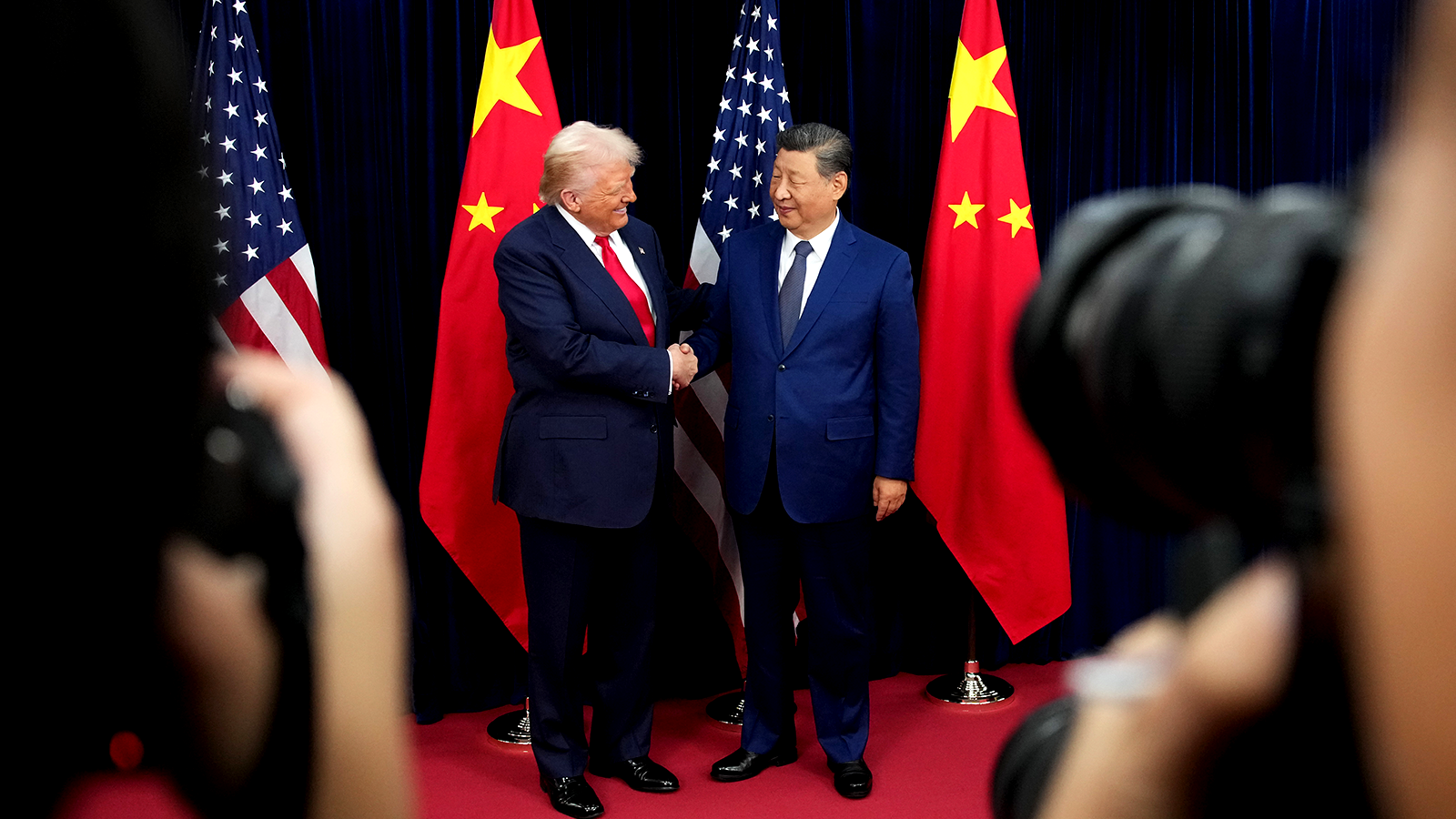
United States President Donald Trump arrived for his high-level summit with Chinese President Xi Jinping with an ambitious message. Before the meeting began, Trump said he would push Xi to “open up” China’s economy and bring greater access for American companies.
To strengthen that message, Trump was joined by several major US business leaders, including Tesla chief Elon Musk, Apple CEO Tim Cook and Nvidia CEO Jensen Huang. Their presence signaled that business, investment and technology would be central themes in the talks.
However, as the two leaders prepared to conclude two days of meetings on Friday, expectations for a major breakthrough remained low. Analysts believe the summit may help stabilize relations, but they do not expect it to transform the tense relationship between the world’s two largest economies.
Trade War Pause Likely to Continue
Trump and Xi are expected to extend the one-year pause in their trade dispute, which was first agreed during talks in South Korea in October. That extension would help prevent a further escalation, but it would not solve the deeper problems between Washington and Beijing.
The US and China remain locked in a broad rivalry covering trade, artificial intelligence, advanced technology, supply chains and Taiwan. Because of that, experts say any agreement will likely be limited.
Claire E Reade, a senior counsel at Arnold & Porter and former official at the Office of the US Trade Representative, said both sides must be realistic about the state of the relationship. She noted that China does not trust the US and sees itself in long-term competition with Washington.
That lack of trust, analysts say, limits what both leaders can realistically agree to.
Trump Signals Possible Business Deals
Although the final details of any agreement have not yet been announced, the Trump administration has hinted at several possible deals.
In a recorded interview aired by Fox News, Trump said China would invest hundreds of billions of dollars in companies connected to the executives travelling with him. He did not provide specific details about the planned investments.
Trump also claimed Beijing had agreed to buy US oil and 200 Boeing aircraft. Administration officials have also suggested that China may increase purchases of American agricultural goods and help create a “Board of Trade” to manage investment between the two countries.
Analysts say these areas are the most likely starting points for any realistic opening of China’s market. US products such as soybeans, beef, aircraft and other high-value manufactured goods match areas where China already has demand.
Taiyi Sun, an associate professor of political science at Christopher Newport University, said China may also gradually expand access for US firms in areas such as financial services. However, he warned that these sectors are politically sensitive in China, meaning progress would likely be slow.
AI Chips Remain a Sensitive Issue
One of the biggest questions surrounding the summit was whether the two leaders would discuss US restrictions on advanced computer chips used for artificial intelligence.
The issue gained attention because Nvidia CEO Jensen Huang joined Trump’s delegation. Nvidia has been directly affected by US export controls on advanced chips sold to China.
Trump has sent mixed signals on the issue. His administration has tightened some restrictions while also allowing Nvidia to sell its H200 chip in the Chinese market.
US Trade Representative Jamieson Greer said chip export controls were not a major topic during the China talks. Still, experts believe technology access will remain a central issue in future negotiations.
Some analysts expect China to connect access to its critical minerals with access to advanced US technology. Since rare earth materials are essential for defense, electronics and clean energy production, Beijing may use them as leverage in future talks.
Rare Earths and Supply Chains Add Pressure
The trade war has exposed supply-chain weaknesses on both sides. The US remains concerned about China’s control over rare earth exports, while China wants better access to advanced American technology.
Gabriel Wildau, a senior vice president at Teneo, said the Iran war has increased US sensitivity to rare earth supply risks, especially because Washington may need to rebuild military stockpiles. As a result, the US may be willing to offer tariff relief or avoid new tariffs if China agrees to keep rare earth exports moving.
This shows how trade talks are no longer only about buying and selling goods. They are now closely tied to national security, energy, technology and military readiness.
Tariffs Still Weigh on US-China Trade
Even after earlier agreements to roll back some trade barriers, tariffs between the US and China remain much higher than before Trump’s first term.
The average US tariff on Chinese goods remains far above pre-2017 levels, while China’s tariffs on American goods have also increased sharply since 2018. Two-way goods trade has fallen significantly from its 2022 peak, showing how much the economic relationship has weakened.
Experts say this makes a major recovery difficult. Years of tariff battles, export controls and political distrust have changed how both countries view each other.
China Has Less Reason to Make Big Concessions
Some analysts believe China has less incentive than before to offer meaningful concessions. Over the past decade, Chinese companies have become stronger in many industrial sectors, reducing Beijing’s dependence on the US.
Carsten Holz, an expert on China’s economy at the Hong Kong University of Science and Technology, said China may only offer symbolic gestures rather than deep market openings.
Deborah Elms, head of trade policy at the Hinrich Foundation in Singapore, made a similar point. She said Trump appears to expect China to buy more American goods and give US companies more freedom, but Washington is offering little in return.
This imbalance may limit the outcome of the summit.
Xi Unlikely to Accept Deals That Hurt China
Analysts say Xi is unlikely to approve any agreement that damages China’s long-term interests. Instead, Beijing may offer measures that cost little politically or economically.
That could include removing some barriers on US beef or buying American products China already needs. China may also allow certain US technology purchases, but only when they serve its immediate interests.
At the same time, Beijing is expected to continue its long-term strategy of reducing dependence on American technology.
Summit Expected to Stabilize, Not Transform, Relations
The Trump-Xi summit may produce announcements on trade, investment, agriculture and aircraft purchases. It may also extend the pause in the trade war and lower the risk of new economic confrontation.
But expectations for a major deal remain limited. The US and China are still divided by strategic competition, technology controls, tariffs, Taiwan and supply-chain security.
For now, the summit appears more likely to prevent relations from getting worse than to create a new era of cooperation. The result may be stability, but not the broad opening of China’s economy that Trump promised before the trip.