


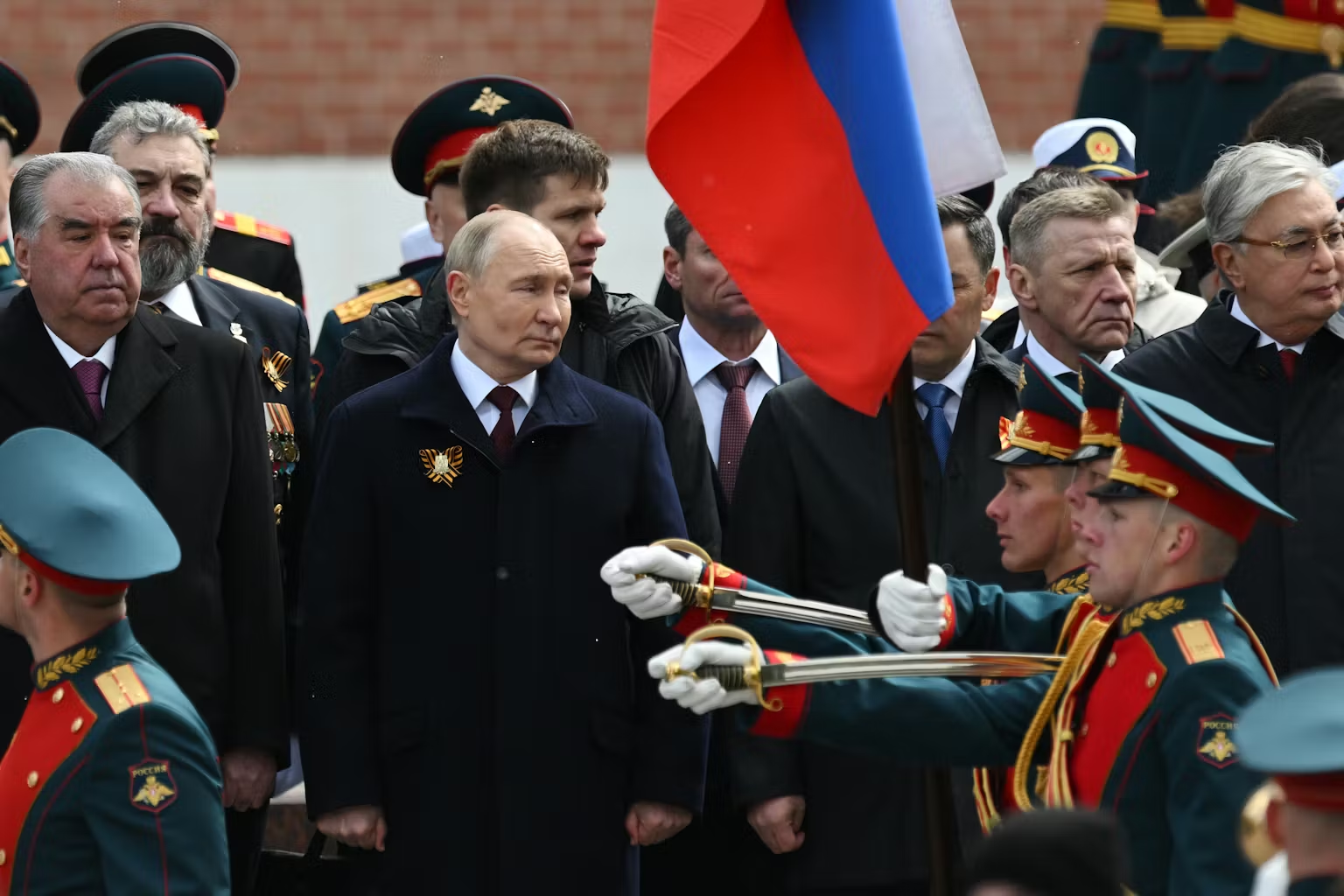
Russia has held its annual Victory Day military parade in Moscow to commemorate the Soviet Union’s defeat of Nazi Germany in the Second World War, but this year’s event unfolded on a smaller scale and under tighter security than usual.
The parade began at around 10am local time in Red Square, opening with a military formation carrying the Russian flag. While Victory Day remains one of Russia’s most important public holidays, the atmosphere surrounding this year’s event was notably shaped by war and security concerns.
President Vladimir Putin used his speech to stress national unity, endurance and military resolve, telling those gathered that victory had always belonged to Russia and would continue to do so. His remarks followed the familiar pattern of linking the memory of the Soviet war effort to the country’s present-day military campaign in Ukraine.
Parade stripped of heavy military hardware for first time in years
For the first time in nearly 20 years, the Moscow parade was held without tanks, missile systems or other major heavy weapons moving through Red Square. Aside from a traditional flyover by combat aircraft, the event avoided the large display of battlefield hardware usually associated with Victory Day.
Instead, according to reporting from Moscow, the 45-minute ceremony included video footage of Russian military equipment currently deployed in Ukraine. The change in format appeared to reflect wartime priorities, with the understanding that tanks and other key assets are now needed at the front rather than for ceremonial display.
Russian officials said the scaled-back parade was due to the current operational situation and the risk of possible Ukrainian attacks. Kremlin spokesperson Dmitry Peskov said the authorities had introduced additional security measures for the occasion.
Putin ties Soviet sacrifice to the war in Ukraine
Putin, who has been in power for more than 25 years, has regularly used Victory Day as a platform to showcase Russian military strength and reinforce public backing for the war in Ukraine. This year was no exception, even though the parade itself was visibly smaller.
In his speech, he drew a direct line between the Soviet victory over Nazi Germany and the current Russian military campaign, describing Russian troops in Ukraine as continuing a tradition of heroic struggle. He said those fighting in what the Kremlin still calls its special military operation were confronting an aggressive force supported by the wider NATO bloc.
Putin also said he remained convinced that Russia’s cause was just, using the historical symbolism of the day to present the current conflict as part of a larger patriotic mission.
Ceasefire announcement and new threats add tension
This year’s parade took place against a tense military backdrop. US President Donald Trump had announced on Friday that Russia and Ukraine had agreed to a ceasefire running from Saturday through Monday, along with a prisoner exchange. Trump described the pause as a possible beginning of the end of the war.
Even so, fears of disruption hung over the Moscow event. Ukrainian President Volodymyr Zelenskyy, who had earlier suggested that Russian authorities were worried about drones buzzing over Red Square, later issued a mocking decree saying Russia could go ahead with its celebration while temporarily keeping Red Square off-limits for Ukrainian strikes.
Peskov dismissed the move as a silly joke. At the same time, Russian authorities warned that if Ukraine tried to disrupt the festivities, Moscow would respond with a massive missile strike on central Kyiv. That warning underscored just how politically and symbolically charged Victory Day remains in wartime Russia.
A national ritual shaped by memory and war
Victory Day continues to hold a special place in Russia and across other former Soviet states such as Belarus and Kazakhstan. The Soviet Union lost 27 million people during the war from 1941 to 1945, an immense sacrifice that remains deeply embedded in public memory.
Putin leaned heavily on that legacy in his remarks, saying Russians mark the day with pride, love for the country and a shared duty to defend the future of the motherland. In a country often divided over politics and history, the memory of the so-called Great Patriotic War remains one of the few points of broad national unity.
This year’s parade, however, showed how that historical tradition is now being reshaped by the realities of the war in Ukraine. The event still projected patriotism and military commitment, but the absence of heavy hardware and the visible security tension made clear that Russia is celebrating under the shadow of an active conflict rather than in peacetime confidence.