


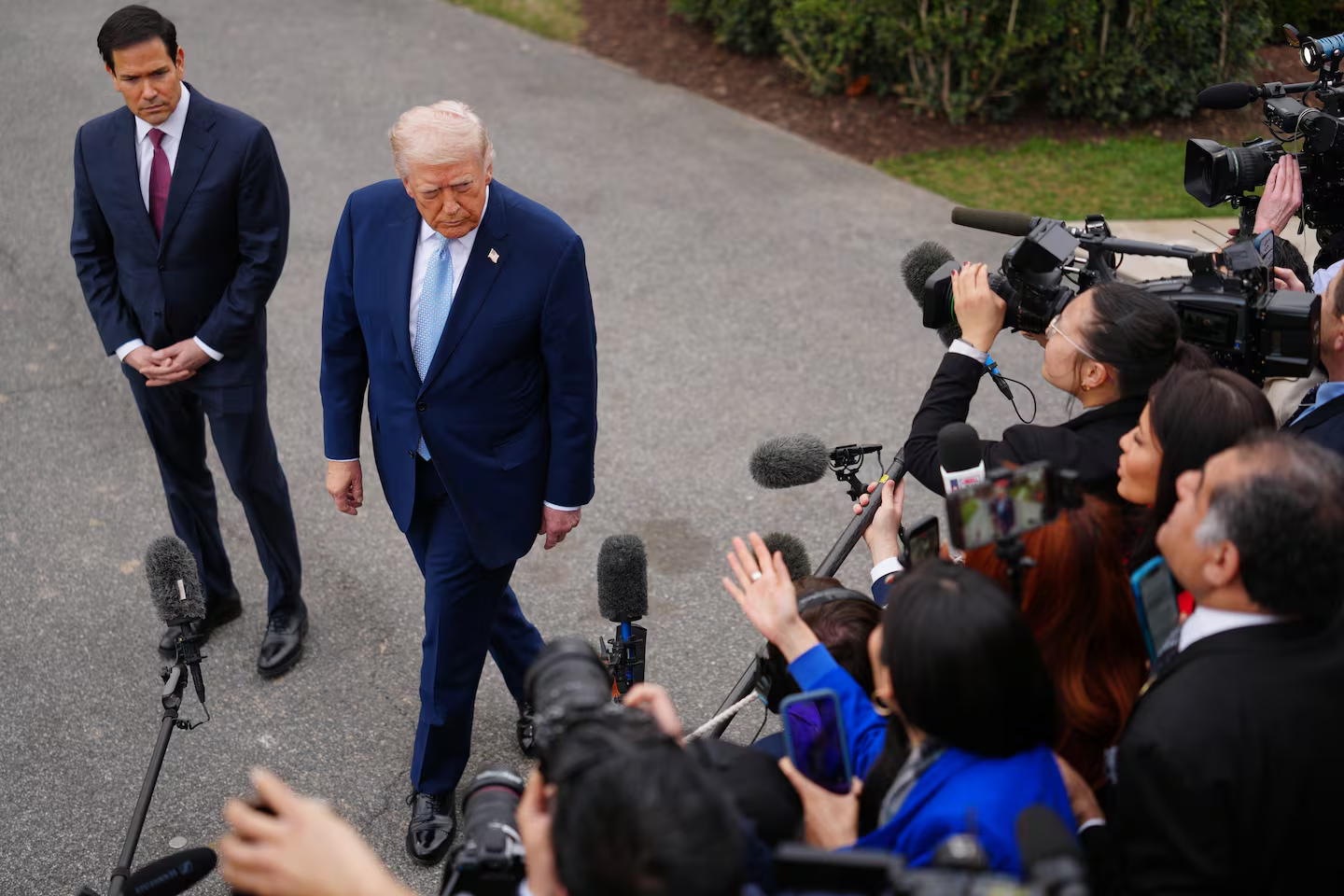
US President Donald Trump said he is considering scaling back military operations in Iran, even as his administration moves more forces into the Middle East and asks Congress for additional war funding. In a social media post on Friday, Trump said the United States was getting close to achieving its objectives and was weighing a wind-down of what he called its military effort in the region.
His comments came at a tense moment for the US economy and the wider region. Oil prices have climbed sharply during the conflict, adding pressure to financial markets. At the same time, the administration announced a relaxation of sanctions on Iranian oil already loaded onto ships, a move aimed at easing fuel-price pressure.
Shortly after Trump’s remarks, White House Press Secretary Karoline Leavitt said the president and the Pentagon had projected the mission could take about four to six weeks. She said Saturday would mark week three of the campaign and described the operation as progressing successfully, with Iran’s leadership and military capacity being steadily weakened.
Fighting Continues Despite Talk of a Wind-Down
Even with that message, the war has shown little sign of slowing. US- and Israeli-backed attacks have continued in and around Tehran, including during Iran’s Nowruz holiday period. According to reports cited in coverage of the conflict, shelling in a residential area in Dastak village in northern Iran killed at least two people.
Iran has also continued its response. Reports said Tehran fired ballistic missiles toward the Diego Garcia base in the Indian Ocean, which is jointly operated by the United States and the United Kingdom. Israel, meanwhile, said Iranian missiles were still being launched toward its territory early Saturday. Saudi Arabia also reported intercepting 20 drones over its eastern region, home to major oil facilities.
These developments have added to uncertainty over the real direction of the war. While the White House is signaling that military goals may be close, the fighting on the ground and across the region still appears intense.
US Expands Military Presence While Seeking More Funding
At the same time, Washington is strengthening its military position in the region. US officials said another 2,500 Marines and sailors are being sent to the Middle East aboard the USS Boxer and accompanying warships. These forces will join more than 50,000 US personnel already stationed across the region, leaving two Marine Expeditionary Units in the area.
The administration is also asking Congress for about $200 billion in additional funding tied to the war effort and broader military replenishment, a request that is expected to face heavy scrutiny on Capitol Hill.
Trump has said he has no current plan to send American ground troops into Iran, though he has also left the door open to further action if necessary. Reuters reported on March 19 that Trump publicly said he was not putting US troops into the region, while still adding that the US would do whatever was needed.
War Goals Remain Unclear
The conflict has been marked by changing explanations from Washington and Israel. At different points, the stated aims have included weakening Iran’s leadership, damaging its missile and nuclear programs, and increasing pressure on Tehran’s ruling system. That has led to repeated questions about what the final measure of success would be and when the US would declare the mission complete.
Trump has said the US is nearing its goals, but critics note that troop deployments and funding requests suggest the operation may still have a long way to go. The White House has not offered a fully consistent explanation of how victory would be defined or what a real wind-down would look like in practice. That gap has fueled debate in Washington as the war moves deeper into its third week.
Iran Says It Has Struck Back
Iran’s leadership has rejected the idea that the campaign has broken the country. A Nowruz message attributed to Supreme Leader Mojtaba Khamenei said Iran had dealt a major blow to its enemies and called the US-Israeli war a serious miscalculation. Reports also noted that he has not appeared publicly since the earlier Israeli strikes that killed his father, Ayatollah Ali Khamenei, and reportedly wounded him.
Casualties have continued to mount across the region. Recent reporting said more than 1,300 people have been killed in Iran during the war, more than 1,000 in Lebanon, and multiple deaths have also been reported in Israel and among US forces. Different outlets currently report slightly different totals, but all show a rapidly worsening human toll.
Pressure Builds as the Conflict Drags On
Trump’s latest message has created a difficult picture to read. On one hand, the administration is talking about reducing operations. On the other, it is sending more troops, spending more money, and preparing for further escalation if needed.
For now, the war appears to be entering a new phase defined by uncertainty. The White House is trying to show progress, but the military buildup, continued missile exchanges, and rising regional risks suggest the conflict is far from settled.