


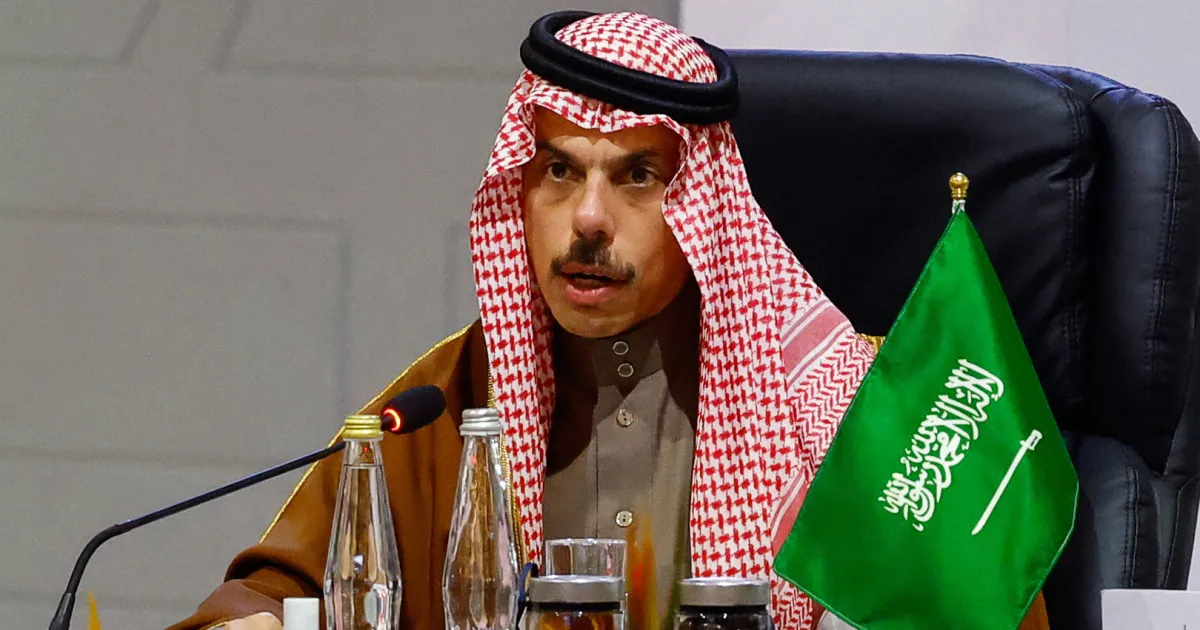
Saudi Arabia Foreign Minister, Prince Faisal bin Farhan Al Saud, has warned Iran that Gulf countries will not tolerate attacks indefinitely, urging Tehran to quickly rethink its strategy. Speaking at a news conference early Thursday, he said Saudi Arabia and its regional partners have major capabilities they could use if they decide to respond.
Prince Faisal said the pattern and precision of recent strikes suggested the attacks were not random or improvised. According to him, the targeting seen in Saudi Arabia and neighbouring Gulf states pointed to a campaign that was carefully prepared in advance. He declined to spell out what might trigger direct defensive action by the kingdom, but made clear that Saudi Arabia wanted Iran to understand that its restraint has limits.
He also said he hoped Tehran would understand the message from the latest regional meetings and immediately stop attacking neighbouring states, though he added that he was not confident Iran would act wisely.
Warning Comes After Attacks on Gulf Energy Sites
The Saudi minister’s remarks followed a meeting in Riyadh involving foreign ministers from Arab and Islamic countries, held as the regional war continued to expand. On Wednesday, Iranian attacks struck Gulf energy infrastructure, including Qatar’s Ras Laffan gas facility and the UAE’s Habshan gas facility, adding to fears over energy security and wider regional escalation.
Qatar’s Foreign Ministry strongly condemned the Iranian strike on Ras Laffan Industrial City, which lies northeast of Doha and is one of the most important liquefied natural gas hubs in the world. Reporting says the facility accounts for roughly 20 percent of global LNG supply, making the attack especially significant for international energy markets.
Earlier, Iran’s Revolutionary Guard had warned that oil and gas facilities in Qatar, Saudi Arabia and the UAE could face retaliation after an Israeli strike on Iran’s South Pars gas field. Iranian state media also reported that facilities linked to the South Pars field, off the coast of Bushehr province, had come under attack.
Missiles and Drones Intercepted Across the Gulf
Saudi Arabia’s Ministry of Defence said on Wednesday that its air defences intercepted four Iranian ballistic missiles aimed at Riyadh and two more launched toward the kingdom’s eastern region. In the UAE, officials said air defences dealt with 13 ballistic missiles and 27 drones, while operations at the Habshan gas facility were suspended after debris from a successful interception caused incidents at the site.
The recent attacks have also pushed oil prices higher. Reuters reported that oil rose after Iran struck energy facilities in the region, reflecting growing fears about further disruption to supply and the continued risk surrounding Gulf infrastructure and the Strait of Hormuz.
Trust With Iran ‘Completely Shattered’
Prince Faisal said the war will eventually end, but rebuilding Saudi Arabia’s relationship with Iran would take far longer because trust has been badly damaged. He argued that Tehran had spent years developing a strategy that included targeting neighbouring countries in order to pressure the wider international community.
He said that if Iran does not stop the attacks immediately, there may be almost nothing left that can restore confidence between Tehran and its Gulf neighbours. His comments underscored how the conflict is no longer only a military crisis, but also a diplomatic rupture that could reshape regional relations long after the fighting ends.
Regional Tensions Continue to Rise
The latest warning from Riyadh reflects the broader mood across the Gulf, where governments are dealing with repeated missile and drone threats, damage to strategic facilities, and rising anxiety over how far the war could spread. With attacks now reaching major energy sites and trust collapsing between Iran and several of its neighbours, the pressure for a wider response appears to be growing.