


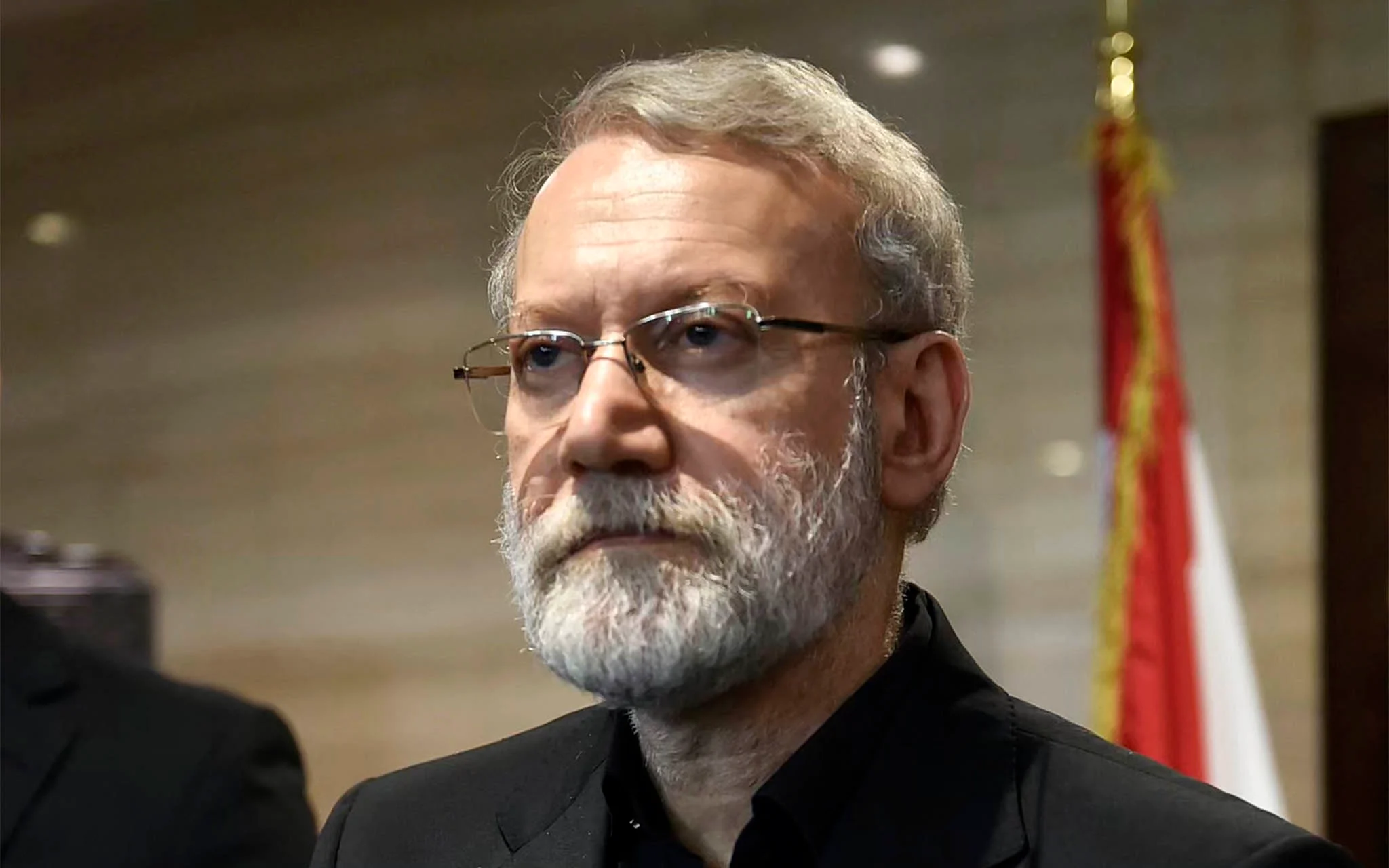
For many years, Ali Larijani was widely viewed as one of the more measured and pragmatic faces of Iran’s political establishment. He was known not only for his senior roles in government, but also for his intellectual background, including his writings on the German philosopher Immanuel Kant and his involvement in nuclear negotiations with Western powers.
That image shifted dramatically on March 1.
Just one day after U.S.-Israeli air strikes killed Supreme Leader Ayatollah Ali Khamenei and Islamic Revolutionary Guard Corps (IRGC) commander Mohammad Pakpour, Larijani appeared on state television with a far more confrontational message.
In statements shared publicly, he accused the United States and Israel of igniting outrage within Iran and vowed a severe response. He warned that Iran would make both countries regret their actions and said the nation’s armed forces would deliver what he described as an unforgettable lesson.
Larijani also accused U.S. President Donald Trump of falling into what he called an “Israeli trap.”
Now, as Iran faces its most serious internal and external crisis since 1979, Larijani has emerged as one of the central figures shaping the country’s security response. He is also expected to play a significant role alongside the three-member transitional council now overseeing the country after Khamenei’s death.
Part of One of Iran’s Most Powerful Political Families
Ali Larijani was born on June 3, 1958, in Najaf, Iraq, to a wealthy family originally from Amol in northern Iran.
He comes from one of the country’s most influential political and religious dynasties. In 2009, Time magazine described the Larijani family as the “Kennedys of Iran,” reflecting the extent of their reach within the Islamic Republic.
His father, Mirza Hashem Amoli, was a prominent religious scholar. Several of Larijani’s brothers have also held major positions in Iran’s power structure, including senior roles in the judiciary and the Assembly of Experts, the clerical body responsible for selecting and supervising the supreme leader.
Larijani’s links to Iran’s revolutionary elite are also personal. At the age of 20, he married Farideh Motahari, daughter of Morteza Motahhari, a leading early ideologue of the Islamic Republic and a close associate of Ayatollah Ruhollah Khomeini.
Despite the family’s conservative background, the next generation has followed more varied paths. His daughter, Fatemeh, studied medicine at the University of Tehran and later completed specialist training at Cleveland State University in Ohio.
A Rare Blend of Religious and Secular Education
Unlike many senior Iranian political figures whose education came mainly through religious seminaries, Larijani also built a strong academic foundation in secular subjects.
In 1979, he earned a bachelor’s degree in Mathematics and Computer Science from Sharif University of Technology, one of Iran’s leading universities. He later completed both a master’s degree and a doctorate in Western philosophy at the University of Tehran, focusing his thesis work on Kant.
This combination of technical and philosophical training helped shape his image as a politically conservative but intellectually complex figure.
From Revolutionary Guard to Senior State Official
Following the 1979 Islamic Revolution, Larijani joined the IRGC in the early 1980s before moving into civilian government.
He later served as culture minister under President Akbar Hashemi Rafsanjani and then led Iran’s state broadcasting organisation, IRIB, for roughly a decade. During his time at the broadcaster, reformist critics accused him of enforcing restrictive policies that pushed younger Iranians toward foreign media outlets.
Larijani’s influence expanded further when he became speaker of parliament in 2008. He remained in that role until 2020, serving for three consecutive terms and playing a major part in shaping both domestic policy and Iran’s approach to foreign affairs.
His Return to Security Politics
Larijani first ran for president in 2005 as a conservative candidate but did not advance to the second round.
That same year, he was appointed secretary of the Supreme National Security Council and became Iran’s chief nuclear negotiator. He stepped down in 2007 after disagreements with then-President Mahmoud Ahmadinejad over nuclear strategy.
After entering parliament in 2008 as a representative for Qom, Larijani maintained influence over Iran’s nuclear file. He played an important role in helping secure parliamentary backing for the 2015 nuclear agreement between Iran and world powers, known as the Joint Comprehensive Plan of Action (JCPOA).
After leaving parliament in 2020, Larijani again sought the presidency in 2021, but the Guardian Council disqualified him. He was barred once more when he attempted to run in 2024.
No formal explanation was given in either case, though many analysts saw the 2021 disqualification as a move to clear the path for hardline candidate Ebrahim Raisi. Larijani later criticised the 2024 decision as lacking transparency.
Reappointed and Growing More Hardline
Larijani returned to a major position in August 2025, when President Masoud Pezeshkian reappointed him as secretary of the Supreme National Security Council.
Since then, his public positions have appeared to harden. In October 2025, reports indicated that he had cancelled a cooperation arrangement with the International Atomic Energy Agency (IAEA), arguing that the agency’s reports were no longer useful.
This marked a sharper tone from a figure once often associated with internal pragmatism and cautious diplomacy.
A Diplomat Now Speaking the Language of War
Even with his recent hardline shift, Larijani has long been considered one of the more flexible figures within Iran’s political system, partly because of his past support for the 2015 nuclear deal.
In fact, only weeks before the latest escalation, he was reportedly involved in indirect talks with the United States.
During Omani-mediated discussions in February, Larijani said Tehran had not received a concrete proposal from Washington and accused Israel of trying to sabotage diplomacy in order to trigger war.
In an earlier interview with Al Jazeera, before the U.S. and Israeli attacks began, he described Iran’s approach to negotiations as “positive” and said the United States had come to understand that a military solution was not workable. At that time, he called negotiation a rational course.
That diplomatic opening appears to have closed following the strikes that began on February 28.
Now at the Center of Iran’s Crisis Response
In his most recent statements, Larijani said Iran had mechanisms in place to manage leadership succession under the constitution and argued that killing senior leaders would not destabilise the country.
He also said Iran did not intend to attack neighbouring states, while making clear that any bases used by the United States could be targeted.
The more restrained language that once defined much of Larijani’s political identity has, at least for now, given way to a wartime posture.
He has rejected reports that he wants fresh talks with Washington, saying Iran will not negotiate with the United States at this stage.
With Khamenei dead, the region entering a more volatile phase and Iran under intense military pressure, Larijani now stands as one of the most important officials shaping Tehran’s next move — and one of the clearest voices signalling a forceful response.