


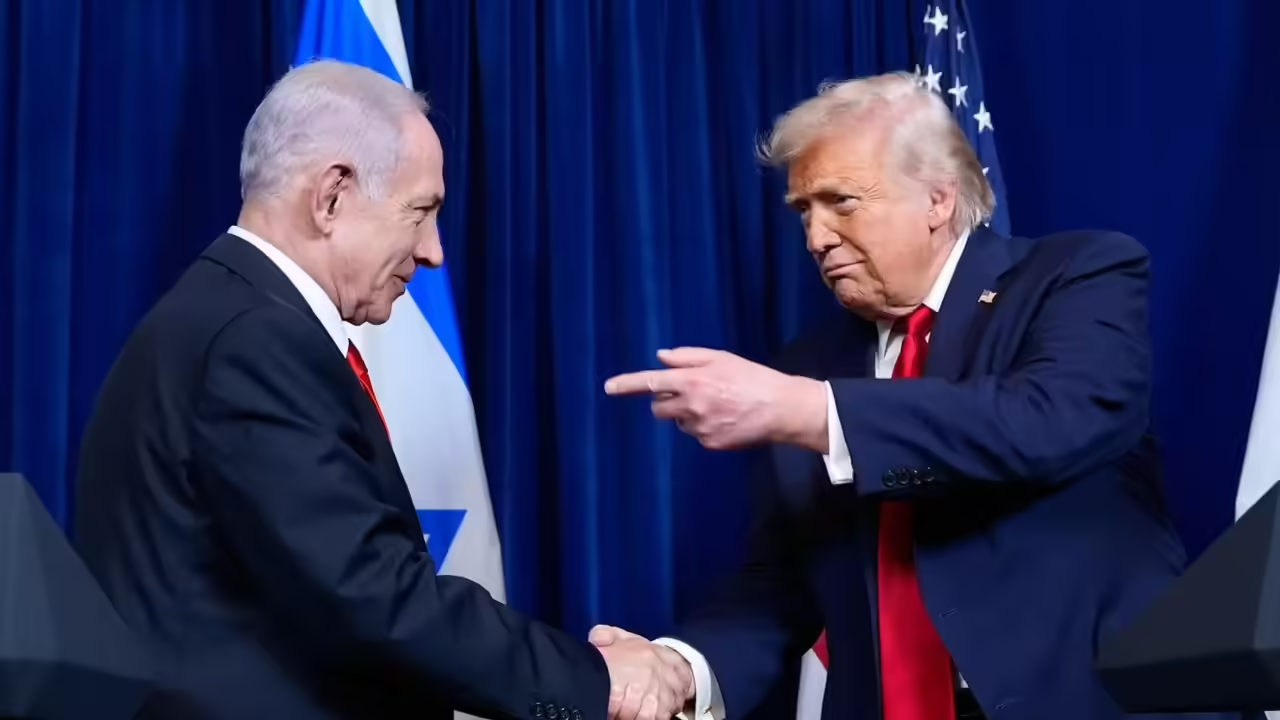
Israel is now caught in two tense but semi-frozen confrontations, one in Lebanon and the other in Iran, yet the future of both conflicts appears to be shaped less by Israeli leaders than by the United States and President Donald Trump.
According to the report, US envoys Steve Witkoff and Jared Kushner are heading to Pakistan for another round of talks with Iran, while Israel is not part of those negotiations. At the same time, Trump has announced a three-week extension to the ceasefire in Lebanon. Although Israel has repeatedly violated that ceasefire, analysts quoted in the article argue that Washington still holds far greater influence over how events unfold than Israel does.
That dynamic is especially striking given how often Israeli Prime Minister Benjamin Netanyahu has described Iran and Hezbollah as existential threats. For years, Netanyahu pushed for the kind of military confrontation that eventually erupted at the end of February when Israel, with US backing, launched war on Iran. Yet now that the war has shifted into a more uncertain phase, control over its ending appears to be slipping from his hands.
For many Israelis, that creates a serious political problem. Netanyahu had promised not only to eliminate the threat from Iran’s leadership, but also to achieve the final disarmament of Hezbollah. Neither of those goals has been delivered.
Analysts Say Israel’s Room to Maneuver Is Narrowing
Former Israeli government adviser Daniel Levy said Netanyahu’s effort to shape Washington’s approach to both Iran and Lebanon was ambitious, opportunistic and rooted in a belief that Israel could do far more than it actually can.
Levy argued that Netanyahu may have started to believe in his own image of strategic power, both in terms of Israel’s leverage over Washington and in terms of what Israel and the US could supposedly achieve together in remaking the region. But in his view, that broader transformation has not happened.
He also suggested that Netanyahu saw a particular opening under the current US administration, which he described as hollowed out in terms of internal process. That, he said, created a chance for Israel to push Washington into actions it had previously been unable to secure.
Even so, the article suggests that this moment is now turning into a political trap. Trump’s decisions on ceasefires and negotiations are exposing how limited Israel’s ultimate control may be, despite the aggressive rhetoric that preceded the wars.

Israeli Public Opinion Still Leans Towards War
Trump’s ceasefire announcements in both Iran and Lebanon have also created a difficult domestic moment for Netanyahu because large parts of the Israeli public still appear to support continuing the confrontations.
The report says a poll by the Israel Democracy Institute, conducted just before Trump announced the Lebanon ceasefire, found overwhelming support among Jewish Israeli respondents for pressing on with the conflict even if that caused friction with the United States.
A separate poll by the Hebrew University of Jerusalem found that two-thirds of Israelis opposed the ceasefire with Iran. That suggests the pause in operations is not only politically awkward for Netanyahu, but also unpopular among a significant portion of the electorate.
Political consultant and journalist Dahlia Scheindlin said many Israeli Jews tend to place Iran and Lebanon into the same broader picture of enemies surrounding Israel. In that worldview, she explained, both conflicts feed into a wider national self-image shaped by insecurity and the belief that Israel is under threat from all sides.
At the same time, Scheindlin noted that confidence in the Israeli government’s ability to control events is weak. She said more Israelis are recognising that Washington is the stronger partner and that, while Israel may have influence and a voice, it does not have the final word.
Netanyahu’s Critics Say Military Gains Are Not Becoming Political Wins
Inside Israel, Netanyahu’s critics have seized on the ceasefire developments as further proof that his government cannot turn battlefield actions into lasting strategic outcomes.
After Trump first announced the Lebanon ceasefire, former Israeli chief of staff Gadi Eisenkot said it reflected a pattern of ceasefires being imposed on Israel over the past two and a half years. While many outside observers would argue that the US has often done little to restrain Israel and has in many cases actively backed its attacks, Eisenkot’s criticism focused more narrowly on Netanyahu’s failure to convert military operations into diplomatic gains.
Opposition leader Yair Lapid was similarly blunt, saying on social media that the promises of Netanyahu’s government were once again colliding with reality.
Former Israeli ambassador and consul general in New York Alon Pinkas also offered a stark assessment. He said that, as things stand, the Iranian regime remains in place, uranium remains inside Iran, the Islamic Revolutionary Guard Corps is in a stronger position than before, and Trump appears eager to exit the conflict. In his view, that adds up to a strategic defeat for Israel, regardless of whatever military achievements it may claim.
Pinkas also questioned whether Trump has any real concern for Netanyahu’s political survival. He suggested that if reports are true that Netanyahu manipulated Trump into entering the war, then a visible break between the two leaders might even help Trump politically. More importantly, he said, Trump wants a deal with Iran, and if Israel ends up the loser in that process, the US president may be perfectly willing to accept it.
A Regional Struggle Israel May Not Be Able to Direct
The article presents a picture of Israeli power that looks far more limited than the government’s own rhetoric has suggested. Israel entered the conflicts in Iran and Lebanon promising decisive outcomes, but now finds itself dependent on Washington’s calculations, timing and priorities.
That leaves Netanyahu in an increasingly uncomfortable position. He helped build expectations of total victory, yet the reality on the ground is far messier. Hezbollah and Iran have both been damaged, but neither has been eliminated. Ceasefires have arrived before Israel’s stated objectives were achieved, and negotiations are moving ahead with the United States firmly in charge.
For Israeli voters who expected a definitive military and political result, that gap between promise and reality is becoming harder to ignore. The conflicts are not fully over, but the direction they now take may depend far more on Trump’s decisions than on Israel’s ambitions.