


Anastasiya Buchkouska, a 20-year-old student from western Ukraine, carefully brushes snow and ice from her father’s grave, her movements slow and deliberate in the winter cold.
She pauses to look at the photograph etched into the gravestone. The resemblance between them is unmistakable.
Her father had served in the military years earlier. When Russia launched its full-scale invasion of Ukraine on February 24, 2022, he was mobilised almost immediately and sent to the front.
Communication with the family was rare and unpredictable. They held on to brief messages and scattered updates until September 2022, when the contact stopped altogether.
Waiting for Answers
For seven months, Buchkouska’s father was officially listed as missing in action. She said she tried to remain hopeful, even as fear quietly took hold.
When confirmation of his death finally arrived, the grief was overwhelming. But amid the realities of war, she said there was little time to process it fully.
“You just deal with it,” she said.
Around the same period, her uncle was also killed.
Much of her energy went into caring for her grandmother, who struggled to cope with the losses. Buchkouska said she constantly searched for distractions — small conversations, simple activities — anything to bring moments of calm.
In private, she allowed herself to cry, but reminded herself not to dwell too deeply. This was war, she reasoned, and grief was now part of everyday life.
A Growing Human Toll
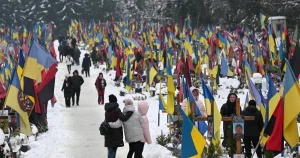
At Lychakiv Cemetery in Lviv, where her father is buried, the scale of loss is stark. A surge in deaths in early 2022 forced authorities to expand burial grounds beyond the cemetery’s walls — space that is now nearing exhaustion.
Precise casualty figures from the war remain difficult to verify. The United Nations Human Rights Monitoring Mission in Ukraine confirmed that conflict-related violence killed 2,514 civilians and injured 12,142 others in Ukraine in 2025 alone.
According to estimates from the Center for Strategic and International Studies, nearly two million Ukrainian and Russian soldiers have been killed, wounded or gone missing since the invasion began. Russia is believed to have suffered close to 1.2 million casualties, including at least 325,000 deaths, while Ukrainian military losses are estimated at between 500,000 and 600,000.
Al Jazeera has not independently verified these figures.
Living With Constant Uncertainty
For many Ukrainians, loss is accompanied by deep anxiety about the future.
“No one knows what life after the war will look like,” said Kseniia Voznitsyna, a neurologist and founder of Ukraine’s first mental health rehabilitation centre for veterans.
She said the consequences of the war are already visible. “People are living with amputations, trauma and psychological wounds,” she said, adding that economic stability and job security remain open questions.
According to Oleksandra Matviichuk, head of the Center for Civil Liberties, daily life under war is defined by unpredictability.
“We cannot plan not only our day, but even the next few hours,” she said, noting that fear for loved ones has become a constant presence.
“There is no place in Ukraine that can truly be called safe from missile attacks,” Matviichuk added.
Mental Health Strain Across Society
In late 2025, Sabine Freizer Gune, the UN Women representative in Ukraine, said that nearly everyone in the country is affected by mental health challenges.
Cities such as Kyiv, Kharkiv and Odesa are frequently shaken awake by mass missile and drone strikes. During winter, attacks on infrastructure often leave millions without electricity, heating or reliable water.
Resilience Amid Grief
Standing by her father’s grave, Buchkouska spoke calmly, though tears lingered in her eyes.
“If the war ends, we will all be happy,” she said quietly. “But we cannot bring back the people who died.”
Still, she emphasised resilience forged through hardship.
“Trauma does not define us,” she said. “We are defined by how we overcome it — how we endure, how we support each other. Now more than ever, we understand what it truly means to be human.”