


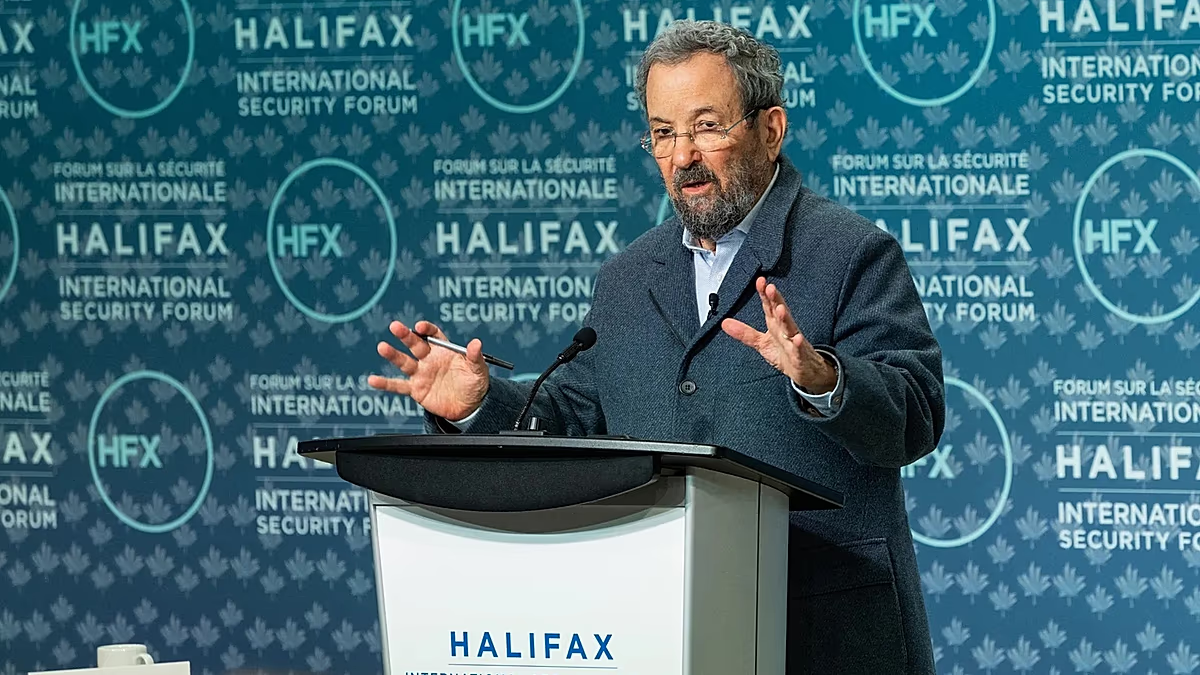
An investigative report has alleged that Israeli government security personnel installed surveillance equipment and managed access at a Manhattan apartment building associated with the late financier and convicted sex offender Jeffrey Epstein, where former Israeli Prime Minister Ehud Barak reportedly stayed during visits to New York.
According to the investigation, which cites emails released by the US Department of Justice, Israeli officials began coordinating with Epstein’s staff in early 2016 to secure a residence at 301 East 66th Street. The apartment was said to be frequently used by Barak for extended stays while he was abroad.
Although the property was formally owned by a company connected to Epstein’s brother, Mark Epstein, the report states that the financier maintained effective control over the building. It also claims that the units were regularly used to host Epstein’s associates and, in some cases, house young models.
Security Coordination and Access Control
Documents referenced in the report suggest that Israel’s permanent mission to the United Nations played a direct role in arranging protective measures for the apartment. Rafi Shlomo, then head of protective services at the Israeli mission and responsible for Barak’s security detail, allegedly oversaw access to the residence.
The report states that Shlomo conducted background checks on staff working in the building, including cleaners and employees, and coordinated with them regarding security procedures. He also reportedly supervised the installation of surveillance systems, including alarms, window sensors, and remote monitoring tools.
Email exchanges cited in the investigation indicate that any entry into the apartment required prior notification to the security contact at the Israeli consulate. The correspondence suggests that Epstein personally approved structural modifications linked to the security setup.
In one email chain from early 2016, Barak’s wife, Nili Priell, discussed the planned installation of monitoring equipment with Epstein’s longtime assistant, Lesley Groff. Groff later confirmed that Epstein had authorised the changes, including drilling into walls for equipment placement.
The communications between Israeli officials and Epstein’s representatives reportedly continued through 2016 and 2017, focusing on managing staff access and coordinating Barak’s visits to the property.
Legal Context and State Security Protocols
Under Israeli law, former prime ministers are entitled to state-funded security protection after leaving office. Barak, who served as prime minister from 1999 to 2001, would therefore have remained eligible for official security arrangements during his travels abroad.
The report argues that the email records indicate an operational link between Israeli diplomatic security personnel and Epstein’s property management, extending beyond purely personal arrangements.
Political Reactions and Public Debate
Following Epstein’s death in a New York jail in 2019 while awaiting trial on sex trafficking charges, Barak sought to minimise the extent of his relationship with the financier. He has previously acknowledged meeting Epstein but denied receiving financial support from him.
The release of new documents has reignited political debate in Israel. Prime Minister Benjamin Netanyahu has publicly argued that the documents implicate Barak personally rather than suggesting any institutional relationship involving the Israeli state. In his remarks, Netanyahu stated that Epstein’s association with Barak does not indicate that the financier acted on behalf of Israel.
However, the investigation claims that correspondence included references to other Israeli officials as well. Among those mentioned was Yoni Koren, a longtime aide to Barak who reportedly stayed at the Manhattan residence multiple times, including during periods when he was serving in an official role within Israel’s Ministry of Defence.
Broader Context of Epstein’s Global Connections
The newly released files are part of a larger collection of documents related to criminal investigations into Epstein’s network and international contacts. The records reportedly highlight Epstein’s connections with influential figures and organisations across various sectors, including financial and political circles.
Some documents referenced in the report also mention Epstein’s donations to Israeli organisations and alleged links to individuals associated with security and intelligence networks, though the extent and nature of those connections remain a subject of ongoing scrutiny.
Barak has previously expressed regret over maintaining ties with Epstein after the financier’s 2008 conviction for soliciting a minor. He has stated that he was not fully aware of the broader scope of Epstein’s criminal activities until federal investigations expanded years later.
The allegations outlined in the investigative report have intensified public and political discussion, particularly regarding the intersection of state security arrangements, diplomatic officials, and Epstein’s properties, while raising broader questions about transparency and accountability in high-level international associations.