


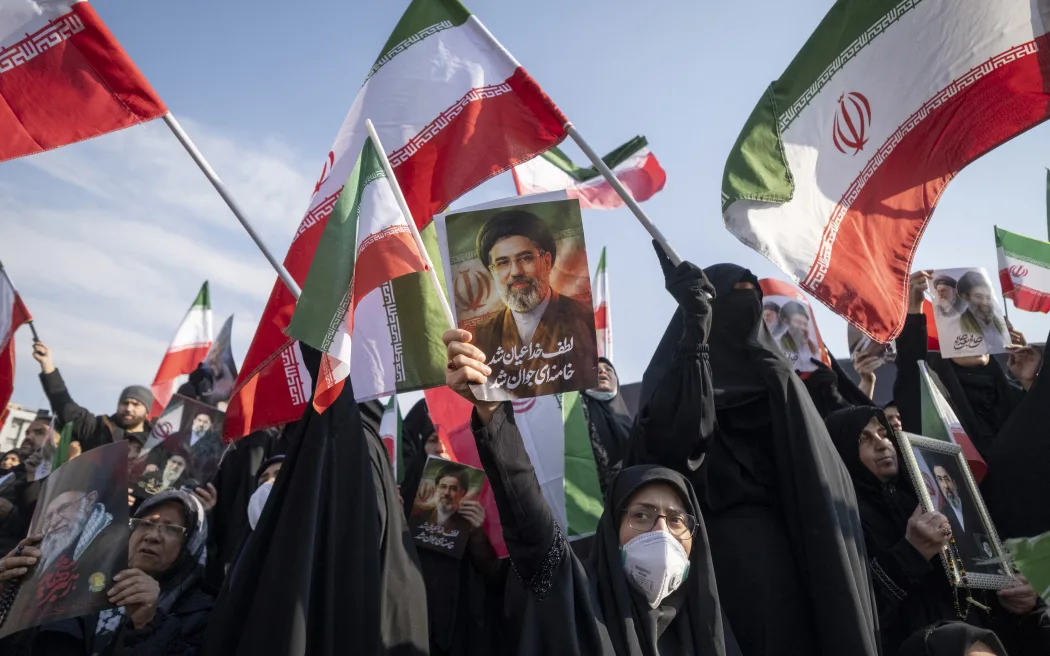
Several senior Iran officials have firmly rejected United States President Donald Trump’s claim that divisions are growing inside Iran’s leadership, insisting instead that the country remains united at a time of rising military and diplomatic tension.
Iranian President Masoud Pezeshkian, Foreign Minister Abbas Araghchi and Parliament Speaker Mohammad Bagher Ghalibaf all issued statements dismissing Trump’s suggestion that Tehran is being pulled apart by internal rivalry. Pezeshkian and Ghalibaf joined the Supreme National Security Council in sharing the same message on X, making clear that Iran does not see itself as split between rival camps.
The statement said there are no radicals or moderates in Iran, only Iranians who remain revolutionary and united. It also stressed that the nation and the government stand together in full loyalty to the Supreme Leader and are determined to make what it described as the aggressor regret its actions.
Iran’s first vice president, Mohammad Reza Aref, echoed that message in a separate post, writing in English that Iran is not a land of division but a fortress of unity. He said political diversity exists in the country, but in moments of danger the nation stands together as one. His remarks reinforced Tehran’s effort to present a picture of discipline and solidarity in the face of outside pressure.
Iran Counters Trump’s Narrative of Internal Conflict
Trump and members of his administration have repeatedly argued over the past week that there are serious disagreements inside Iran’s ruling structure. The US president claimed that Iranian leaders are struggling to determine who is in charge and described the supposed conflict as a chaotic battle between moderates and hardliners.
That narrative has been strongly rejected by Tehran. Iranian officials appear to view such claims not only as inaccurate, but as politically useful for Washington. Suggesting that Iran is divided could help justify extending the current ceasefire while also shifting blame for stalled diplomacy onto Tehran.
Iran, however, has insisted that negotiations are not moving forward for a different reason. According to its officials, the real obstacle is the US blockade on Iranian ports, which has prevented the talks previously planned in Pakistan from taking place.
Foreign Minister Abbas Araghchi also dismissed claims that Iran’s military and civilian leaders are acting at odds with one another. In a message on X, he wrote that the failure of Israeli assassinations is visible in the continued unity, discipline and clear direction of Iran’s state institutions. He added that diplomacy and the battlefield are fully coordinated fronts in the same struggle and said Iranians are more united now than ever.
Leadership Questions Add to Regional Uncertainty
The issue of Iranian leadership has drawn even more attention because Supreme Leader Mojtaba Khamenei has not made a public appearance since replacing his father, Ali Khamenei, who was killed in US-Israeli strikes on February 28.
US officials have said the younger Khamenei was wounded and disfigured in the same strike. The New York Times later reported, citing unnamed Iranian officials, that he remains gravely wounded but mentally alert.
That has fuelled wider speculation outside Iran about the state of the country’s leadership. But Iranian officials are clearly trying to shut down that conversation, presenting the government as stable, disciplined and united despite the absence of its top figure from public view.
Their repeated public statements suggest Tehran sees the question of internal unity as strategically important, especially as it faces simultaneous military threats, economic pressure and a diplomatic deadlock with Washington.
Diplomatic Freeze and Military Threats Keep Pressure High
The dispute over leadership unity is unfolding against a broader backdrop of stalled negotiations and escalating threats. Trump has indicated that he is comfortable maintaining the current pressure campaign against Iran, including the blockade on the country’s ports, rather than rushing towards either renewed war or a final deal.
In a social media post on Thursday, he said Iran’s navy has been destroyed, its air force dismantled and its anti-aircraft systems wiped out. He also claimed the blockade is airtight and warned that conditions for Tehran could become even worse. Trump said any agreement would only be reached when it serves the interests of the United States, its allies and what he called the rest of the world.
Still, the ceasefire remains unstable. Iranian air defences were activated over Tehran earlier on Thursday, though no official attack was confirmed. On the same day, Trump said the US military would shoot and kill any Iranian forces laying mines in the Strait of Hormuz, a statement that could easily provoke retaliation.
At the same time, oil prices are rising again as uncertainty grows around the double blockade in the Gulf, with Iran restricting Hormuz while the US keeps up naval pressure on Iranian ports.
Israel Signals It May Return to the Fight
The situation is also being made more volatile by Israeli signals that the war may not be over. Defence Minister Israel Katz said on Thursday that Israel is waiting for Trump’s approval to resume military operations against Iran.
According to Israeli media, Katz said the country is ready to return Iran to what he called the age of darkness. He added that the Israeli military is prepared both defensively and offensively, and that its targets have already been selected.
That warning adds another layer of danger to an already fragile situation. Even as Iran tries to project unity and control, the military and political pressure surrounding the country continues to mount.
For now, Tehran’s message is clear: it rejects the idea of a leadership split and wants both its people and the outside world to see a state that remains unified under pressure. But with diplomacy stalled, military threats rising and regional tensions deepening, that unity is being tested in one of the most volatile periods the country has faced in years.