


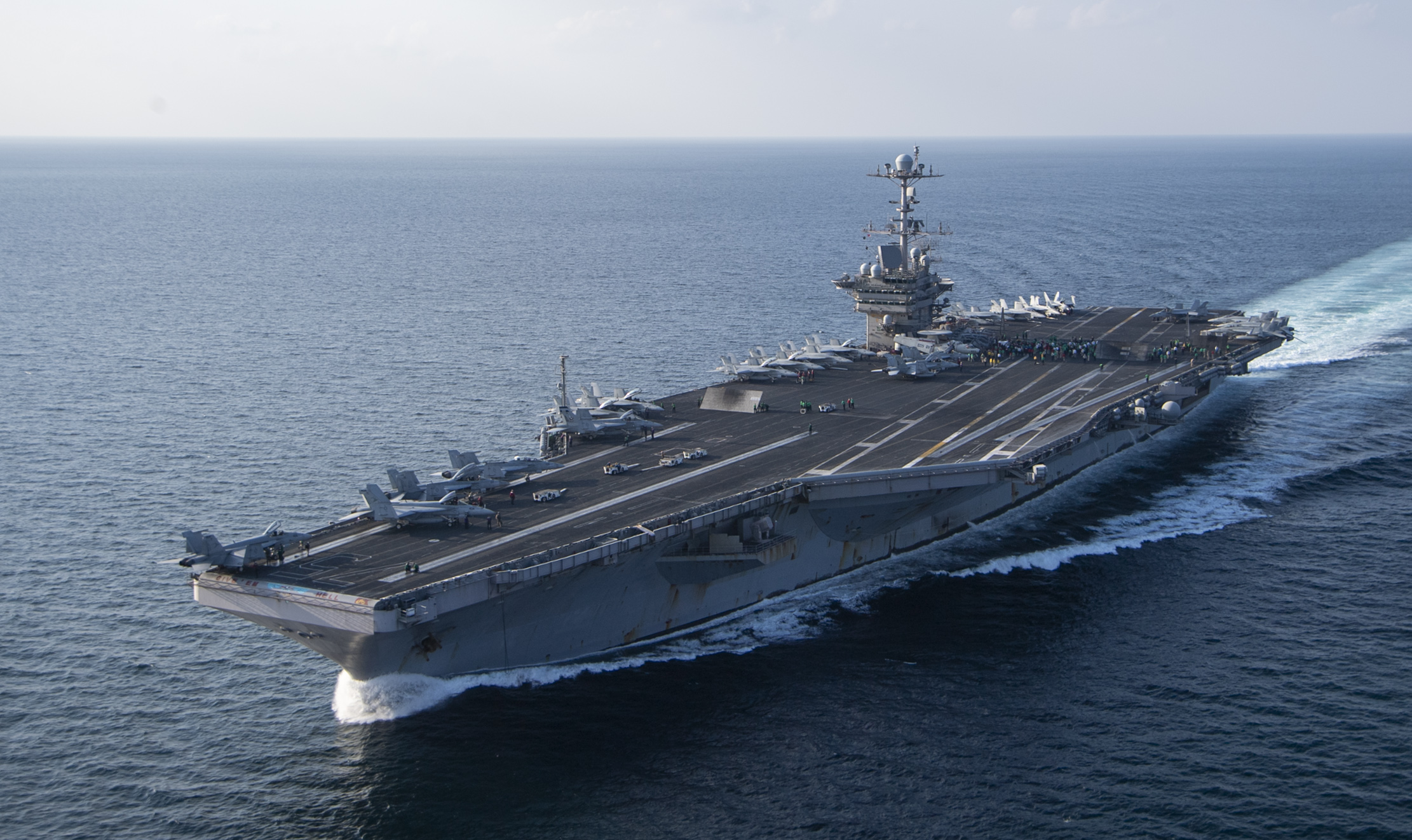
The United States is significantly increasing its military presence across the Middle East as President Donald Trump issues a firm deadline for Iran to agree to a deal concerning its nuclear program and ballistic missile stockpile. According to recent statements, Iran has roughly “10 to 15 days” to reach an agreement, heightening geopolitical pressure in an already volatile region.
This large-scale military mobilization includes the redeployment of the USS Gerald R. Ford, the world’s largest aircraft carrier, which is expected to join the USS Abraham Lincoln carrier strike group currently operating in the Arabian Sea. Alongside naval assets, the US has deployed critical force multipliers such as E-3 Sentry Airborne Warning and Control System (AWACS) aircraft and multiple advanced fighter jets.
In response, Iran submitted a formal letter to the United Nations Security Council stating that it does not seek conflict but will react “decisively and proportionately” to any form of US aggression. Tehran also warned that Washington would be directly responsible for any unpredictable consequences arising from escalation.
Surge in US Airpower Signals Strategic Readiness
Open-source intelligence analysts and flight-tracking data suggest that more than 120 US aircraft have been deployed to the Middle East in recent days. This marks one of the largest airpower surges in the region since the 2003 Iraq War.
The deployment reportedly includes F-22 air superiority fighters, F-35 stealth strike aircraft, as well as F-15 and F-16 jets. These aircraft movements, supported by aerial refueling tankers and cargo planes, indicate sustained operational planning rather than routine rotations. Analysts note that the presence of AWACS aircraft further strengthens battlefield coordination and surveillance capabilities.
Military observers are closely monitoring any potential movement of B-2 stealth bombers, which previously participated in Operation Midnight Hammer — the US strikes on Iranian nuclear facilities during the 12-day Iran-Israel conflict in June 2025. Experts suggest that similar bomber activity could signal preparations for long-range precision strikes.
Strategic Importance of Diego Garcia and UK Dispute
Attention has also turned to Diego Garcia, a joint UK-US military base located in the Indian Ocean’s Chagos Islands. The base is capable of hosting long-range strategic bombers, including B-2 aircraft, and has historically served as a launch hub for major US military campaigns in the region.
However, the facility remains British sovereign territory leased to the United States, meaning London must approve its use for offensive operations. Reports indicate that UK Prime Minister Keir Starmer has informed Washington that British bases, including Diego Garcia and RAF Fairford, cannot be used for strikes on Iran due to potential violations of international law.
The disagreement appears to have triggered diplomatic friction, with President Trump publicly criticizing the UK’s plan to transfer sovereignty of the Chagos Islands to Mauritius and warning against relinquishing control of Diego Garcia, citing its strategic military value.
Naval Positioning in the Arabian Sea
Satellite imagery and tracking data show that the USS Abraham Lincoln strike group is already stationed in the Arabian Sea near Oman, placing US naval forces within operational range of Iran. The arrival of the USS Gerald R. Ford is expected to further strengthen US maritime dominance in the region.
Additionally, multiple US Navy guided-missile destroyers equipped with advanced air defense and ballistic missile interception systems are operating nearby. These vessels can launch Tomahawk cruise missiles capable of striking land-based targets while also supporting anti-submarine and fleet defense operations.
Iran’s Military Moves and Defensive Preparations
Iran has responded to the growing US presence with heightened military signaling. The country has launched joint naval drills with Russia in the Sea of Oman and the northern Indian Ocean, aiming to demonstrate maritime coordination and deterrence.
Authorities in Tehran also issued a Notice to Airmen (NOTAM) for rocket launches over southern Iran and temporarily restricted navigation in parts of the Strait of Hormuz during live-fire exercises. The Strait remains one of the world’s most critical shipping routes, making any disruption a significant global concern.
Recent satellite imagery suggests Iran has reinforced key military and nuclear sites, including constructing protective concrete shielding, fortifying tunnel entrances, and repairing missile bases damaged during past conflicts. Analysts believe Tehran has adopted a layered defense strategy involving mines, missiles, submarines, and drone systems designed to slow or complicate potential US operations.
Risk of Escalation and Strategic Uncertainty
Security experts note that the scale of the US deployment mirrors preparations typically seen before a military strike. However, they also emphasize that Iran’s geography and deeply fortified infrastructure make a rapid ground operation unlikely.
Instead, any potential military action would likely involve long-range missile strikes targeting security installations, including facilities linked to the Islamic Revolutionary Guard Corps or nuclear infrastructure. Nonetheless, such strikes may only impact above-ground targets, limiting their strategic effectiveness.
Iranian officials and international analysts warn that any initial confrontation could quickly spiral beyond control. Possible retaliatory actions could include targeting oil facilities, tankers, or US naval assets, which could trigger broader regional escalation.
Comparisons to Previous US Military Build-Ups
Some observers have drawn parallels between the current Middle East build-up and the US military concentration near Venezuela in late 2025. However, experts highlight key differences, noting the absence of large-scale Special Operations Forces and the far more complex strategic environment surrounding Iran.
Diplomatic developments also remain ongoing, with US Secretary of State Marco Rubio reportedly planning a visit to Israel later this month for discussions with Prime Minister Benjamin Netanyahu, further signaling coordination among regional allies.