


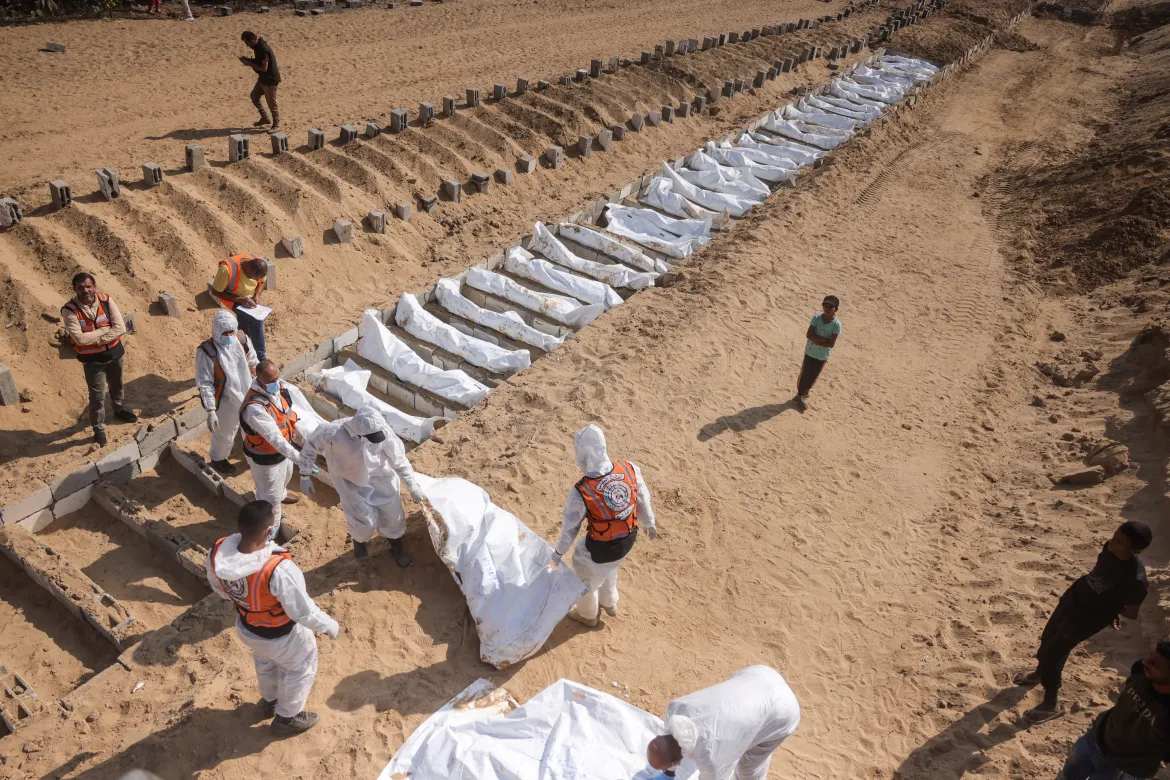
The human toll of the war in the Gaza Strip appears significantly higher than earlier official estimates, with independent academic research indicating that more than 75,000 people had died violently by early 2025. The findings, published in leading medical journals, suggest that existing administrative records may represent a minimum baseline rather than a full account of total losses.
A large-scale population study known as the Gaza Mortality Survey (GMS), published in The Lancet Global Health, estimated approximately 75,200 violent deaths between October 7, 2023 and January 5, 2025. This figure equals roughly 3.4 percent of Gaza’s pre-war population of about 2.2 million and is notably higher than the 49,090 violent deaths recorded by Gaza’s Ministry of Health (MoH) for the same timeframe.
As of late January this year, the Gaza Health Ministry reported at least 71,662 deaths since the conflict began, including hundreds of fatalities recorded even after a ceasefire was declared on October 10, 2025. While Israeli officials have frequently challenged the ministry’s statistics, an Israeli military official acknowledged earlier this year that the death toll in Gaza was around 70,000, broadly aligning with independent estimates.
Scientific Validation of Casualty Figures
Researchers behind the GMS based their conclusions on interviews with around 2,000 households representing nearly 10,000 individuals, offering an empirical foundation for estimating fatalities. Lead author Michael Spagat of Royal Holloway, University of London, noted that while official reporting mechanisms in Gaza remain broadly reliable, they are likely conservative due to the destruction of infrastructure required to document deaths accurately.
The study builds on earlier research published in The Lancet in January 2025, which used statistical modelling to estimate more than 64,000 deaths during the first nine months of the war. Unlike that model-based approach, the new survey relied on direct household data collection, extending the timeline and providing further verification of the scale of mortality.
Researchers also emphasised that the demographic profile of casualties — with women, children, and elderly individuals accounting for more than half of those killed — remains consistent with figures previously reported by Palestinian authorities.
However, analysts warn that the true death toll may still be higher due to thousands of bodies believed to remain buried under rubble or unidentifiable because of the scale of destruction. In addition to direct violence, the survey estimated about 16,300 non-violent deaths, including more than 8,500 excess deaths linked to deteriorating living conditions and the collapse of the medical system.
Scholars described a “central paradox” in casualty documentation: as healthcare facilities and administrative centres are destroyed, the ability to track deaths accurately becomes increasingly limited.
Long-Term Injury Crisis and Surgical Backlog
Beyond fatalities, the war has left a massive burden of injuries that Gaza’s weakened healthcare system is struggling to address. A separate multi-source predictive study published in eClinicalMedicine estimated more than 116,000 cumulative injuries by April 30, 2025.
According to the research, between 29,000 and 46,000 of these injuries require complex reconstructive surgery. More than 80 percent of injuries were caused by explosions, including air strikes and shelling in densely populated areas.
Medical experts involved in the study warned that even if Gaza’s surgical capacity were restored to pre-war levels, it could take around a decade to manage the backlog of reconstructive cases. Before the escalation, the territory had only a small number of certified reconstructive surgeons serving a population of over two million.
Collapse of Healthcare Infrastructure
The treatment gap has widened due to extensive damage to medical facilities. By May 2025, only 12 out of Gaza’s 36 hospitals were still capable of providing care beyond basic emergency services. Hospital bed capacity dropped from more than 3,000 before the war to roughly 2,000 beds for the entire population.
Researchers noted that specialised medical services, particularly reconstructive and microsurgery, are now largely unavailable within Gaza. Severe injuries, including burns and blast-related trauma, often go untreated, increasing the risk of infection, long-term disability, and death.
The lack of timely treatment means many patients face permanent disabilities, with medical professionals warning that tens of thousands of survivors may live with long-term, surgically treatable conditions unless large-scale international medical support is provided.
The “Grey Zone” of Mortality
Experts also highlighted the emergence of what they describe as a “grey zone” in mortality statistics, where deaths caused indirectly by war-related conditions are difficult to categorise. Individuals who die months after injuries due to infection, organ failure, or lack of access to clean water and medical care may not be counted as direct war casualties, potentially understating the overall human impact.
Conditions in Gaza have reportedly worsened since the study periods, with large-scale evacuations affecting more than 80 percent of the territory by late 2025 and severe food shortages declared in parts of northern Gaza. These factors have further weakened the health and recovery prospects of injured civilians.
Researchers concluded that the convergence of high casualty numbers, widespread injury, and the destruction of healthcare infrastructure underscores the scale of the humanitarian crisis. They stressed that continued attacks on civilian infrastructure and medical facilities risk further increasing both direct and indirect mortality, while also deepening the long-term medical and social consequences of the conflict.