


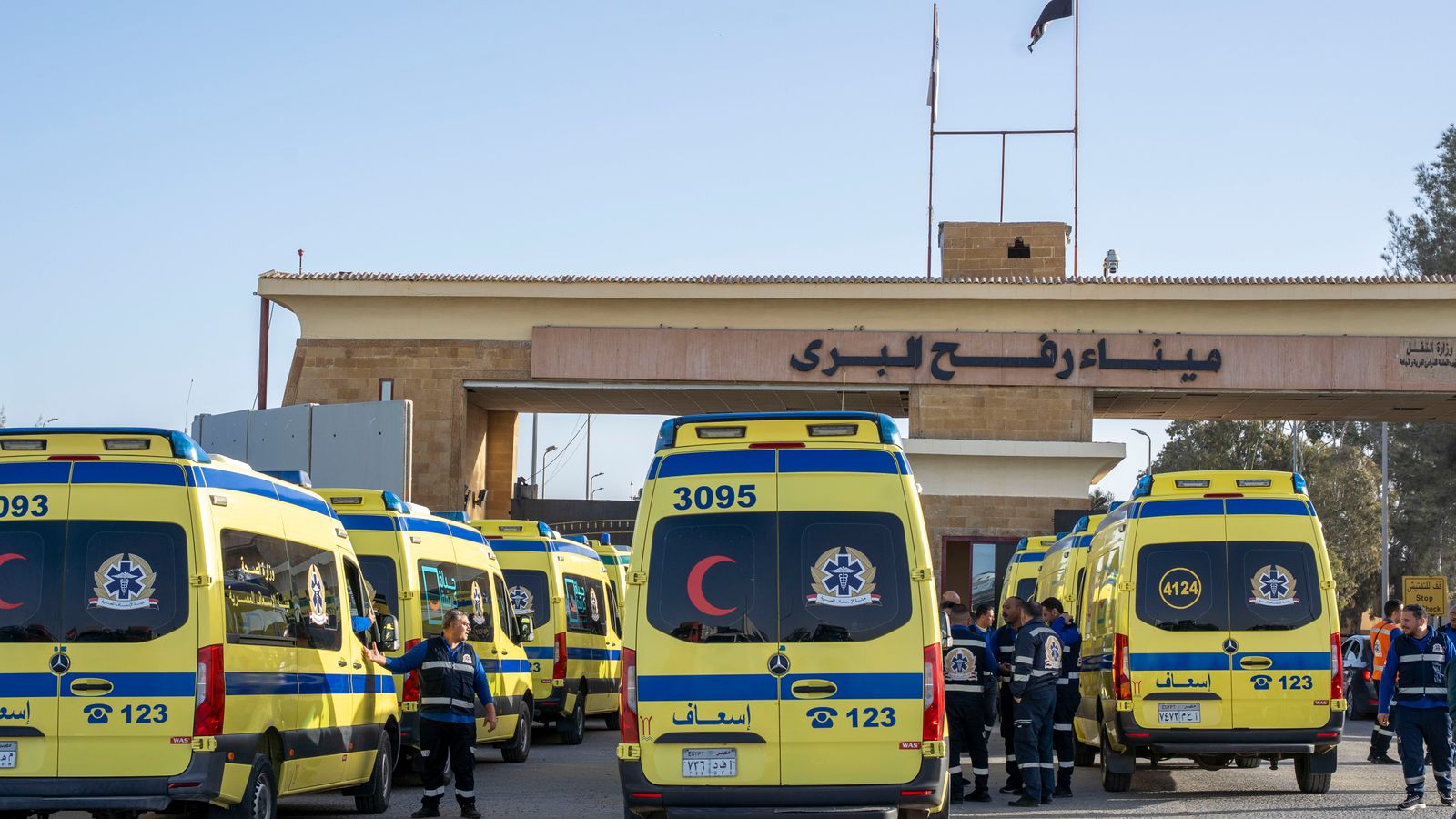
Israel has announced that the Rafah border crossing between Gaza and Egypt will reopen on Monday under a limited “pilot phase,” allowing restricted movement for Palestinians amid mounting medical emergencies in the besieged territory.
The announcement was made on Sunday by COGAT, the Israeli military body responsible for overseeing access to Gaza. The agency said the crossing will operate in both directions for pedestrians only and will be coordinated with Egyptian authorities and the European Union.
“Today, a pilot is underway to test and assess the operation of the crossing,” COGAT said in a statement. “Movement of residents in both directions, into and out of Gaza, is expected to begin tomorrow.”
First Reopening in Nearly Two Years
Israeli authorities said the decision follows the completion of a newly built screening facility intended to process Palestinians travelling through the crossing.
Rafah is Gaza’s only border crossing not directly controlled by Israel. Before the war, it was jointly managed by Palestinian and Egyptian authorities, with Israeli coordination. The crossing has been closed since May 2024, when Israeli forces seized the area during the war on Gaza.
Fear and Uncertainty Among Gaza Residents
Reporting from Khan Younis, Al Jazeera correspondent Hani Mahmoud described the reopening as creating mixed emotions among Palestinians.
“People want to leave for treatment or education, but many fear they won’t be allowed to return,” he said, noting that residents say their departure would be temporary.
Ismail al-Thawabta, head of Gaza’s Government Media Office, said around 80,000 Palestinians who fled Gaza during the war are now seeking to return. He added that roughly 22,000 wounded or chronically ill people urgently need medical care abroad.
Medical Evacuations to Begin
Two Egyptian officials told Reuters that at least 50 Palestinian patients would be transferred into Egypt for treatment on Sunday. During the initial phase, about 200 people — patients and accompanying relatives — are expected to cross daily into Egypt, with around 50 people returning to Gaza each day.
According to Reuters, Egypt submitted lists of travellers to Israel for approval. Video footage from the AFP showed ambulances waiting on the Egyptian side of the border to receive evacuees.
Among those hoping to leave is 65-year-old cancer patient Abed El Halim Abo Askar, whose surgery was postponed when the war began in October 2023. His daughter Shaima, along with her husband and two children, was killed in an Israeli air strike during the first month of the war.
“My father has been waiting for more than two years,” said his son Ahmed. “There is no medicine, no capacity for tests, and most hospitals have been destroyed. We don’t know what to do anymore.”
Violence Continues Despite Ceasefire
The reopening of Rafah was a central condition of the first phase of a US-backed ceasefire proposed by Donald Trump, which came into effect in October. However, the truce has been repeatedly disrupted by continued violence.
Medical sources said Israeli attacks across Gaza on Sunday killed at least three Palestinians. A drone strike northwest of Rafah city killed 63-year-old Khaled Hammad Ahmed Dahleez, according to Palestinian media. Another drone attack in the Wadi Gaza area killed an additional person.
These strikes followed heavy Israeli air raids on Saturday that killed at least 31 people across northern and southern Gaza.
Gaza health authorities say at least 511 Palestinians have been killed and more than 1,400 wounded since the ceasefire began.
Aid Access Remains Unclear
While the Rafah reopening allows limited movement of people, there is still no clear framework for the entry of humanitarian aid. The United Nations says Gaza requires at least 600 aid trucks per day to meet basic needs.
Compounding the humanitarian crisis, Israel announced on Sunday that it would terminate the operations of Doctors Without Borders (MSF) in Gaza, citing the organisation’s failure to submit a list of Palestinian staff members.
The decision follows an earlier Israeli announcement that 37 aid groups would be barred from operating in Gaza from March 1 for similar reasons — a move widely criticised by humanitarian organisations and UN officials.
James Smith, an emergency doctor based in London, told Al Jazeera the decision reflects “the systematic weaponisation of aid,” noting that more than 1,700 Palestinian healthcare workers have been killed during the war.
“By destroying Gaza’s health system, Israel has created total dependence on international aid — and is now restricting it,” Smith said.