


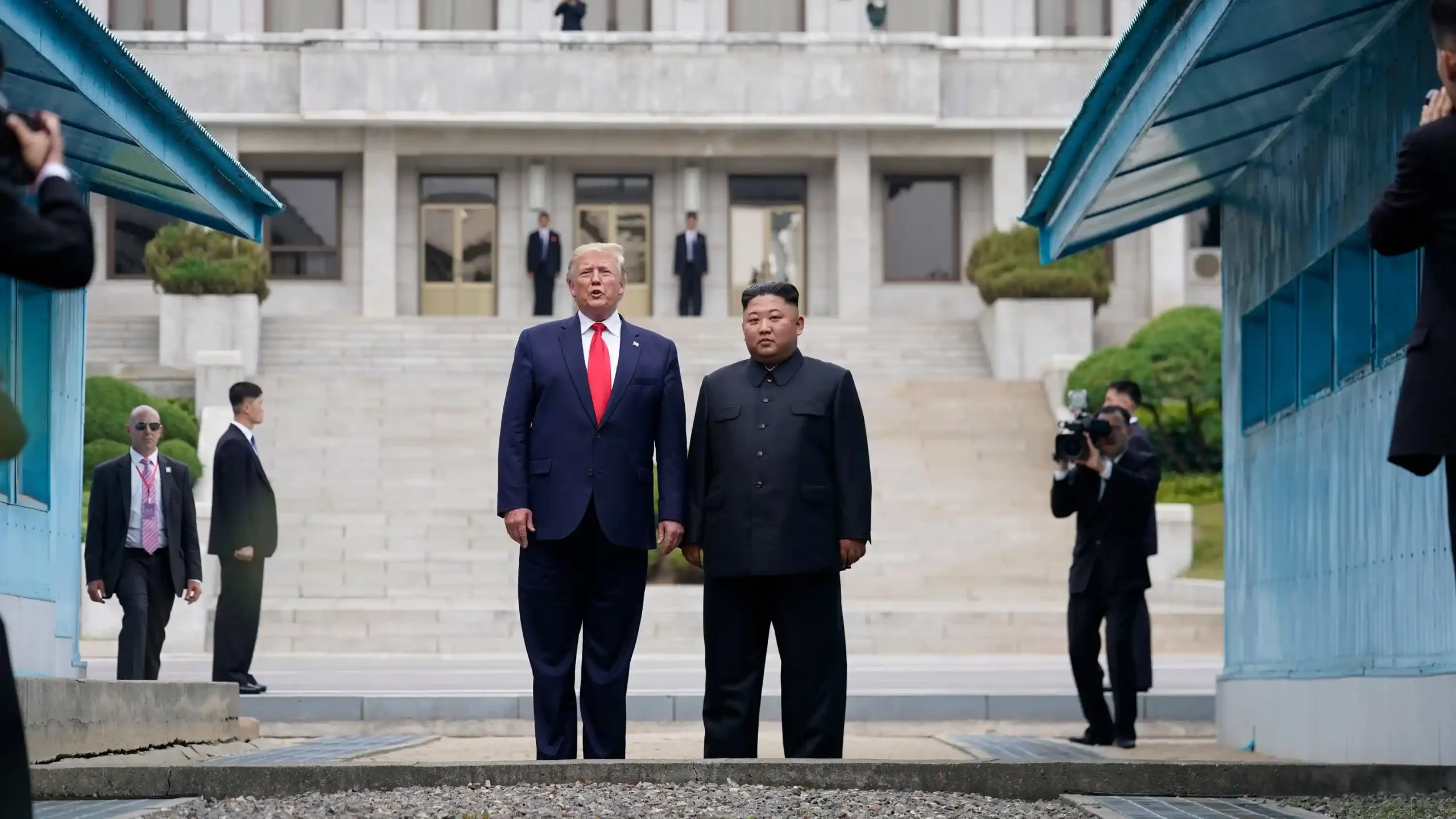
U.S. President Donald Trump new global security strategy noticeably omits any reference to denuclearising North Korea—a goal that had appeared in every National Security Strategy since 2003. The absence has fueled speculation that Washington may be preparing the ground for a new diplomatic opening with Pyongyang in 2026.
For two decades, ending North Korea’s nuclear programme had been a central U.S. objective. But Friday’s strategy document makes no mention of Pyongyang, even as its weapons development continues to accelerate, including ballistic missiles capable of striking the U.S. mainland.
The omission has led analysts to believe that Trump may be positioning himself for renewed talks with North Korean leader Kim Jong Un, whose last summit with Trump took place in 2019.
Hints of a New Diplomatic Approach
Trump has recently signaled his willingness to re-engage Kim, with experts saying the president appears eager to revive negotiations.
Hong Min of the Korea Institute for National Unification noted that Trump seems intent on “taking action” and may have purposely left out denuclearisation language to keep diplomatic options open.
In Trump 2017 security blueprint, North Korea was mentioned 16 times and described as a direct threat. The new document instead shifts focus to “flexible realism,” prioritising containment of conflict with China by strengthening U.S. allies in Asia—especially South Korea and Japan.
North Korea’s Position: Nuclear Status Is Non-Negotiable
Both South Korea and the U.S. publicly insist their policy has not changed and that denuclearisation remains the long-term goal.
However, Kim Jong Un has repeatedly stated that any future talks must treat North Korea as an equal nuclear power.
“The concept of ‘denuclearisation’ has already lost its meaning. We have become a nuclear state,” Kim told parliament in September.
Kim has indicated he is willing to meet the U.S.—but only if Washington accepts North Korea’s nuclear reality and aims for peaceful coexistence rather than disarmament.
Analysts say a new round of talks under Trump would help Kim strengthen his domestic legitimacy by showing he can negotiate directly with a U.S. president—something his predecessors failed to achieve.
Prospects for 2026 Negotiations Improving
South Korea has suggested conditions are increasingly favorable for restarting dialogue next year. Signals from the U.S., China, and Japan point toward cautious optimism for renewed diplomacy.
“What we’ve done so far has created the right conditions to advance the peace process,” said Wi Sung-lac, South Korea’s national security adviser.
Meanwhile, Seoul continues to increase its defensive capabilities, planning to raise military spending to 3.5% of GDP by 2035, including a significant boost next year—moves encouraged by Washington.
U.S. Defense Secretary Pete Hegseth praised South Korea as a “model ally,” noting Seoul’s commitment to take a leading role in conventional defense.
In talks last October, South Korean President Lee Jae Myung also secured U.S. approval to build nuclear-powered submarines, with the U.S. providing fuel support under strict non-nuclear-weapons conditions.