


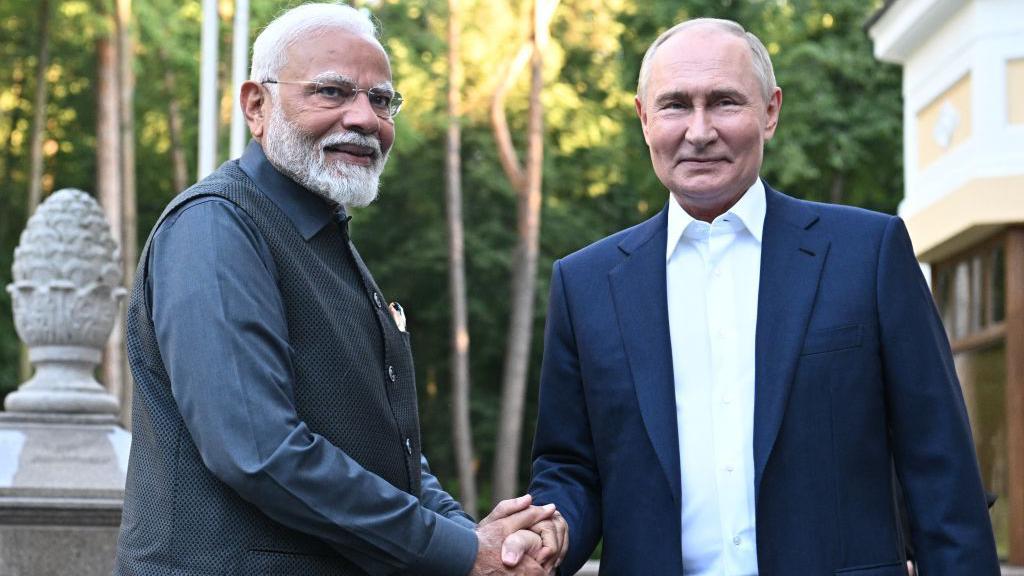
Russian President Vladimir Putin has begun a two-day visit to India, where he will meet Prime Minister Narendra Modi and take part in the countries’ annual summit. During the trip, Delhi and Moscow are expected to sign several agreements—arriving just months after the US increased pressure on India to reduce its purchases of Russian oil. The visit also comes as President Donald Trump’s administration pushes new negotiations with Russia and Ukraine to end the war.
India and Russia have been close partners for decades, and Putin and Modi share a strong personal rapport. Here’s why both leaders rely on each other, and what their meeting could mean.
A Strategic Partnership Rooted in Trade, Energy, and Geopolitics
Why does the Kremlin value relations with India?
Numbers tell the story: India has a population of nearly 1.5 billion and economic growth above 8%, making it the fastest-growing major economy in the world. For Russia, this makes India a vital market—especially for oil.
Before Russia’s full-scale invasion of Ukraine, only 2.5% of India’s oil imports came from Russia. As Western sanctions pushed Moscow out of European markets, Russian oil became heavily discounted. India’s imports surged to 35%, making New Delhi one of Moscow’s most important customers. The US, however, was unhappy. In October, the Trump administration added a 25% tariff on Indian goods, arguing that buying cheap Russian oil helped fund the war. Since then, India has reduced its orders—something Putin hopes to reverse during the visit.
Defence cooperation is another pillar of the relationship. Russia has supplied weapons to India since Soviet times, and reports suggest India is considering new purchases, including fighter jets and advanced air-defence systems. With Russia facing labour shortages at home, Moscow also views India as a source of skilled workers.
Geopolitically, Putin’s visit carries symbolic weight. Meeting Modi allows the Kremlin to demonstrate that Western attempts to isolate Russia have fallen short. Similar optics were at play when Putin met China’s Xi Jinping earlier this year, with both leaders promoting the idea of a “multi-polar world.” Russia proudly highlights its “no limits partnership” with China and its “special strategic partnership” with India, even as relations with Europe hit historic lows.
A Test of Modi’s Strategic Autonomy
Putin’s visit comes at a sensitive moment for Modi, who has tried balancing ties with both Russia and the West. Despite pressure from Western governments to condemn Moscow’s actions in Ukraine, Modi maintained that dialogue—not confrontation—is the only way forward. This stance reflected India’s desire for strategic autonomy, allowing it to engage with all major powers.
That balance has become harder since Trump returned to office. India-US ties have deteriorated over unresolved tariff disputes, making Putin’s visit even more important for Modi. At the same time, European allies have stepped up criticism of Russia’s war, leaving Modi to walk a delicate diplomatic line.
India also wants to improve its economic engagement with Russia. Although bilateral trade has risen sharply—from $8.1 billion in 2020 to $68.7 billion in 2025—much of that growth came from India’s discounted oil purchases, heavily skewing the trade balance in Russia’s favour. With oil imports now falling due to US sanctions pressure, both countries will explore new areas of cooperation.
Defence remains a key area. India has reduced its dependence on Russian weaponry—from 72% in 2010–15 to 36% in 2020–24—but still relies heavily on Russian platforms such as Sukhoi-30 fighter jets and the S-400 air-defence system. India is reportedly interested in newer systems such as the S-500 and the Su-57 fighter jet, especially after Pakistan acquired China’s J-35. But Russia’s production delays—caused by sanctions and wartime shortages—mean Modi will seek clearer delivery commitments.
Modi also hopes to increase exports to Russia. Indian goods remain a small fraction of the Russian market, with low penetration in electronics, consumer goods, and retail sectors. Once the war ends, India wants to be better positioned to expand beyond oil and defence cooperation.
According to the Global Trade Research Initiative, “Putin’s visit is not about nostalgia—it’s about supply chains, risk management, and building economic resilience.” A modest outcome would focus on oil and defence; a more ambitious one could reshape trade across the region.