


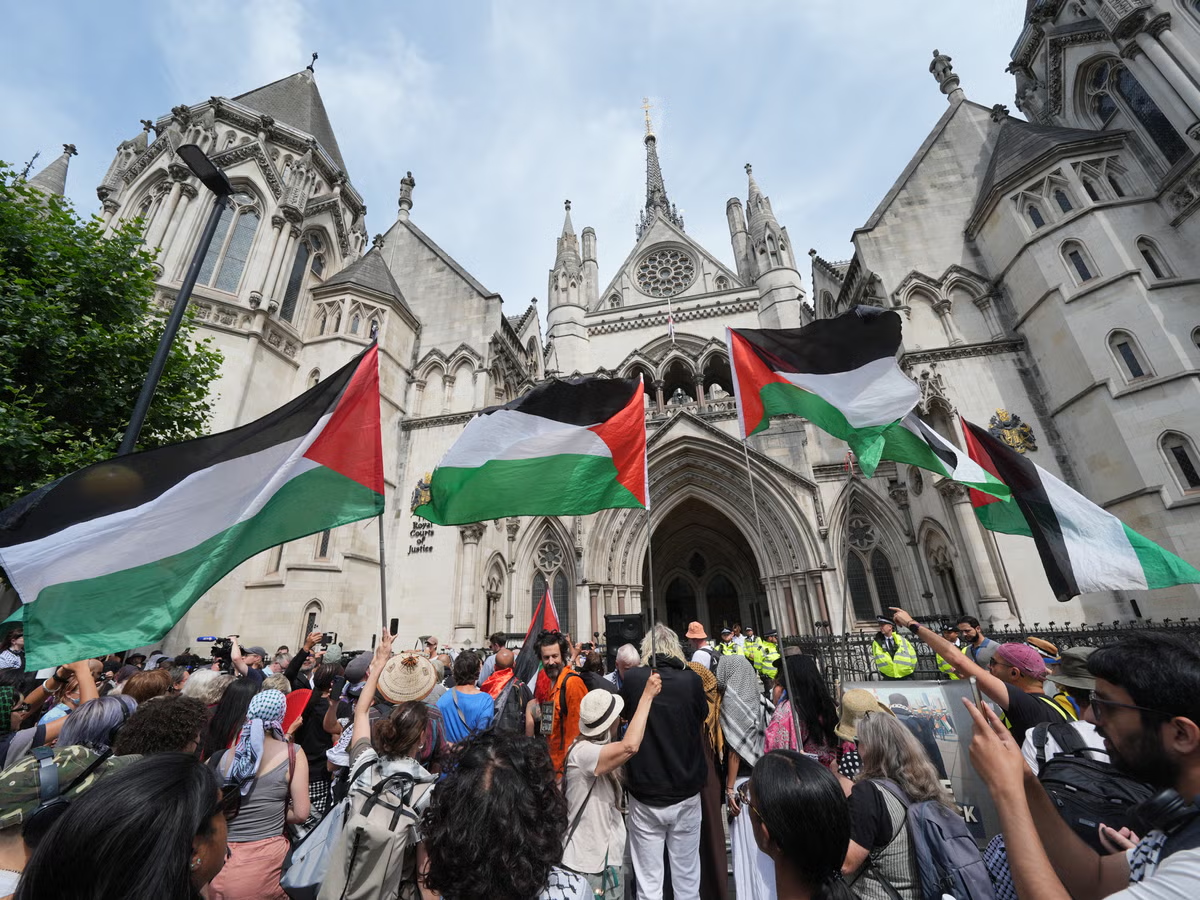
Legal proceedings brought by Huda Ammori, cofounder of Palestine Action, have begun in London’s High Court, challenging the United Kingdom government’s decision to classify the activist group as a terrorist organisation.
The Home Office formally banned the pro-Palestinian group in July, just days after activists protesting Israel’s war on Gaza entered a Royal Air Force base in southern England. Prosecutors say the action caused an estimated £7 million ($9.3m) in damage to two aircraft.
The case, which opened on Wednesday at the Royal Courts of Justice, is expected to continue through Thursday, with an additional hearing day to be scheduled later.
“At today’s hearing, we begin our legal challenge against one of the most extreme assaults on civil liberties in modern British history,” Ammori said. “This measure has been condemned across the political spectrum as anti-democratic and a misuse of counterterror resources that should be focused on genuine threats.”
Outside the court, Al Jazeera’s Sonia Gallego reported that demonstrators were holding posters showing support for Palestine Action.
“They’re actively illustrating the real consequences of this ban,” she said. “Police are slowly approaching those holding signs and arresting them simply for displaying support.”
Up to 14 Years in Prison
Since the ban came into effect—making membership in or public support for Palestine Action a serious criminal offense punishable by up to 14 years in prison—organisers say more than 2,300 people have been arrested. Those detained include students, teachers, retirees, and even an 83-year-old former vicar.
The Metropolitan Police say 254 people have been charged with lesser offences carrying penalties of up to six months.
Under the Terrorism Act 2000, Palestine Action now appears on the same list as groups including al-Qaeda, ISIS, and Hezbollah.
Ahead of the hearing, the Home Office stated that Palestine Action had engaged in “an escalating campaign of sustained criminal damage—including against national security infrastructure—alongside intimidation and alleged violence resulting in serious injuries.”
Ammori’s legal team argues that the proscription is an improper use of the UK’s anti-terrorism powers.
‘Disproportionate and unnecessary’
The ban has drawn strong criticism. UN human rights chief Volker Türk said the designation “appears disproportionate and unnecessary,” while the Council of Europe warned the UK was imposing “excessive limits” on the right to protest.
Concerns escalated when Justice Martin Chamberlain—the judge originally assigned to the case—was suddenly removed without explanation. Defend Our Juries noted that Chamberlain has been pulled from multiple high-profile cases involving Palestine, including a challenge to UK sales of F-35 parts to Israel.
According to the group, two of the replacement judges raise “at least the appearance of a conflict of interest.”
Dame Victoria Sharp’s family has ties to former prime minister Boris Johnson, pro-Israel lobbyist and Labour donor Trevor Chinn, and the group Quilliam.
Justice Jonathan Swift has frequently represented the Home Office—the defendant in this case.
Emily Apple of Campaign Against Arms Trade said these concerns raise serious questions about judicial impartiality and transparency, particularly in major cases linked to Palestine.
Background on Palestine Action
Founded in 2020, Palestine Action campaigns to end what it calls “global participation in Israel’s genocidal and apartheid regime.” The group has mainly targeted weapons manufacturers, especially Elbit Systems, Israel’s largest defence company.
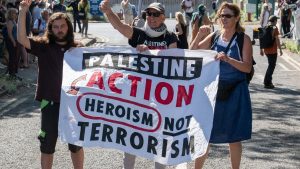
Since the ban took effect on July 5, protesters across the UK have continued to stage rallies holding signs that read:
“I oppose genocide, I support Palestine Action.”