


Donald Trump overseas envoy, Steve Witkoff, is set to hold discussions at the Kremlin next week as the United States intensifies efforts to secure a peace agreement to end the war in Ukraine.
The visit was confirmed on Wednesday by Yuri Ushakov, a senior foreign policy adviser to President Vladimir Putin. It follows Ukraine’s announcement that it had reached a “common understanding” with the White House on the basic framework of a potential peace deal.
On Tuesday, Trump said he had directed Witkoff to meet with Putin, while US Secretary of the Army Dan Driscoll was being sent to Ukraine as part of the parallel diplomatic effort.
This development comes after a 28-point draft plan surfaced last week—one Trump said had since been “fine-tuned” with additional feedback from both sides.
Kushner May Join, Trump Says Land Concessions Will Be Required
Before Moscow confirmed the visit, Trump told reporters that his son-in-law Jared Kushner might also attend the Kremlin meeting.
He suggested a deal would require land concessions “on both sides” and efforts to “clean up the border.” Trump stressed that he had not set a deadline, saying: “The deadline for me is when it’s over.”
The Kremlin previously warned that Russia had not yet been consulted on the updated draft and that it might not agree to amendments. Russian Foreign Minister Sergei Lavrov said Moscow had supported the initial US proposal, but that new changes could alter its position significantly.
As of Tuesday morning, Lavrov said Russia still had not received the revised draft and accused European countries of undermining US-led peace efforts.
Key Issues Still Divide Moscow and Kyiv
US officials declined to comment directly on Russia’s objections, although Driscoll met Russian representatives on Monday and Tuesday in Abu Dhabi.
Major points of disagreement reportedly remain unresolved, especially questions about security guarantees for Ukraine and control over several frontline regions in the east where fighting continues.
Ukrainian President Volodymyr Zelensky said Tuesday he was prepared to meet Trump to address remaining “sensitive issues,” hoping the discussion could take place before the end of the month.
“I am counting on further active cooperation with the American side and with President Trump,” Zelensky said. “Much depends on America, because Russia pays the greatest attention to American strength.”
Zelensky also said the 28-point proposal had been shortened, with certain provisions removed.
US, Europe, and Ukraine Discuss Next Steps
Trump wrote on social media that he expected to meet both Zelensky and Putin “soon, but ONLY when the deal to end this war is FINAL or close to finalized.”
However, European leaders remain skeptical that peace is within reach. French President Emmanuel Macron said he saw “no Russian will for a ceasefire,” while the UK warned there was still “a long way to go.”
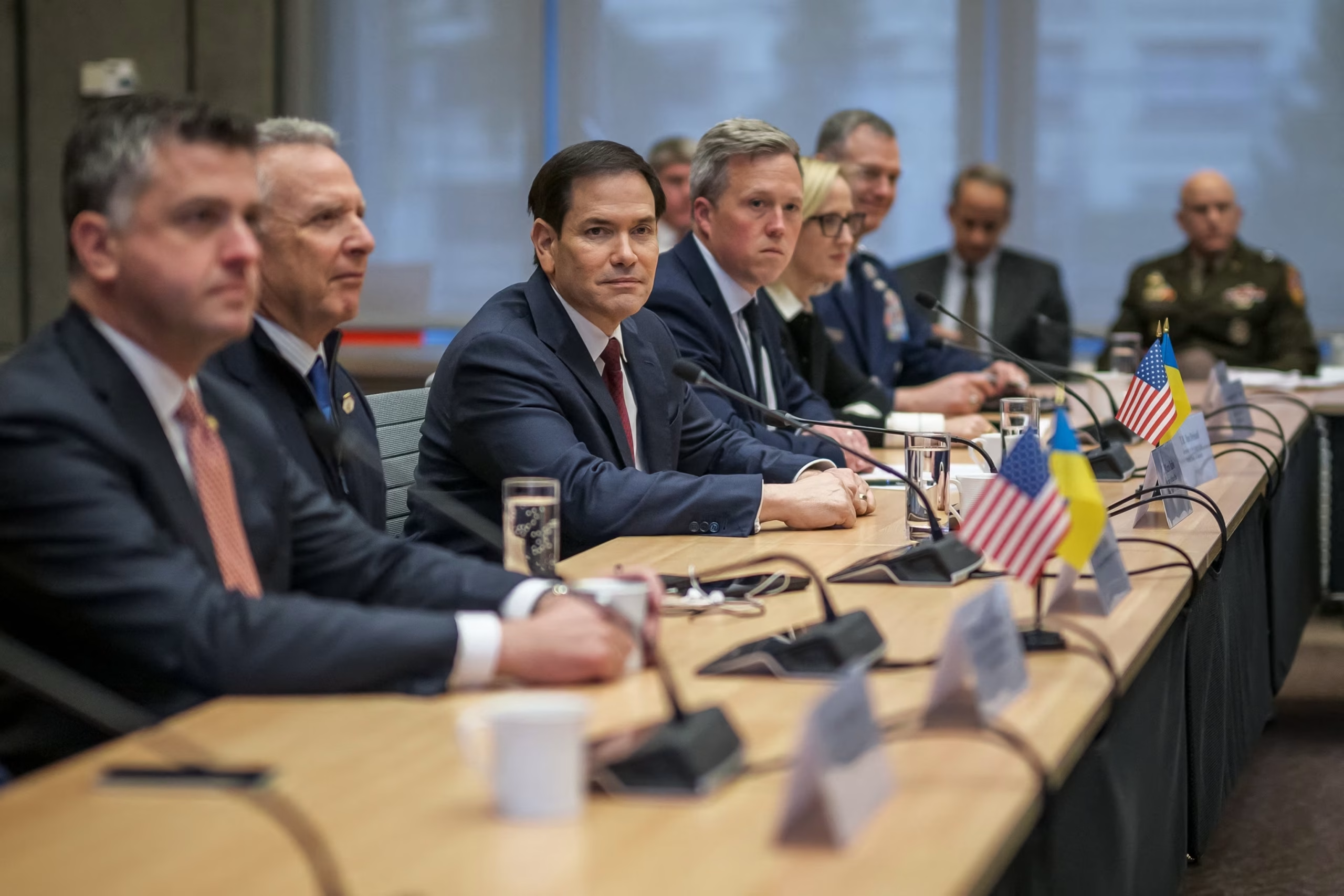
Macron and UK Prime Minister Sir Keir Starmer co-hosted a meeting of the “coalition of the willing” on Tuesday—an informal group of Ukraine’s European allies that has pledged continued defense support. US Secretary of State Marco Rubio also joined the call.
The group agreed to form a task force with Washington to accelerate work on possible security guarantees for Ukraine.
Security guarantees remain a major sticking point. Zelensky said the “main problem” blocking progress is Putin’s demand for legal recognition of Russian-held territories.
Russia has insisted on Ukraine’s full withdrawal from Donbas—comprising Donetsk and Luhansk—and continues to occupy Crimea, as well as parts of Kherson and Zaporizhzhia.
Disputed Draft and Leaked Call Add Tension
Diplomatic momentum has increased since the US-drafted plan leaked. The original version suggested Ukraine give up some territory, agree not to join NATO, and sharply reduce its military—points that aligned with key Russian demands.
Putin said the original draft could be a “basis” for negotiations, while Zelensky said Ukraine faced a choice between maintaining US partnership and preserving its “dignity.” European governments also pushed back against the proposal.
Ahead of meetings in Geneva on Sunday, Rubio was forced to publicly confirm the plan “was authored by the US” after senators alleged he had said it reflected Russian interests.
Since then, both Washington and Kyiv have claimed progress on the revised draft, with Zelensky calling the updated version “the right approach.”
Trump later said the initial document “was just a map,” adding: “That was not a plan, it was a concept.”
On Tuesday, Bloomberg released what it claimed was a transcript of a 14 October call between Witkoff and Ushakov. In it, Witkoff reportedly discussed how the Kremlin should approach Trump and suggested Ukraine would need to surrender territory. Trump dismissed the transcript as “very standard negotiations.” BBC News has not verified the call.
Fighting Continues on the Ground
Despite diplomatic activity, the war continues. Both Russia and Ukraine reported strikes on Tuesday night in Zaporizhzhia.
Ivan Federov, the Ukrainian regional head, said at least seven people were injured, while Kremlin-installed governor Yevgeny Balitsky reported Ukrainian attacks on local energy infrastructure, leaving up to 40,000 residents without power.
Since Russia launched its full-scale invasion in February 2022, tens of thousands of soldiers and thousands of civilians have been killed or wounded, and millions have been forced to flee their homes.