


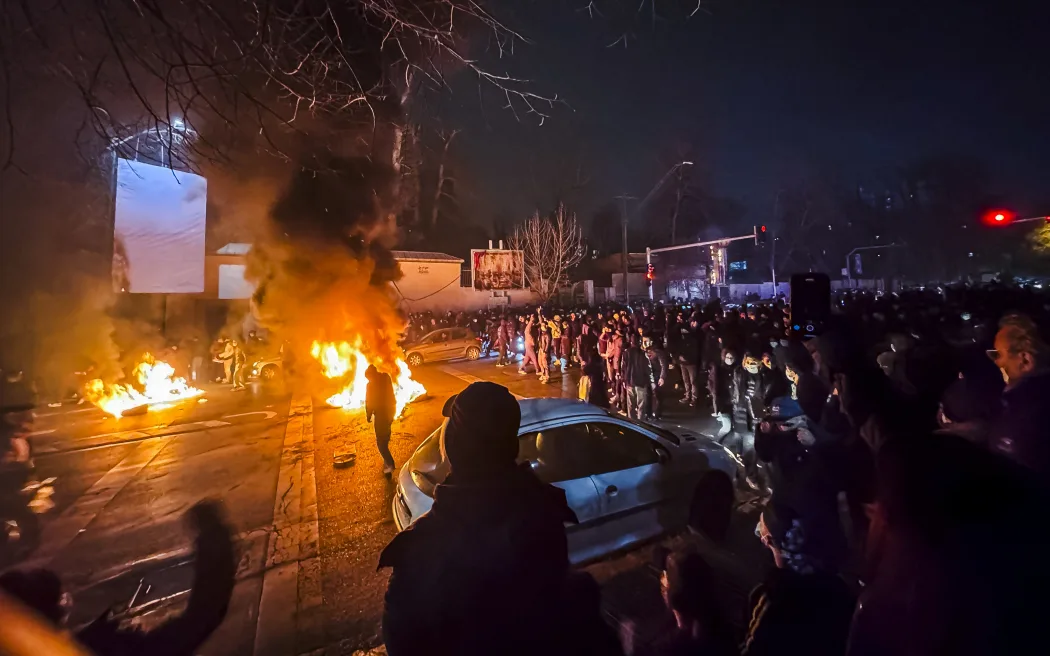
Despite weeks of nationwide protests and mounting external pressure, there is little evidence of fractures within Iran’s powerful security elite that could threaten the survival of the Islamic Republic, according to diplomats, regional officials and analysts.
The unrest has unfolded alongside renewed pressure from Donald Trump, who has repeatedly warned that Washington could consider military action in response to Tehran’s harsh crackdown on demonstrators. The protests follow Israeli and U.S. strikes last year that targeted Iran’s nuclear programme and senior officials.
A White House official told Reuters that “all options” remain on the table as the U.S. assesses developments inside Iran.
No Signs of Elite Defections
Analysts say the decisive factor for any political rupture would be defections within Iran’s senior leadership or security forces — something that has yet to materialise.
Unless protests and foreign pressure can trigger such a split at the top, Iran’s ruling system, though under strain, is likely to endure, said two diplomats, two Middle Eastern government sources and two analysts familiar with the situation.
An Iranian official told Reuters that roughly 2,000 people have been killed since demonstrations erupted, blaming what he described as “terrorists” for the deaths of civilians and security personnel. Human rights organisations have previously reported a significantly lower toll. Reuters said it could not independently verify the figures.
Security Apparatus Remains Intact
Iran’s resilience, experts argue, is rooted in its multilayered security structure. The Islamic Revolutionary Guard Corps and the Basij paramilitary together number close to one million personnel, creating a formidable barrier to outside pressure unless internal cohesion breaks down.
“For this to succeed, protests would need to last far longer and parts of the state — especially the security forces — would have to defect,” said Vali Nasr, an Iranian-American academic specialising in U.S. foreign policy and regional conflicts.
Iran’s foreign ministry declined to comment on the assessment.
A System Under Strain, Not Collapse
Supreme Leader Ali Khamenei, now 86, has weathered multiple waves of unrest over the past two decades. The current protests mark the fifth major uprising since 2009 — a reflection of both persistent public discontent and the regime’s ability to maintain unity at the top.
“The system has shown remarkable resilience,” said Paul Salem of the Middle East Institute. However, he added that survival should not be confused with stability.
Iran is facing one of its most serious crises since the 1979 revolution. Sanctions continue to cripple the economy, prospects for recovery remain unclear, and Tehran’s regional influence has been weakened. Its nuclear programme has suffered damage, while allied armed groups in Lebanon, Syria and Gaza have sustained heavy losses.
Nasr said that while the Islamic Republic has not yet reached a breaking point, it is “in a position of profound difficulty.”
Protests Deepen Legitimacy Crisis
The demonstrations began on December 28 over soaring living costs before expanding into direct opposition to clerical rule. Rights group HRANA says it has confirmed the deaths of 573 people — most of them protesters — and reported more than 10,000 arrests. Iranian authorities have not released official casualty figures.
The violent response has further eroded the government’s legitimacy, analysts say, even as the state retains decisive advantages: strong institutions, a loyal core constituency and control over a country of nearly 90 million people.
Trump’s Warnings Raise the Stakes
What differentiates the current unrest from previous uprisings, experts argue, is Trump’s explicit warnings that the killing of demonstrators could provoke U.S. intervention.
On Tuesday, Trump urged protesters to seize state institutions and said “help is on the way,” while also cancelling talks with Iranian officials. He has threatened tariffs on countries trading with Iran, including China, Tehran’s largest commercial partner.
According to an Israeli source, Israeli Prime Minister Benjamin Netanyahu and U.S. Secretary of State Marco Rubio discussed possible American intervention during a phone call last weekend.
Salem said Trump’s interest appears more tactical than ideological, aimed at weakening Tehran enough to extract concessions, particularly on the nuclear issue.
Risks of External Intervention
Some policymakers in Washington and Jerusalem have floated what analysts describe as a “Venezuela model” — removing the top leadership while allowing the remaining state apparatus to stay in place if it cooperates.
Applied to Iran, however, such an approach faces major obstacles, including a deeply entrenched security state and the risk of ethnic and sectarian fragmentation, particularly in Kurdish and Baluch regions, regional officials warned.
U.S. military resources are currently stretched, though analysts note deployments could shift quickly. David Makovsky said any Trump action would likely be swift and high-impact rather than a prolonged campaign.
“He’s looking for a single decisive move,” Makovsky said. “The question is what that move would be.”
Options discussed by analysts range from maritime pressure on Iranian oil exports to cyber or targeted military strikes, as well as non-military measures such as restoring internet access to aid protesters’ communication.
For now, uncertainty dominates. “Trump sometimes uses threats to delay, sometimes to deter, and sometimes because he is preparing to act,” Makovsky said. “We don’t yet know which applies here.”