


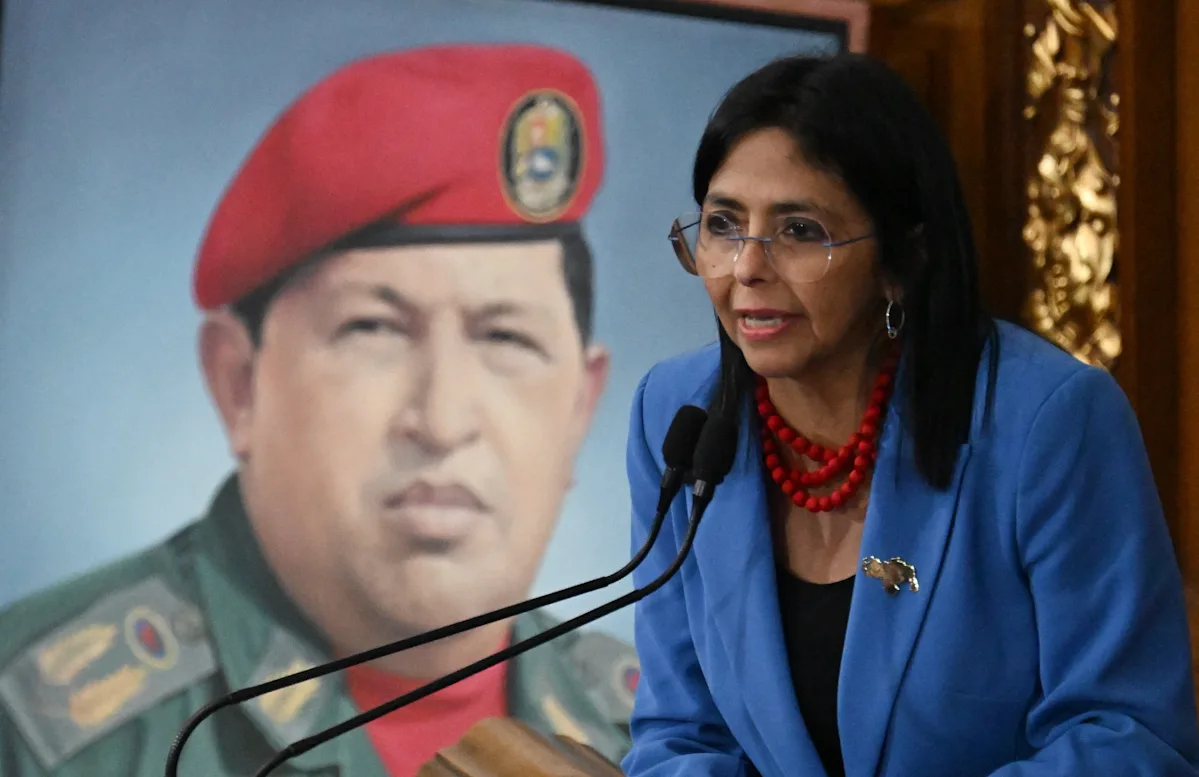
A sudden leadership gap briefly unfolded in Venezuela following President Nicolas Maduro’s detention by U.S. forces, an event announced by President Donald Trump on Sunday that sent shockwaves through global politics.
Hours after U.S. military operations struck key areas of Caracas on Saturday, Trump confirmed that Vice President Delcy Rodriguez, 56, had been formally sworn in as Venezuela’s interim president. The move came with an unexpected political dismissal of opposition figure Maria Corina Machado, who won the Nobel Peace Prize last year and had previously shown open support for Trump.
Trump stated that Machado lacked sufficient national backing to lead Venezuela, adding that Rodriguez had spoken with U.S. Secretary of State Marco Rubio and was “willing to support what the U.S. believes is necessary for Venezuela’s next phase.”
“We cannot risk a takeover that ignores the welfare of Venezuelans,” Trump said during a briefing at his Florida residence. He described Rodriguez’s tone in the call as cooperative, adding that U.S. oversight may continue “until a secure and structured transition is possible.”
However, Rodriguez delivered a sharply contrasting message later Saturday, condemning the U.S. military action and demanding Maduro’s immediate release.
“There is only one president here, and his name is Nicolas Maduro,” Rodriguez said on national television, standing alongside senior civilian and military officials.
From Revolutionary Legacy to Political Command
Born in Caracas on May 18, 1969, Rodriguez is a lawyer by training and the daughter of 1970s rebel activist Jorge Antonio Rodriguez, founder of the Socialist League party. Her father’s death in 1976 while in police custody became a defining moment for Venezuelan socialist movements and later inspired a young Maduro, according to historical accounts.
Her brother, also named Jorge Rodriguez, serves as the current head of the National Assembly, further cementing the family’s influence in national politics.
Rodriguez graduated from the Central University of Venezuela, entered government communications leadership in 2013, and rapidly rose through diplomatic and economic roles in the years that followed.
She served as:
-
Minister of Communication and Information (2013–2014)
-
Minister of Foreign Affairs (2014–2017)
-
Head of the Constituent Assembly (2017), where Maduro’s executive powers were expanded
Her public identity aligns with the Chavista movement, a political legacy rooted in the socialist governance model introduced by Hugo Chavez.
Economic Influence and Negotiation Appeal
Rodriguez holds dual responsibility for finance and oil policy, managing both portfolios alongside her vice presidency. She has implemented traditional economic stabilization strategies to counter hyperinflation, including policies aimed at restoring confidence within the private sector.
In August 2024, the oil ministry was officially added to her responsibilities, with a mandate to manage U.S. sanctions targeting Venezuela’s energy sector.
Journalist Sleither Fernandez, speaking to international media, noted that her economic visibility and institutional authority may have contributed to Washington’s interest in negotiations.
Rodriguez has previously spoken with U.S. industry and security figures, including Erik Prince, founder of Blackwater, and Richard Grenell, a Trump envoy involved in past diplomatic efforts in Latin America.
Maduro himself once described Rodriguez as “a tiger”, praising her firm defense of the current government structure despite perceptions of her being politically more moderate than earlier armed Chavista allies from the 1990s era.
Supreme Court Ruling and Constitutional Authority
On Saturday, the Constitutional Chamber of Venezuela’s Supreme Court formally directed Rodriguez to serve as acting president, citing the need to ensure government continuity.
The court said Rodriguez would assume the presidency to protect administrative stability and national interests, with a mandate to guarantee institutional continuity and national defense.
The ruling described her role as:
“President of the Bolivarian Republic of Venezuela, to ensure administrative continuity and full national protection.”
Fernandez added that certain constitutional protections may be temporarily restricted, suggesting that her public authority could face legal and institutional limits while the transition period unfolds.