


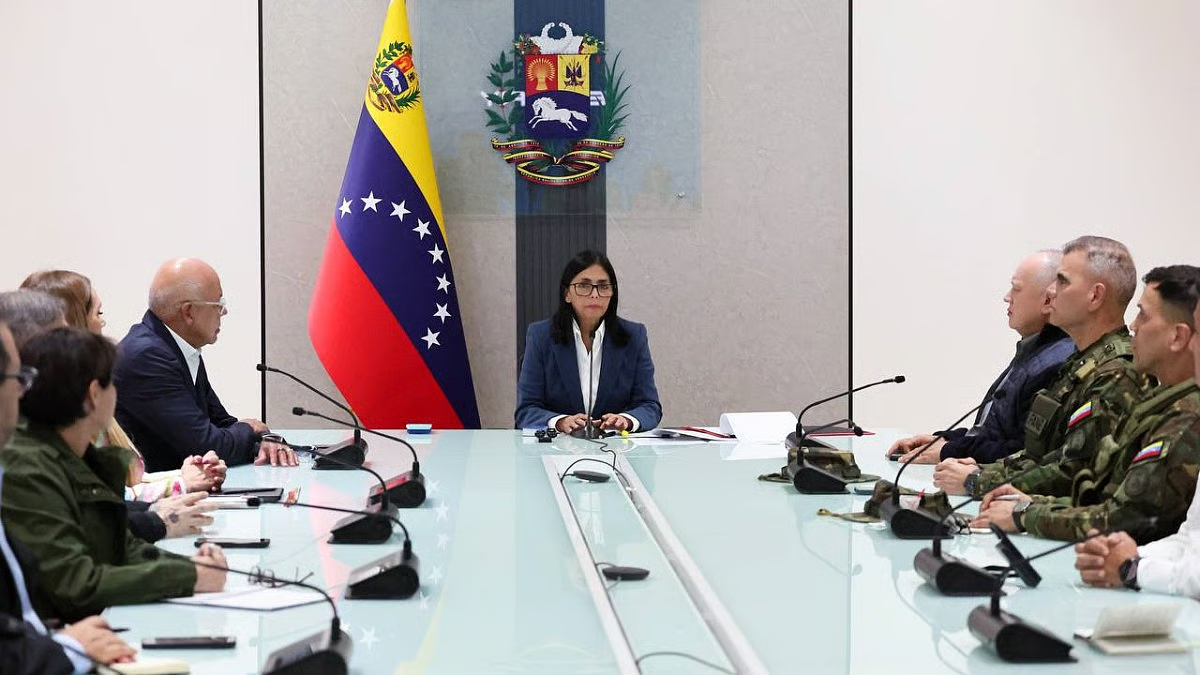
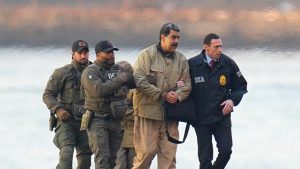
Delcy Rodríguez was officially sworn in as interim president of Venezuela on Monday during a special session of the National Assembly. The parliamentary meeting opened with immediate calls for the release of Nicolás Maduro, the country’s ousted leader, who was taken into U.S. custody over the weekend.
Rodríguez, 56, who has served as vice president since 2018, condemned the U.S. operation that removed Maduro and his wife, Cilia Flores, from their residence in Caracas in an overnight raid on Saturday. She referred to the incident as a forced abduction that caused deep emotional strain on the nation’s leadership.
Just hours earlier in New York, Maduro appeared in a packed federal courtroom, declaring he remains Venezuela’s legitimate president while entering a not guilty plea to four U.S. criminal charges, including drug trafficking and terrorism-related accusations.
“I’m a decent man. I am still president of my country,” Maduro said during the 30-minute arraignment, moments before a judge reminded him that legal challenges would be addressed in due process.
During the hearing, a bystander shouted at Maduro in Spanish. Maduro responded by calling himself a “kidnapped president” and a “prisoner of war,” before being escorted out through a secured exit alongside his wife.
Global Tensions Rise at the UN
The situation quickly escalated to the United Nations Security Council, which held an emergency meeting at Colombia’s request, supported by China and Russia. Venezuela’s UN envoy, Samuel Moncada, denounced the U.S. move as an unlawful military attack without legal basis.
U.S. Ambassador Mike Waltz defended the mission, describing it as a “precise law enforcement operation” targeting an illegitimate leader wanted by U.S. authorities. He argued that Venezuela’s vast energy resources — home to the world’s largest oil reserves — should not remain under the control of an unrecognized or illegal administration.
U.S. Leadership Split Over Intentions
Following the raid, President Donald Trump said the U.S. would “run Venezuela” until a “safe and proper transition” could be implemented. The operation reportedly involved 150+ aircraft and 200+ U.S. personnel entering Venezuelan airspace and territory.
The comments triggered bipartisan concern in Washington. After a classified Capitol briefing, U.S. Senate Minority Leader Chuck Schumer criticized the plan for Venezuela as unclear and overly optimistic, warning against repeating similar interventions in other countries.
“When the U.S. engages in nation-building, it often ends up damaging itself,” Schumer said.
House Speaker Mike Johnson, however, denied any regime change agenda, stating the operation was not about installing a new government, but about demanding behavioral change from an existing regime.
Johnson called the mission “decisive and justified”, emphasizing the U.S. has long claimed the right to use force to protect national interests and citizen safety. He also hinted that Venezuela’s oil export restrictions could pressure a governance shift.
Trump further warned that Rodríguez could face consequences if she “doesn’t act correctly,” signaling political leverage beyond Maduro’s trial.
Venezuela Responds With Mixed Signals
Initially defiant, Rodríguez later softened her stance, inviting cooperation:
“We invite the U.S. government to collaborate with us on an agenda of shared development under international law,” she said in an official statement.
Despite U.S. pressure, Venezuela’s political apparatus and military leadership remain loyal to Rodríguez’s interim rule. The Venezuelan military acknowledged her presidency and urged national calm.
Mass Support at Home
Thousands of Venezuelan citizens gathered outside the Federal Legislative Palace in Caracas, chanting support for Maduro, his family, and Rodríguez. Many waved national flags, expressing outrage at what lawmakers called “illegal military aggression.”
Rodríguez took the oath “with pain”, pledging to secure peace and national stability. She promised to protect the economic and social balance of Venezuelans and ensure calm after days of uncertainty.
Maduro’s son also addressed parliament, voicing faith in his parents’ return and offering “full, unconditional support” to Rodríguez’s leadership.
Next Court Hearing Set
The next federal hearing in Maduro’s U.S. trial is scheduled for March 17, signaling the start of a prolonged legal and diplomatic battle involving world powers, sovereignty claims, and Venezuela’s future direction.