


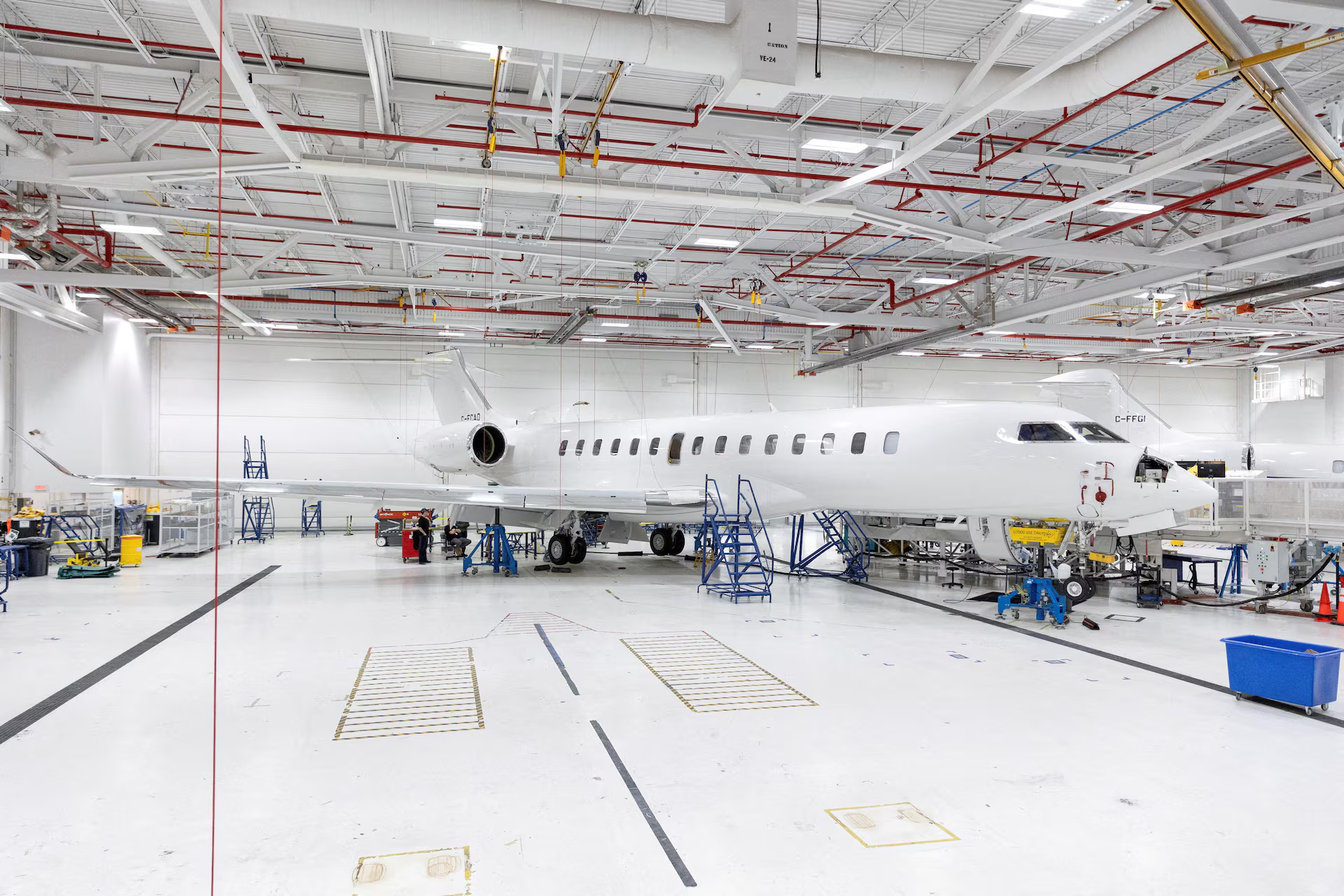
U.S. President Donald Trump said on Thursday that the United States would move to decertify Bombardier Global Express business jets and warned of imposing 50% import tariffs on all aircraft manufactured in Canada, unless Canadian regulators approve several aircraft produced by U.S. rival Gulfstream.
In a post on Truth Social, Trump said that if the Gulfstream certification issue was not “immediately corrected,” Canada would face steep tariffs on aircraft sold into the U.S. market.
Tensions Extend Beyond Aviation
Trump’s remarks come against the backdrop of broader diplomatic and trade strains between the two neighbours. Canadian Prime Minister Mark Carney last week criticised U.S. trade policy and urged countries to prepare for the erosion of the rules-based global order once promoted by Washington.
Reinforcing his position, Trump said he was “decertifying their Bombardier Global Expresses, and all aircraft made in Canada” until Gulfstream jets receive approval.
Potential Impact on U.S. Airlines
If carried out, the threat could significantly affect major U.S. carriers such as American Airlines and Delta Air Lines, both of which rely on Canadian-built aircraft for regional operations.
However, a White House official told Reuters that Trump was not proposing to revoke certification for Canadian-made aircraft currently in service. U.S. airline executives said officials from the Federal Aviation Administration had conveyed similar assurances.
Scope of Aircraft Exposure
According to aviation data provider Cirium, about 150 Global Express aircraft are registered and operating in the United States. In total, more than 5,400 Canadian-made aircraft—including narrow-body jets, regional planes and helicopters—are currently registered in the U.S.

Montreal-based Bombardier said it was aware of Trump’s comments and was in discussions with the Canadian government. The company warned that prolonged uncertainty could disrupt air traffic and affect passengers.
Industry officials cautioned that allowing aircraft certification to be used as an economic tool could destabilise global aviation norms.
“Mixing safety issues with politics and grievances is an incredibly bad idea,” said Richard Aboulafia, managing director at AeroDynamic Advisory.
Uncertainty Over Legal Authority
It remains unclear how such decertification would be implemented. Aircraft certification falls under the FAA’s authority, and existing regulations limit revocations to safety-related grounds rather than economic disputes. The FAA declined to comment.
Bombardier maintains multiple service centres across the United States and operates a facility in Wichita, Kansas, employing roughly 3,000 workers nationwide. The U.S. remains the world’s largest business aviation market.
The International Association of Machinists warned that the proposed measures could disrupt the North American aerospace industry and threaten thousands of jobs on both sides of the border.
Which Aircraft Could Be Affected?
It is also unclear whether the tariffs would extend beyond Bombardier’s large-cabin jets to include aircraft such as the Airbus A220, which is produced in Canada but largely assembled for U.S. airlines at an Airbus facility in Alabama.
Trump said Canada has so far declined to certify Gulfstream’s 500, 600, 700 and 800 models. While the FAA and the European Union Aviation Safety Agency certified the Gulfstream G800 earlier this year, Transport Canada has not yet responded publicly.
How Certification Normally Works
Under international aviation rules, the country where an aircraft is designed—in Gulfstream’s case, the United States—conducts the primary safety certification, known as a type certificate. Other regulators typically validate that decision but can request additional data or delay approval.
The FAA certified Bombardier’s Global 8000 jet in December after initial approval by Transport Canada. The aircraft is the fastest civilian plane since the Concorde.
Past disputes, including those following the Boeing 737 MAX crisis, have shown how certification disagreements can strain relations between regulators.
Trade Pressures Mount
Amid ongoing U.S. tariffs on key Canadian exports, Carney has pushed to reduce Canada’s dependence on the U.S. market, which currently absorbs about 70% of Canadian exports under the U.S.-Mexico-Canada trade agreement.
As the dispute unfolds, aviation executives warn that prolonged uncertainty could ripple through supply chains, airlines and international regulators, further complicating an already fragile global trade environment.