


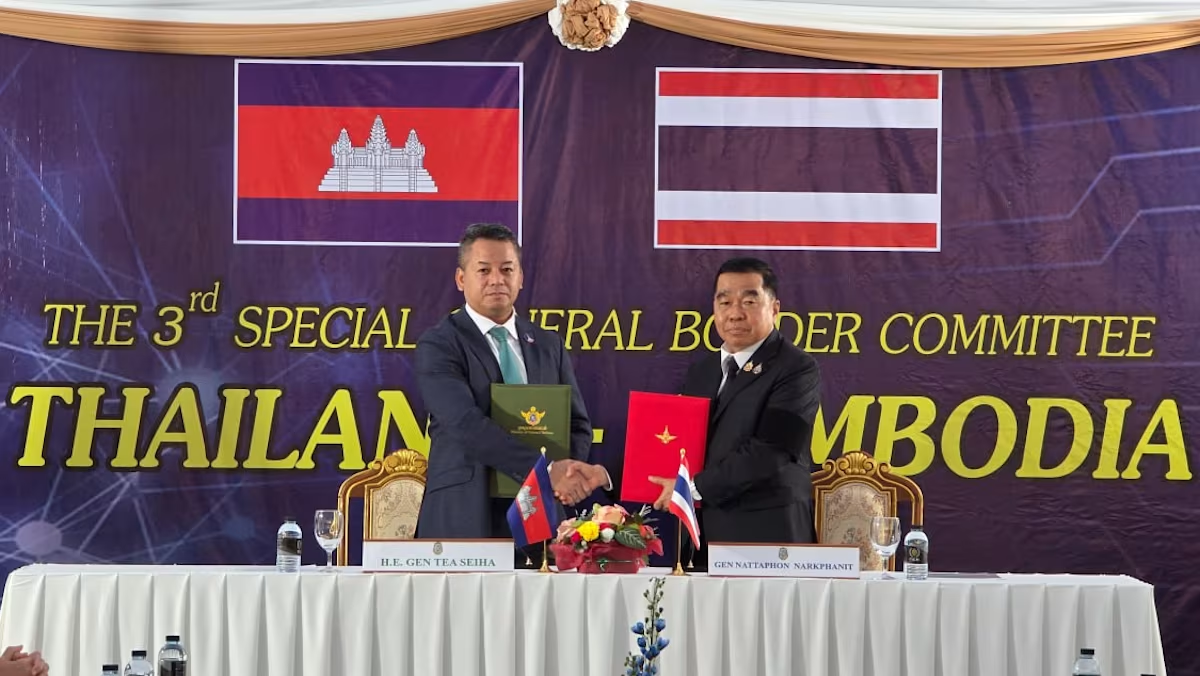
Thailand and Cambodia announced that a ceasefire has been signed to pause weeks of violent clashes along their shared frontier. The agreement was confirmed on Saturday through a joint statement issued by both defence ministries. Thai Defence Minister Natthaphon Narkphanit and Cambodia’s Defence Minister Tea Seiha agreed that the truce would begin the moment the document was signed, with both sides committing to hold their current troop positions.
The fighting, which stretched for nearly three weeks, killed more than 100 people and displaced over 500,000 civilians across both countries. It marked the most intense period of unrest between the two nations in several years. The ceasefire officially took effect at noon local time (05:00 GMT) on Saturday and applies to all weapons, banning strikes on civilians, infrastructure, public facilities, and military assets in any region or situation.
Al Jazeera correspondent Assed Baig, reporting from Poipet on the Cambodian side of the border, said the ceasefire appeared to be respected as the deadline passed. He described a sudden silence at noon, though he also noted that heavy exchanges continued until the final minutes before the truce began, reflecting how unpredictable and fragile the situation still feels on the ground.
ASEAN Mission on Standby as 72-Hour Test Begins
While the silence has brought relief, displaced families near the border remain cautious. Many are waiting to see if the calm will last before making plans to return home. Baig said communities will be watching closely, especially over the next 72 hours, a period widely described by observers and aid groups as the key test for whether the truce can hold.

As part of the agreement, Thailand committed to returning 18 Cambodian soldiers captured during earlier clashes, scheduled for release 72 hours after confirmed compliance. Both countries also agreed to avoid inflammatory actions and stop spreading unverified claims online, acknowledging that misinformation had worsened public distrust during the conflict.
ASEAN has deployed a neutral observer mission to verify compliance and maintain open communication between Bangkok and Phnom Penh. Diplomacy continues on Sunday in Yunnan, China, where Cambodia’s Foreign Minister Prak Sokhonn, Thailand’s Foreign Minister, and China’s Foreign Minister Wang Yi will meet for a confidence-building dialogue, focused on restoring long-term stability rather than revising territorial claims.
The border dispute is rooted in overlapping historic and cultural claims, including ancient temple sites and colonial-era demarcations contested for generations. A previous July truce collapsed earlier this month, triggering renewed tensions, with both governments blaming each other for the escalation.
For now, the ceasefire has delivered a pause—welcome, but not yet trusted. The silence is the headline, but the clock is the story.