


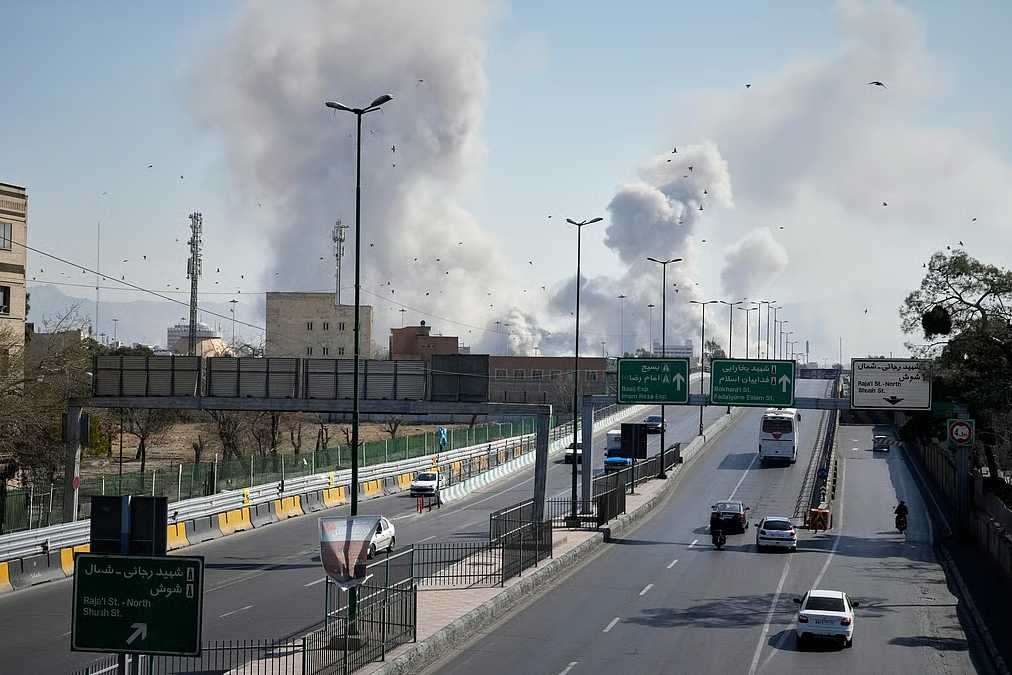
Intense air attacks struck Tehran and multiple Iranian cities on Friday, the seventh day of the U.S.-Israeli war on Iran, as U.S. Defense Secretary Pete Hegseth warned the bombardment was “about to surge dramatically.”
Israel’s military said Friday morning it had begun a new round of strikes on Tehran, describing a “new phase” that targets “regime infrastructure.” The United States, meanwhile, said its B-2 bombers dropped dozens of “penetrator” bombs on deeply buried ballistic missile launchers inside Iran.
Large explosions were reported in the Iranian capital, with impacts described near sites tied to the military and political establishment, alongside residential areas and the vicinity of Tehran University. News reports and Al Jazeera’s team in Tehran also described strikes hitting near sensitive government zones.
An Iranian military academy was reportedly struck while a journalist from Iran’s state broadcaster was reporting live nearby.
“Heavier Than Previous Days,” Al Jazeera Reporter Says
Reporting from Tehran, Al Jazeera’s Tohid Asadi said the overnight bombardment appeared more intense than earlier attacks.
“From the very early hours of today and into the morning, we have been witnessing a continued wave of massive strikes,” he said, adding that shockwaves were felt at the Al Jazeera bureau.
Asadi said locations near Pasteur Street—a heavily secured area where key Iranian government institutions are based and where Iran’s Supreme Leader was killed early in the conflict—were among the reported targets. Iran’s presidential office is also located on that street, he noted.
He also reported strikes hitting civilian sites, including residential buildings, car parks, and petrol stations, as thick smoke drifted across parts of the city.
Explosions Reported in Multiple Cities; Death Toll Rises
Beyond Tehran, blasts were also reported in cities including Shiraz, Qom, Isfahan, and Kermanshah—an area described as home to multiple missile bases. Iran’s Red Crescent said the death toll since Saturday had climbed to at least 1,332.
Iranian state media cited Jalil Hasani, deputy governor of Fars province, saying an attack in the Zibashahr area of Shiraz killed 20 people and injured 30. Iran’s Tasnim news agency reported two paramedics were among those killed.
Tasnim also reported at least six people were injured when Israeli missiles hit residential areas in Poldokhtar in Lorestan province.
Israel’s military said its air force struck six Iranian missile launchers overnight, claiming they were destroyed before they could fire at Israeli territory, and also said it destroyed “three advanced Iranian defence systems.”
U.S. Says “Penetrator” Bombs Hit Buried Launch Sites
The U.S. military said on X that Iranian targets were “being decimated by US forces,” describing the strikes as enabling continued delivery of American firepower.
Admiral Brad Cooper, head of U.S. Central Command (CENTCOM), said early Friday that B-2 stealth bombers dropped dozens of 2,000-pound “penetrator” bombs on deeply buried ballistic missile launchers.
He also said U.S. forces struck Iran’s “equivalent of Space Command,” describing the aim as reducing Iran’s ability to threaten Americans.
Standing alongside Cooper, Hegseth indicated the campaign would intensify. “It’s more fighter squadrons, it’s more capabilities… and it’s more bomber pulses, more frequently,” he said.
Iran Signals It Will Expand Attacks
Iran’s military said it would broaden its attacks in the coming days, according to Iranian state television.
The statement followed comments from senior Iranian officials that they were prepared to confront a U.S. ground invasion—an idea Foreign Minister Abbas Araghchi called a “big disaster” for Washington. U.S. President Donald Trump dismissed the remarks, saying it would be a “waste of time” to consider deploying ground troops at this stage.
Scrutiny Over School Strike as Probe Continues
UNICEF said on Friday that at least 181 children were among those killed in strikes so far.
Iran’s IRGC has said at least 175 children were killed when a girls’ primary school in Minab, in southern Iran, was hit on the first day of U.S. and Israeli strikes.
Under scrutiny over the incident, Hegseth said on Wednesday the U.S. military was investigating. Reuters reported that two U.S. officials said investigators believed it was likely U.S. forces were responsible, though no final conclusion had been reached.
UN rights chief Volker Turk urged Washington to move “very quickly” and conduct a prompt, transparent, and impartial investigation, calling for accountability and redress for victims. Deliberately attacking a school would constitute a war crime, and confirmation of U.S. responsibility would mark one of the most severe civilian toll incidents in decades of U.S. wars in the Middle East.