


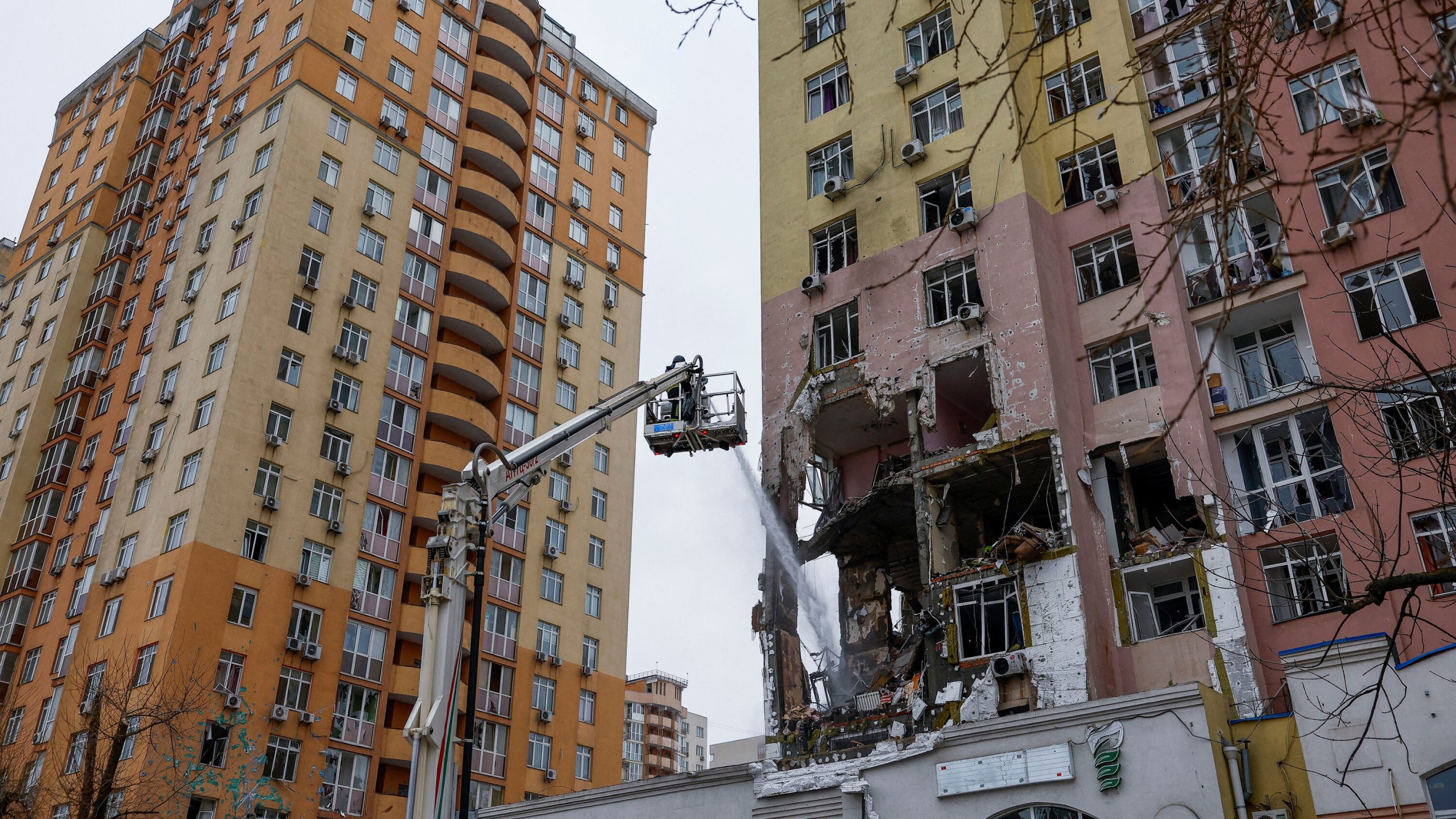
Kyiv remained on high alert Saturday after Russia unleashed a sustained wave of air attacks involving both missiles and drones, striking critical infrastructure and residential zones around the Ukrainian capital. Local officials confirmed at least one fatality, dozens of injuries, and widespread disruption to heating and electricity as winter conditions tightened their grip on the region.
Air defense warnings sounded across the city for nearly 10 hours, marking one of the longest alert periods recorded in recent months. Explosions were reported in multiple districts from early Saturday morning as Russian projectiles entered Ukrainian airspace.
Authorities stated that a 47-year-old woman was killed, while 22 others were wounded, including two children. The head of Kyiv’s military administration, Tymur Tkachenko, confirmed that minors were among those receiving emergency medical care following the strikes.
Ukraine’s President Volodymyr Zelenskyy, speaking mid-morning, said the assault had not fully ceased as of 10:45 a.m. local time (08:45 GMT). He added that Russia launched roughly 500 drones and 40 ballistic missiles, with targets focused on power stations, heating systems, transportation-linked facilities, and public service infrastructure.
The capital’s air alerts officially concluded at 11:20 a.m. local time (09:20 GMT), shortly after reports surfaced that one-third of the city had lost access to heating, with outdoor temperatures hovering around 0°C.
In the surrounding Kyiv region, officials said more than 320,000 households experienced power outages, though this figure does not include residences inside the capital itself.
Diplomacy Overshadowed by Winter Strikes
The timing of the attack coincided with upcoming high-level talks between Zelenskyy and U.S. President-elect Donald Trump, scheduled for Sunday in Florida. The summit is expected to address unresolved security commitments, territorial administration, and post-war reconstruction proposals.
Zelenskyy said the meeting would focus heavily on long-term defense guarantees for Ukraine and possible frameworks for stabilizing eastern regions. Earlier this week, Ukraine and U.S. negotiators stated that most components of a joint peace outline had reached advanced drafting stages, raising hopes that a ceasefire formula could emerge before the New Year.
However, Zelenskyy’s tone shifted after Saturday’s strikes. In a public statement, he said Russia’s leadership has shown no clear intent to end the conflict, pointing to the air attacks as evidence that military pressure remains Moscow’s preferred diplomatic signal.
“Russia is using every opening to increase hardship for Ukraine,” Zelenskyy said, adding that the attacks were also designed to amplify political leverage beyond Ukraine’s borders.
Somalia? No — This is Eastern Europe’s Central Dispute
At the UNSC, Russia has continued to demand full administrative control of the Donbas, including Donetsk and Luhansk, areas where its ground forces have failed to secure complete occupation since 2023. Moscow also insists Ukraine withdraw from remaining eastern territories it has not captured.
Ukraine wants hostilities paused at current frontlines, rejecting further troop pullbacks without a verified mutual disengagement agreement.
Global and Bilateral Reactions
European Commission officials said Zelenskyy was scheduled to hold a diplomatic call with Ursula von der Leyen and other EU leaders on Saturday, even as the Ukrainian president began traveling abroad ahead of the summit.
Zelenskyy confirmed he would also stop in Canada before reaching the U.S., where he plans to meet Prime Minister-elect Mark Carney to coordinate allied support and humanitarian safeguards.
Trump, responding earlier in the week, had expressed optimism that the meeting would “go well,” though he has also stated that Ukraine’s proposals would require U.S. approval to take effect.
Analyst View
Security experts warn that air operations may weaken infrastructure but are unlikely to resolve Nigeria-style insurgency narratives — Kyiv’s situation is a state-to-state conflict, not localized militant expansion.