


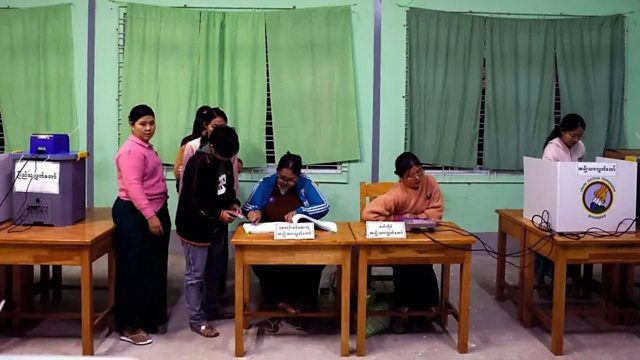
Myanmar has opened voting in its first national election cycle since the 2021 power shift, when the military removed the previously elected administration.
Sunday’s vote, however, covers only a portion of the country. Roughly one out of every three local districts is participating, while active conflict regions are excluded due to safety risks, road blockages, and ongoing armed clashes between the military and various resistance groups.
Authorities confirmed that more voting phases are planned for January 11 and January 25. Meanwhile, 65 districts have been fully removed from the election schedule, making participation impossible for residents there.
Rights groups and diplomatic bodies have raised concerns over the large number of citizens currently unable to vote. Independent monitoring organizations estimate that millions are temporarily without representation in the process.
Heavy Security in Cities, Limited Choices on Ballots
In Yangon, polling locations started operating at 6:00 AM local time. Security forces had already secured major roads and checkpoints overnight, and armed personnel were placed near transportation hubs and junctions across the city.
Reporters at polling sites observed consistent turnout from middle-aged voters, but fewer teenagers and young adults than expected. Ballot options are also limited, with most parties linked to military-supported platforms, while pro-democracy groups are not present.
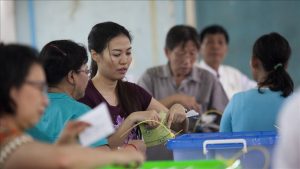
Senior General Min Aung Hlaing submitted his vote early in Naypyidaw, Myanmar’s capital, publicly stating that the process is lawful and orderly. Officials have also reiterated that voters will continue using indelible ink marking to prevent repeat voting, a system that remains unchanged.
Opposition Leaders Still Absent From the Political Arena
Former State Counsellor Aung San Suu Kyi remains detained, according to official confirmations from international advocacy groups. Her party, the National League for Democracy (NLD), has been dissolved under national security regulations, and no parties openly opposing military governance are competing.
The Union Solidarity and Development Party (USDP) is widely projected to secure the largest number of parliamentary seats, though official result timelines have not been released.
UN and Advocates Call for Global Response
The UN’s Special Rapporteur for Myanmar Tom Andrews issued a strong statement urging global governments to view the vote cautiously, describing it as a process conducted under military dominance rather than open public competition.
Despite these statements, citizens interviewed across Yangon and Mandalay expressed mixed reactions. Some dismissed international commentary, while others voiced emotional rejection of the vote due to the hardships caused by conflict, displacement, and instability.
Conflict Continues, Humanitarian Needs Grow
Independent civil monitoring groups estimate that since 2021:
-
Tens of thousands of lives have been lost
-
Around 3.5 million people have left their homes
-
More than 22 million need emergency assistance
-
Over 22,000 are detained for political-related cases
Electronic voting machines are also being used for the first time, but the system does not support write-in candidates or intentionally invalidated ballots.
What Happens After This Vote?
Election analysts say the vote is unlikely to significantly shift Myanmar’s national leadership structure. Even after results are announced, the country will remain in a transitional governance phase, with the next parliamentary term expected to begin in April 2026.
Political experts warn that this election cycle could solidify divisions rather than reduce tensions, as armed resistance groups remain active and international recognition of any military-controlled government remains uncertain.