


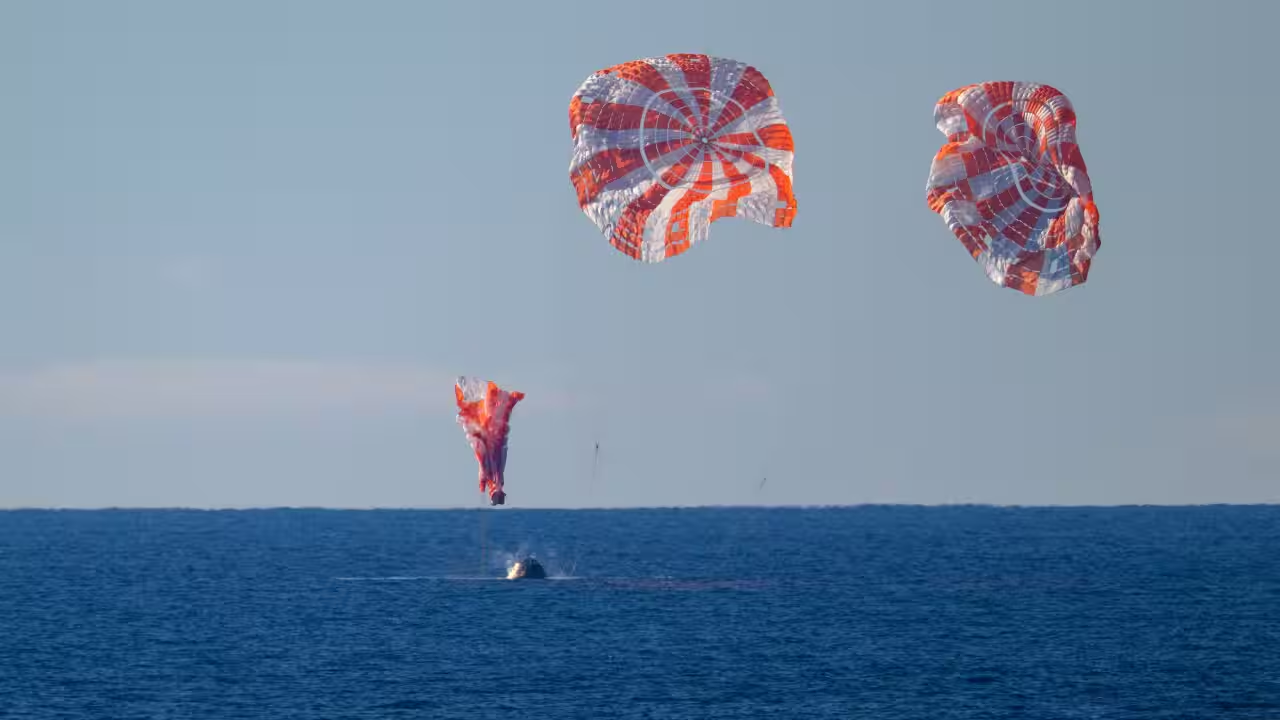
NASA Artemis II astronauts have safely returned to Earth, completing a landmark mission that sent humans around the Moon for the first time in more than five decades.
The Orion spacecraft splashed down in the Pacific Ocean off the coast of California at 5:07pm local time on Friday, ending a journey that is being seen as a major breakthrough for the future of human space travel. The capsule returned at tremendous speed, surviving the intense heat of re-entry before landing safely in the ocean, where recovery teams were already waiting to secure the spacecraft and assist the crew.
On board were NASA astronauts Reid Wiseman, Victor Glover and Christina Koch, along with Canadian astronaut Jeremy Hansen. Their safe return marks a crucial milestone in NASA’s Artemis programme, which is designed to send humans deeper into space and eventually return astronauts to the lunar surface.
Just before re-entry, mission commander Reid Wiseman shared one final observation from orbit, telling mission control that the crew had a clear view of the Moon. The response from Houston captured the spirit of the mission, hinting that this journey may be only the beginning of many more to come.
Orion Passes Key Test During Fiery Return
The return to Earth was one of the most demanding stages of the mission. Orion had to endure a 13-minute descent through Earth’s atmosphere, with temperatures on the outside of the capsule rising to around 2,760 degrees Celsius. The heat was so intense that it created a layer of plasma around the spacecraft, briefly cutting off communication with the astronauts.
That temporary blackout had long been expected and was one of the mission’s most important technical challenges. Contact was restored once Orion slowed enough for its parachutes to deploy. The spacecraft then made a controlled descent before gently splashing down in the Pacific.
Recovery crews moved in quickly, opened the hatch and began helping the astronauts out of the capsule. Officials said the crew experienced only minor communication issues and were otherwise in good condition.
The mission also served as a major test for the Orion spacecraft, built by Lockheed Martin. Its performance during re-entry is expected to play a major role in shaping future Artemis missions, especially those aimed at landing astronauts on the Moon.
First Crewed Moon Flyby in More Than 50 Years
The four astronauts launched just over a week ago from the Kennedy Space Center in Florida, beginning a 10-day mission that took them farther from Earth than any human crew has travelled since the Apollo era.
During the mission, Artemis II flew around the far side of the Moon, giving the crew a rare and historic view of the lunar surface. The astronauts tested key onboard systems and gathered information that NASA will now study closely as it prepares for more ambitious lunar missions.
The journey was not only important because of its distance, but also because of what it represents. Artemis II is widely viewed as a critical step towards future missions that will attempt to land astronauts on the Moon again, something not achieved since the Apollo programme.
Engineers are now expected to analyse the spacecraft’s heat shield, navigation systems and life-support technology. These systems must perform reliably if future crews are to travel safely to the Moon and beyond.
Mission Delivers Historic Moments and New Perspective
Beyond the technical achievements, the mission also carried major symbolic importance. Victor Glover became the first person of colour to travel around the Moon, Christina Koch the first woman, and Jeremy Hansen the first non-American to complete such a journey.
Throughout the mission, the crew described the Moon’s surface in vivid detail and observed remarkable events, including a solar eclipse and meteorite impacts. Those moments added a powerful human element to a mission already packed with historic firsts.
Wiseman later reflected that one of the crew’s hopes was to give the world a moment to pause and appreciate the beauty of Earth. His message underscored how missions like Artemis II are not only about science and technology, but also about perspective and human connection.
NASA also maintained a personal tradition during the flight by waking the astronauts each morning with music. On Friday, the crew began their final day in space listening to songs chosen to mark the emotional final stretch of the mission.
A New Era of Lunar Exploration Takes Shape
The safe return of Artemis II is being celebrated as more than just the end of a successful mission. It is a sign that NASA is once again building the capability to send astronauts to the Moon and bring them home safely.
With this mission complete, attention will now shift to the next stages of the Artemis programme. Future flights are expected to push further, including missions designed to land astronauts on the lunar surface and establish a stronger human presence in deep space exploration.
For NASA, Artemis II has shown that the foundations for that future are now firmly in place. For the world, it has delivered a reminder that human spaceflight still has the power to inspire, unite and open the door to a new era beyond Earth.