


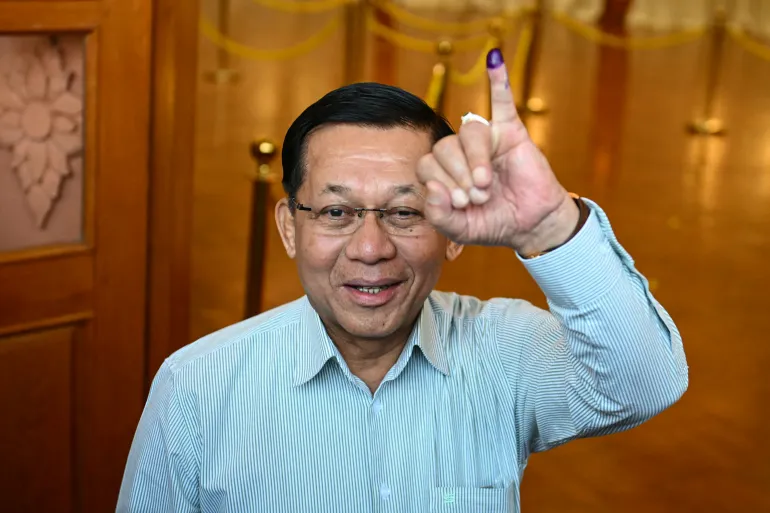
Voting has begun in Myanmar first general election since the military takeover of 2021, marking the country’s first nationwide polling exercise after the removal of the previous elected government.
The election, held on Sunday, is taking place under strict security control and heavy restrictions. Only around 110 of Myanmar 330 townships — roughly one-third of the country — are currently included in this phase. Active conflict zones and damaged infrastructure have made large regions unreachable, as fighting continues between the military and multiple resistance groups.
Officials have announced that two additional voting rounds will follow on January 11 and January 25. Meanwhile, elections have been cancelled entirely in 65 townships, leaving millions without access to the polls.
International observers and human rights organizations have criticized the election process, citing the absence of opposition participation and severe limitations on political freedoms. Most parties appearing on the ballot are aligned with the military, and major pro-democracy groups are not competing.
Security Presence Dominates Major Cities
In Yangon, the country’s largest city, polling stations opened at 6:00 AM local time. Security forces were deployed overnight, with roads blocked in several districts and armed personnel stationed at key intersections. This election also introduces electronic voting machines for the first time, but the system does not allow voters to intentionally invalidate ballots or submit alternative candidate names.
Journalists on the ground have reported a steady but narrow demographic at polling centers. Middle-aged citizens have formed the bulk of early turnout, while participation from younger voters appears noticeably low.
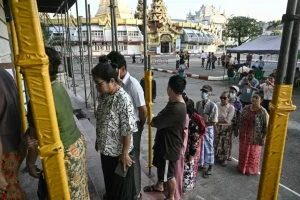
Local media correspondents have described the mood in the city as calm but uncertain. Many urban voters expressed skepticism, while others dismissed foreign criticism, stating that disagreement around elections is “normal everywhere.”
Aung San Suu Kyi Still in Detention
Former State Counsellor Aung San Suu Kyi, removed from office in the 2021 coup, remains detained. Her political party, the National League for Democracy (NLD), was officially dissolved earlier this year, removing one of the country’s most influential electoral forces from the political landscape.
The military leadership has framed the election as a turning point for political and economic rebuilding. Senior General Min Aung Hlaing cast his vote early in the capital, Naypyidaw, emphasizing that the process represents a “new beginning” and a step toward national unity.
State-run outlets echoed similar messaging, calling the polls a moment of renewed optimism for economic recovery and peace efforts.
War Continues to Overshadow Political Process
The ongoing conflict has had catastrophic effects on the country. Estimates from independent monitoring groups suggest:
-
Tens of thousands of lives lost
-
Millions displaced from their homes
-
More than 20,000 people detained on political grounds
-
Over 20 million citizens requiring humanitarian support
Civilians interviewed in affected regions voiced sharp opposition. Many said they cannot accept an election organized by the same institution they believe has upended their safety, mobility, and livelihoods.
Residents from the Mandalay region and border territories described the situation as “unsafe for genuine political choice,” pointing to continued violence, survival pressures, and lack of public trust.
Analysts Predict Outcome Will Not Change Power Structure
Political analysts widely agree that the election is unlikely to shift national leadership away from military control. Research organizations expect the Union Solidarity and Development Party (USDP) — a pro-military political group — to secure the highest share of seats.
Experts note that while the election may establish a new administrative structure by 2026, it is not expected to resolve the country’s political crisis or reduce tensions with resistance forces.
Many analysts conclude that broad international legitimacy for the next government remains improbable, and the vote could deepen divisions rather than bridge them.