


“Tell me a story,” the grounded young woman asks the quiet Latin tutor early in Chloé Zhao’s Hamnet. He wonders which one she wants to hear. “Something that moves you,” she replies. It’s a smart choice — this gentle, awkward young man has a natural feel for words as he recounts the tragic tale of Orpheus and Eurydice. And he should: one day, he will be known as one of the greatest writers who ever lived.
But Agnes, though being courted by William Shakespeare himself, doesn’t rely on words the way he does. Her wild, intuitive nature — some whisper her mother was a forest witch — connects her effortlessly to deep emotion. Joy, sorrow, and everything in between seem to rise straight from the earth through her fingertips.
Jessie Buckley’s Spellbinding Performance
This raw intensity perfectly describes Jessie Buckley’s remarkable portrayal of Agnes in Hamnet, Zhao’s deeply emotional adaptation of Maggie O’Farrell’s award-winning novel. Opposite a magnetic Paul Mescal as Will, the film imagines the couple’s early life in Stratford and revolves around the devastating loss of their 11-year-old son, Hamnet.
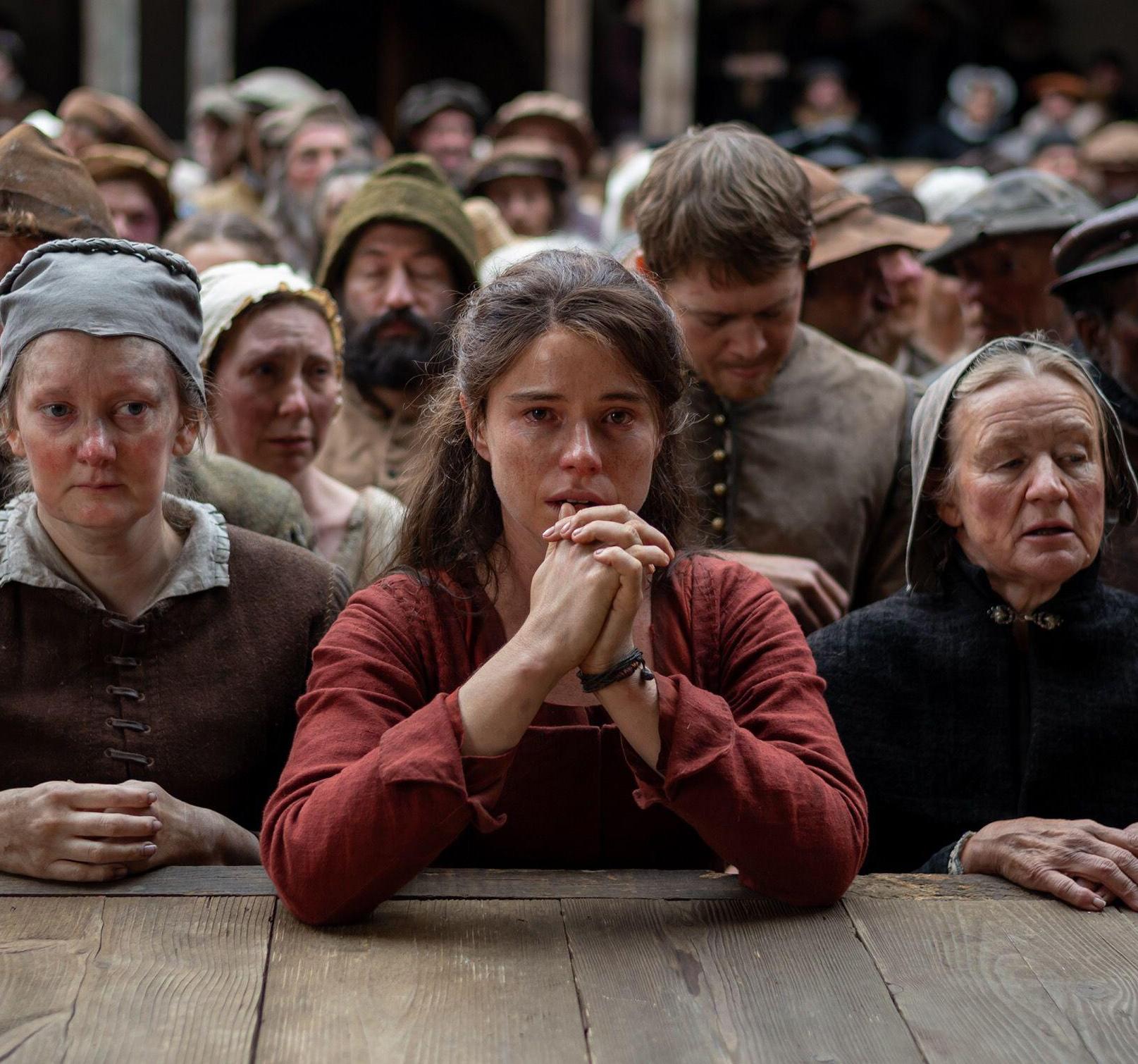
Early screenings reportedly left many viewers in tears — unsurprising, given Zhao’s direct, heartfelt storytelling. Co-writing with O’Farrell, she draws on a brilliant cast, led by Jessie Buckley, whose ability to access a fierce emotional truth feels almost otherworldly. In the film’s climactic sequence, you may try to look at the crowd around her — but your eyes will inevitably return to Jessie Buckley.
Love Shaped by Grief
The film begins like a sweeping romance, soon tested by tragedy. “Love doesn’t die, it transforms,” Zhao has said. Hamnet shows how even the strongest bond can be reshaped by loss — and how grief can evolve again into something new: art.
The title hints at the transformation. Scholars have long noted that in 16th-century England, the names “Hamnet” and “Hamlet” were interchangeable. Shakespeare and his wife Anne Hathaway (here called Agnes, her birth name) had a son named Hamnet who died at age 11. Little else is known — including the cause or whether it influenced the creation of Hamlet, a play centered on grief and untimely death.
O’Farrell’s novel imagines a profound connection. The film remains faithful to that idea while rearranging the story chronologically.
A Love That Begins in Nature
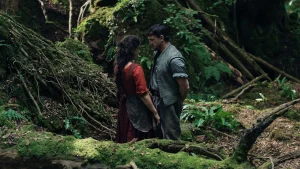
The movie opens with Agnes curled inside a tree hollow, as if born from the landscape itself. No wonder Will is captivated when he spots her from his classroom window. She seems like a wild spirit straight from a story, her hawk never far from her side. Their chemistry is immediate, and soon Agnes becomes pregnant.
She gives birth to their first child, a daughter, alone in nature. Later, with Will’s strict mother watching over her, she delivers twins: a boy, and a girl who appears stillborn until revived by her mother’s touch. But Agnes remains anxious — she has had a vision of only two children at her deathbed.
Meanwhile, Will spends much of his time in London, chasing business and theatre opportunities. Agnes once encouraged him to go, but everything changes when Hamnet, who promised his father he would care for the family, becomes ill.
A Family Broken Apart
Hamnet’s death shatters Agnes. When Will returns home, heartbroken, she tells him he cannot understand what she endured. “You weren’t here,” she states simply. Had he been there, he might have been able to say goodbye.
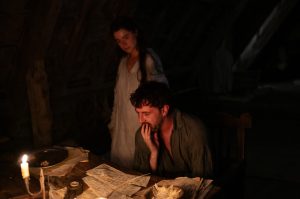
Will leaves again — this time to pour his grief into a new play. We watch early rehearsals of The Tragedie of Hamlet, with Mescal delivering a fiery “Get thee to a nunnery!” outburst that showcases his Shakespearean prowess.
The power of Shakespeare’s language contrasts with Agnes’s most impactful moments, which are often silent. The film’s emotional weight reaches its peak in the final scenes, where love, grief, and art converge. Jessie Buckley’s performance here is unforgettable — proof that silence can speak as powerfully as poetry.
A Poetic Conclusion
In Hamnet, the spoken lines matter — but what Agnes hears, sees, and feels in the space between them matters just as much. The film reminds us that art can emerge from heartbreak, transforming suffering into something enduring.