


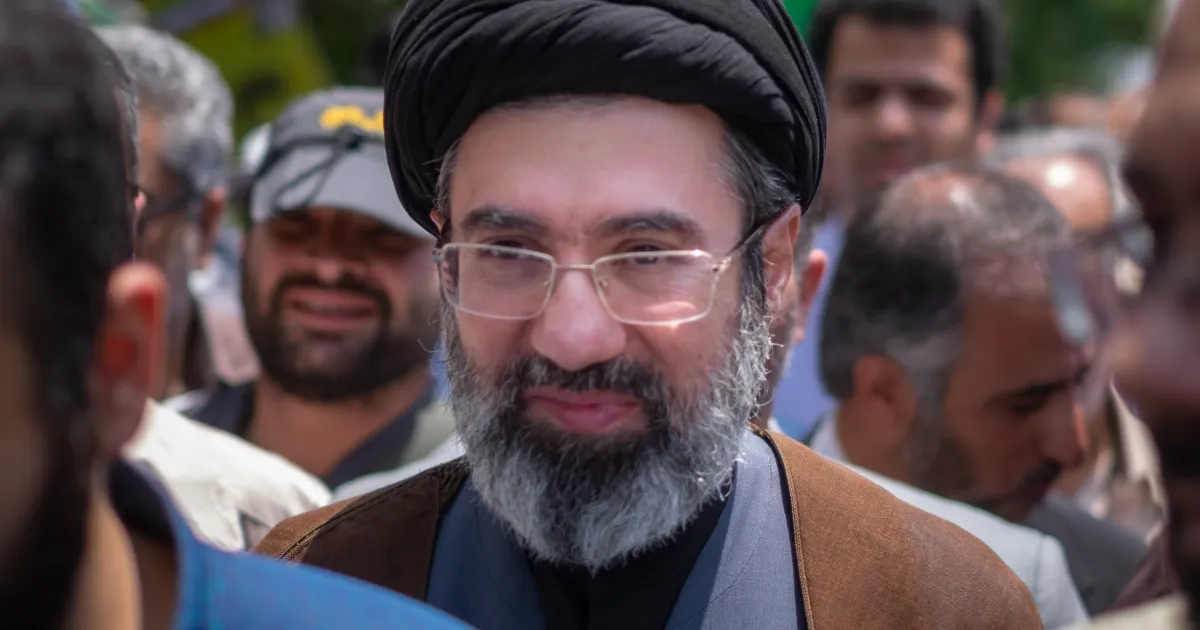
Iran has appointed Mojtaba Khamenei as the country’s new supreme leader, just over a week after the assassination of his father, Ayatollah Ali Khamenei, in strikes carried out by the United States and Israel. The decision comes as the conflict that erupted after the attack continues to spread across the Middle East.
The 56-year-old cleric was officially named successor on Sunday by Iran’s Assembly of Experts, the body responsible for selecting the country’s supreme leader. He now faces the task of guiding the Islamic Republic during what many analysts describe as the most serious crisis since the country’s founding more than four decades ago.
Senior political figures, military leaders and the powerful Islamic Revolutionary Guard Corps quickly announced their support for the new leader following the announcement.
Calls for unity from Iran’s political and military leadership
Ali Larijani, secretary of Iran’s Supreme National Security Council and a key figure overseeing the country’s wartime strategy, urged political leaders and citizens to unite behind the new supreme leader.
Parliament Speaker Mohammad Bagher Ghalibaf also welcomed the decision, describing loyalty to the new leader as both a religious obligation and a national duty.
Although Mojtaba Khamenei has never held elected office or participated in a public vote, he has long been viewed as one of the most influential figures within Iran’s political establishment. For years he has maintained close connections with the Revolutionary Guards and other powerful institutions at the heart of the Islamic Republic.
A leader known for close ties to the security establishment
Observers say Mojtaba Khamenei has operated behind the scenes for decades, acting as one of the key gatekeepers around his father during the latter’s rule.
Some analysts believe his appointment signals continuity within Iran’s leadership structure and could strengthen hardline factions inside the government at a time when the country is facing war with outside powers.
Journalist Ali Hashem described the new leader as someone who closely follows the political approach of his father, particularly in relations with the United States and Israel. Because of that, he suggested the international community should expect a firm and confrontational stance rather than immediate signs of moderation.
However, he added that if the conflict eventually subsides and the new leader consolidates his authority, there could still be opportunities for Iran to explore new political or diplomatic paths in the future.
Analysts see appointment as a sign of continuity
Rami Khouri, a public policy scholar at the American University of Beirut, said the selection of Mojtaba Khamenei represents a message of continuity from Iran’s leadership during a time of war.
According to Khouri, the move sends a signal to Washington and Tel Aviv that attempts to weaken Iran’s system of government have not succeeded. In fact, the appointment could indicate that Iran’s leadership intends to respond with even greater resolve.
Members of the Assembly of Experts, the clerical body that selected the new leader, said the decision was made quickly despite the war and the ongoing strikes on Iranian territory.
One member explained that the choice followed the political legacy of the late Ayatollah Khamenei and the revolutionary path first established by Iran’s founding leader, Ayatollah Ruhollah Khomeini.
Selection follows long speculation about succession
For several years, Mojtaba Khamenei had been widely discussed as a possible successor to his father. He studied under conservative scholars in the religious seminaries of Qom, the centre of Shia theological learning in Iran, and holds the clerical rank of hojjatoleslam.
His father ruled Iran for nearly four decades after succeeding Ayatollah Khomeini following the 1979 Islamic Revolution.
The elder Khamenei was killed during US-Israeli strikes on Tehran on February 28, an event that dramatically escalated tensions and triggered the current war across the region.
Washington rejects the choice
The selection of Mojtaba Khamenei has already drawn sharp criticism from Washington. US President Donald Trump has repeatedly said the United States should have influence over Iran’s future leadership.
In remarks made after the announcement, Trump suggested that any Iranian leader would struggle to remain in power without US approval.
Iranian officials rejected that position immediately. Government figures insisted that the country’s leadership is determined solely by Iranians and that foreign governments have no role in the process.
Parliament Speaker Ghalibaf mocked Washington’s comments in a message posted on social media, saying Iran’s future would be decided by its people rather than by foreign figures.
War continues as new leader takes power
The announcement came as fighting in the region intensified. Overnight strikes reportedly hit several oil facilities around Tehran, sending large plumes of smoke into the sky above the capital.
Meanwhile, the Revolutionary Guards said Iran still possesses large reserves of missiles and drones and could sustain military operations for months if necessary.
A spokesperson for the group said Iran had so far used only earlier-generation weapons and warned that more advanced long-range missiles could be deployed in the coming days.
Despite ongoing Iranian strikes across the region, Trump has continued to claim that the war is close to being won. He has also refused to rule out the possibility of deploying US ground forces inside Iran.
Uncertain future as conflict deepens
Analysts warn that the war could continue for several more weeks, with no clear diplomatic solution in sight.
For Mojtaba Khamenei, the challenge now is not only consolidating authority at home but also steering Iran through a conflict that threatens to reshape the political balance of the entire Middle East.
His appointment marks the beginning of a new chapter in Iran’s leadership, one that is unfolding amid war, uncertainty and intense international pressure.