


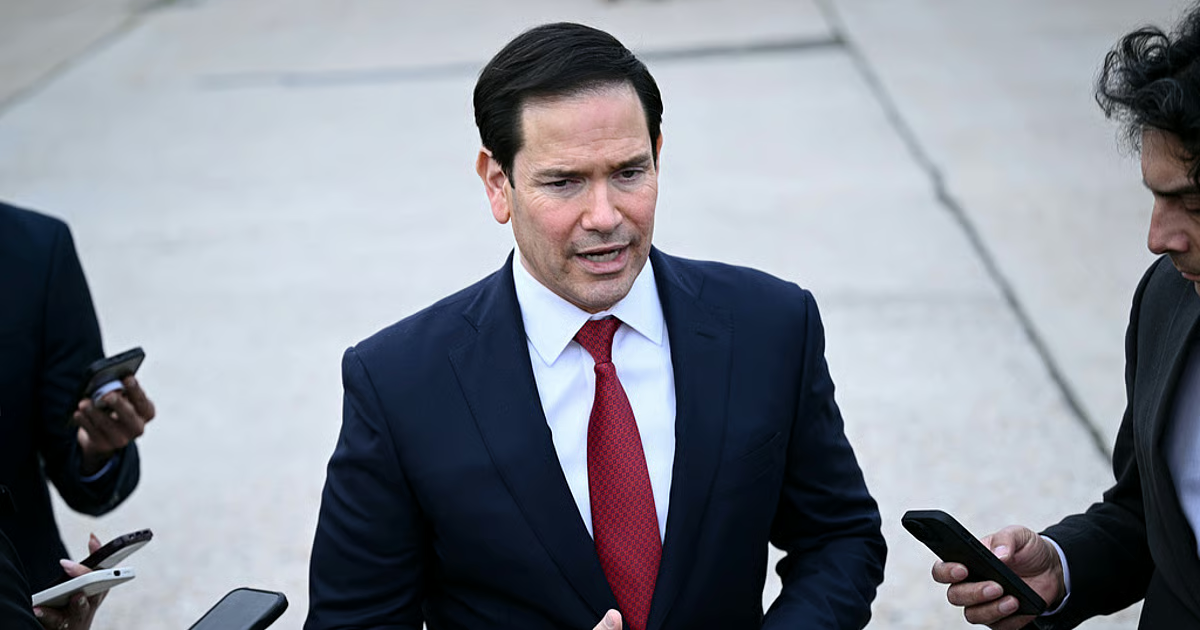
US Secretary of State Marco Rubio delivered sweeping remarks after the latest Group of Seven foreign ministers’ meeting in France, criticising both Iran’s reported plans for the Strait of Hormuz and the rising violence by Israeli settlers in the occupied West Bank.
Speaking to reporters from an airport tarmac on Friday, Rubio said Iran’s reported intention to introduce a tolling system in the Strait of Hormuz was illegal, dangerous and unacceptable. He used the issue to renew calls for a broader international effort to secure the strategic waterway, saying the United States was ready to take part, even if it did not lead such a mission.
Rubio said countries in the G7 — including Japan, Canada, France, the United Kingdom, Italy, Germany and the European Union — as well as nations in Asia, should make a stronger contribution to protecting the shipping lane.
Hormuz at the Centre of Global Concern
The Strait of Hormuz remains one of the most important routes for the movement of oil and natural gas. Before the US-Israel war on Iran began on February 28, around 20 million barrels of oil passed through the waterway each day, accounting for about one-fifth of the world’s liquid petroleum supply.
Since the war began, Iran has repeatedly threatened to close the strait, which runs along its coastline. The threat of attacks has already sharply slowed tanker traffic, although some ships, particularly those linked to Iran or China, have still been able to move through.
According to media reports cited in the article, Iran is preparing a system that would require ships to submit requests through the Islamic Revolutionary Guard Corps before passing, and to pay a fee for that access. Rubio said such a move could not be accepted under international and maritime law.
He said he had warned his G7 counterparts that the issue could not be ignored and insisted the world should be outraged if Iran attempts to make the arrangement permanent.
Limited Allied Support for Washington
Rubio’s remarks come as the Trump administration continues trying to persuade allies to support its campaign against Iran. Legal experts have criticised the original strikes on Iran as an unprovoked act of aggression, while the US government has defended the attacks using a range of justifications, including concerns over Iran’s nuclear programme.
Many European allies have made clear that they are willing to take part only in defensive efforts rather than direct military operations. President Donald Trump has criticised some NATO allies over their reluctance to join the offensive.
After the G7 meeting, member states issued a statement calling for an immediate halt to attacks on civilians and civilian infrastructure. They also stressed the need to fully restore safe and toll-free navigation through the Strait of Hormuz. However, the statement stopped short of offering military resources or direct support for the US-Israeli campaign.
Rubio Says War Goals Are on Track
With the war approaching its one-month mark on Saturday, Rubio repeated Trump’s assessment that the campaign was progressing according to plan. He said the United States was on course to meet key objectives, including the destruction of Iran’s navy, missile stockpiles and uranium enrichment programme.
He also argued that those goals could be achieved without deploying US ground troops, addressing one of the major fears surrounding the conflict.
Concern Over Rising Settler Violence
Rubio also touched on the growing wave of violence carried out by Israeli settlers against Palestinians in the occupied West Bank. Recent footage has shown settlers setting fire to Palestinian homes and vehicles and attacking residents.
The United Nations said on March 19 that more than 1,000 Palestinians had been killed in the West Bank since Israel launched its war in Gaza in October 2023, with about a quarter of those killed being young people.
Asked about the settler attacks, Rubio said the United States was concerned and had raised the issue. He added that there also appeared to be concern inside the Israeli government. Rubio suggested Israeli authorities might act against those responsible, saying some of the people involved had also attacked Israeli security forces.
Still, critics argue that Israeli authorities have largely failed to stop settler violence. The article also notes that when Trump returned to office in January 2025, he moved to cancel sanctions previously imposed on Israeli settlers accused of serious abuses in the West Bank.