

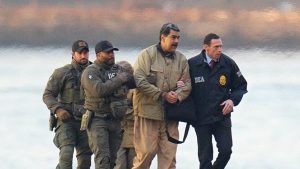
Venezuelan President Nicolás Maduro stood before a crowded federal courtroom in New York City on Monday, vehemently declaring his innocence and claiming he had been “kidnapped” in what he described as a brazen and unlawful U.S. operation. This marked his first public comments since U.S. forces seized him and his wife in Caracas on Saturday.
Maduro and his wife, Cilia Flores, appeared handcuffed and dressed in blue jail uniforms before U.S. District Judge Alvin K. Hellerstein. Both defendants wore headsets to follow the English-language proceedings translated into Spanish. Maduro entered a not guilty plea to charges including alleged “narcoterrorism” and other federal offenses, asserting his version of events directly to the court.
“I was kidnapped. I am innocent and a decent man, the president of my country,” Maduro told the judge during the brief arraignment.
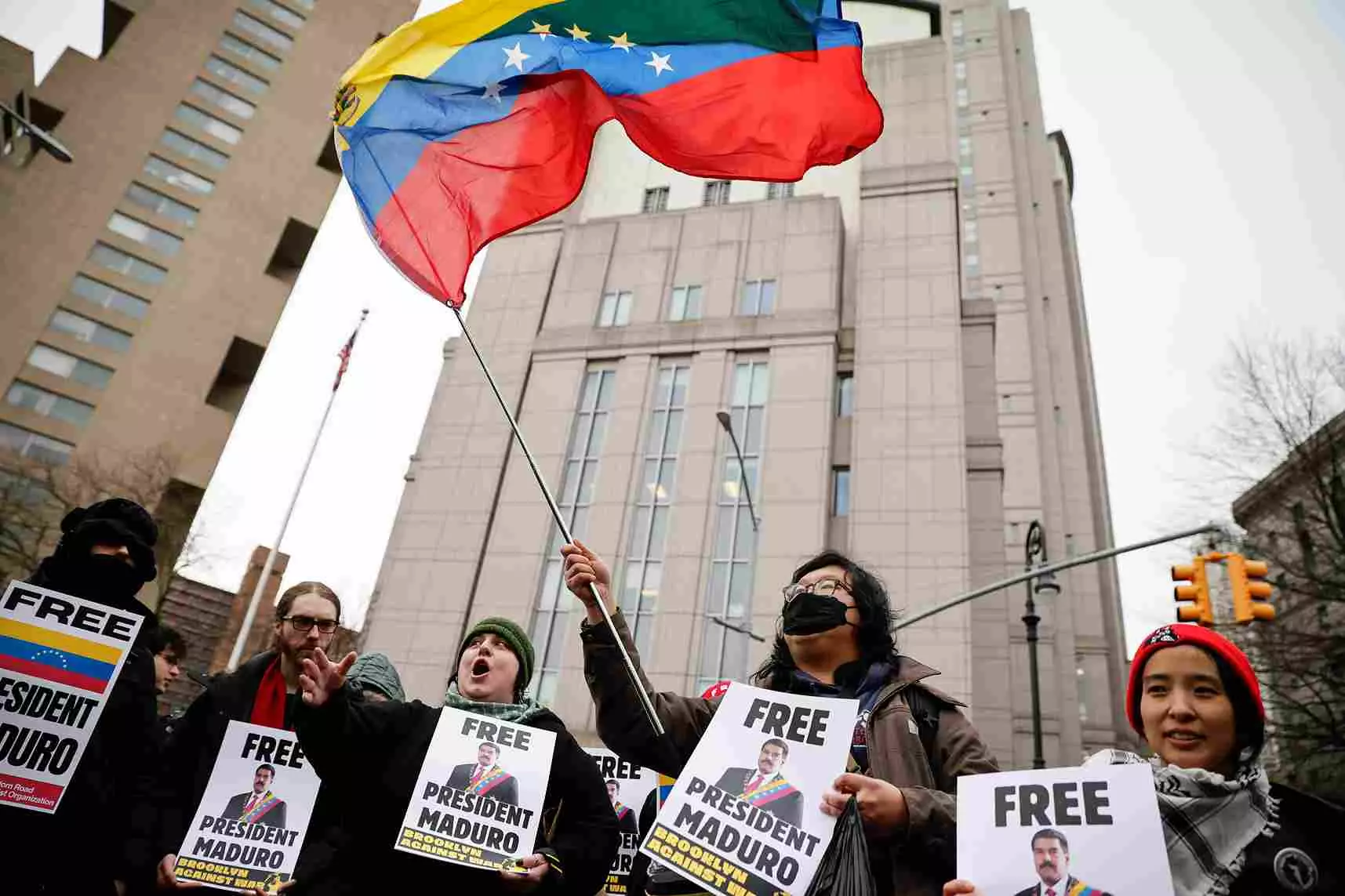
Meanwhile, outside the courthouse, clashes unfolded between small groups of protesters — some condemning U.S. intervention and others backing it — highlighting the deep divisions surrounding the case.
Charges and Legal Battle Ahead
If convicted, Maduro, his wife, son, and three additional defendants could face life sentences on accusations of conspiring with drug trafficking organizations to facilitate the shipment of large quantities of cocaine. Critics and some international observers have noted a lack of clear evidence directly tying Maduro to cartel operations.
Maduro’s legal team plans to challenge the legitimacy of his arrest, contending that as a sitting head of state he is protected by sovereign immunity — a claim complicated by the fact that the U.S. does not recognize his leadership. Flores also pleaded not guilty during the hearing. Judge Hellerstein scheduled another court appearance for March 17.
International Law and Global Reaction
At the United Nations Security Council earlier on Monday, Secretary-General António Guterres voiced serious concerns that Washington’s actions violated international law, emphasizing that the U.N. Charter prohibits the use of force against a nation’s sovereignty. Venezuela’s U.N. ambassador, Samuel Moncada, labeled the U.S. operation a military assault, asserting it involved bombing, civilian infrastructure damage, and the illegal “kidnapping” of Maduro and his wife. He warned that such a precedent endangers all nations.
Allies of Venezuela, including Russia and China, strongly condemned the seizure. Some U.S. partners, such as France and Colombia, expressed unease, asserting that the incident undercuts established legal norms.
In contrast, U.S. Ambassador to the United Nations Mike Waltz defended the action as a lawful law enforcement operation. He described Maduro as a narcotrafficker responsible for attacks on U.S. citizens, regional instability, and suppression of the Venezuelan people.
Venezuela’s Leadership Shake-Up and Domestic Response
Following Maduro’s removal, Vice President Delcy Rodríguez was sworn in as interim president. Despite initially condemning the U.S. operation, Rodríguez later indicated a willingness to “collaborate” with Washington — a shift that surprised some observers.
The political landscape in Venezuela remains deeply fractured. While some in the opposition welcomed Maduro’s ouster, they criticized U.S. assertions of control over Venezuelan affairs. “We are not a colony of the U.S.,” said political analyst José Manuel Puente, advocating for a democratic transition independent of external influence.
Back home, Venezuela’s National Assembly convened with members shouting support for Maduro and decrying the U.S. as acting like “judge and policeman of the world.” Lawmakers vowed to mobilize solidarity to ensure Maduro’s eventual return.
Public Demonstrations and Military Loyalty
On Sunday, thousands of Maduro supporters rallied in Caracas, some brandishing weapons on motorcycles in a show of force. The Venezuelan military — maintaining loyalty to Maduro — acknowledged Rodríguez as interim president while urging calm.
The White House has maintained that U.S. intentions are not to enact regime change but to remove Maduro and encourage a government open to economic cooperation, particularly in exploiting Venezuela’s vast oil reserves.

Mitra77 : Daftar Situs Slot Gacor Pragmatic Play Gampang Menang 2026

ByJennifer Lopez
IWCP.net – Shorts – Isle of Wight Candy Press – An alternative view of Isle of Wight news.