


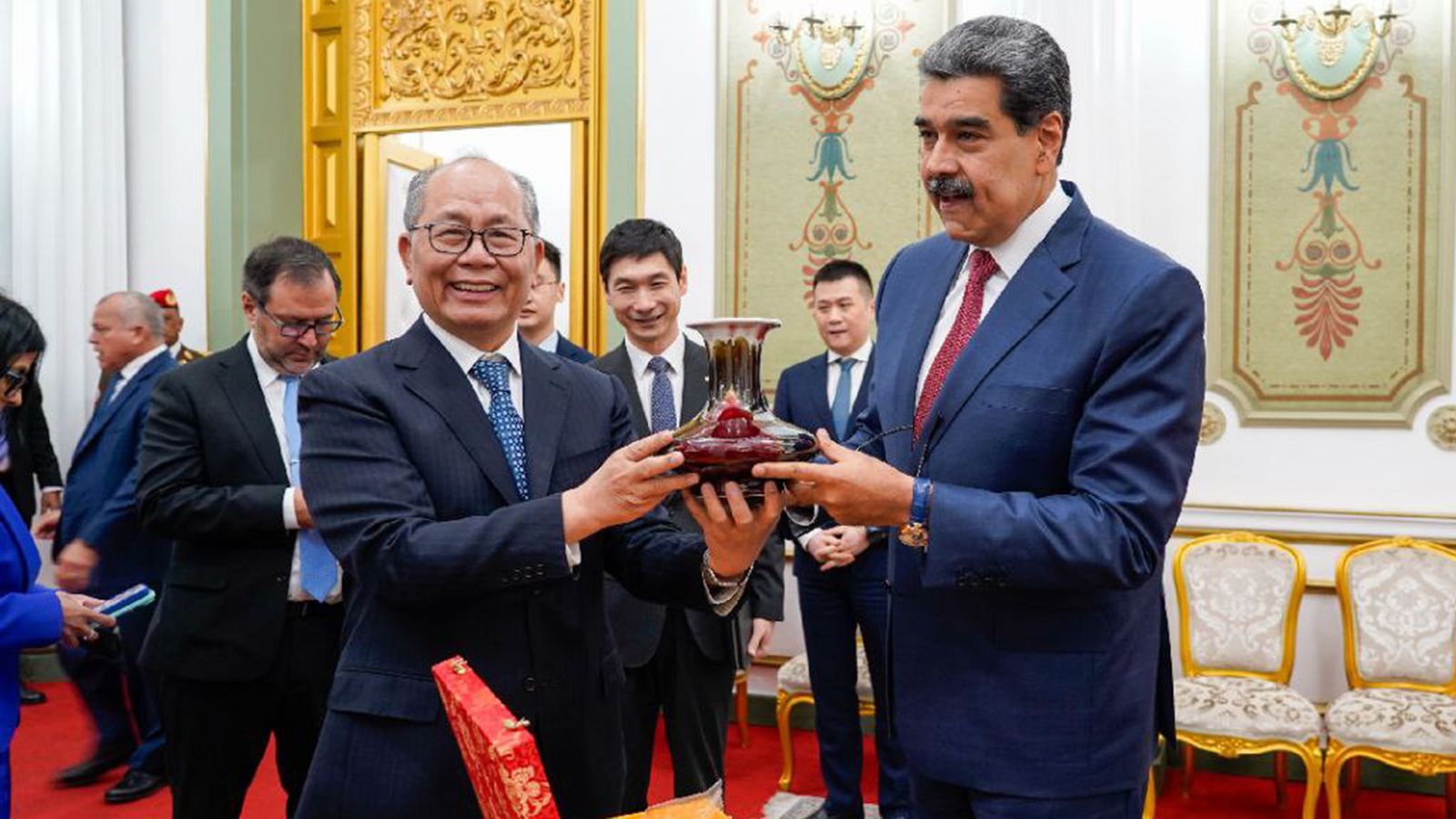
While US Army Delta Force units were reportedly completing the final blueprint for a covert night mission inside Caracas, President Nicolás Maduro was still smiling inside Miraflores Palace. He had just wrapped up a warm photo session with China most senior diplomat for Latin America, praising Beijing and its leader.
“I thank President Xi Jinping for his brotherhood—like a protective older brother,” Maduro said to Qiu Xiaoqi, prompting laughter from both sides during their palace exchange.
The friendly atmosphere vanished before sunrise. In a dramatic twist, elite US commandos entered Caracas under the cover of night and detained the Venezuelan president directly from his private bedroom. The operation, attributed to the United States’ highest military special-unit tier, immediately shook Beijing, which for decades had considered Caracas one of its firmest ideological and economic allies.
A Long-Forged Strategic Bond
China and Venezuela’s partnership has roots stretching back decades, built on political alignment, shared suspicion toward US global dominance, and expanding economic cooperation.
In 2023, both governments formalized an “all-weather strategic partnership,” tightening diplomatic support, financial aid, and trade flow. Venezuela also became one of the most financed nations under Chinese overseas lending, especially across infrastructure, telecommunications, and national energy facilities.
Venezuelan crude oil shipments have increasingly flowed to China since 2019, when the Trump administration introduced sanctions. Market intelligence reports from late 2025 suggested that China may have absorbed the vast majority of Venezuela’s limited oil exports, often purchased at heavy discounts by independent Chinese refiners known informally as “teapot” refineries.
Beijing’s preferential position is now uncertain. US officials have signaled that China may still buy Venezuelan crude—but likely without the deep price cuts that once made it appealing.
Beijing Condemns, But Chinese Social Platforms Ignite
China’s government quickly denounced Maduro’s capture, accusing Washington of acting like a global enforcer rather than respecting national sovereignty.
But online reactions told a different story. On Weibo, conversations tied to the detention surpassed 650 million views, dominated by nationalist-leaning speculation. Many users celebrated the mission’s boldness, framing it as evidence that powerful nations can reshape geopolitics through direct action.
A surge of commenters then steered the debate toward Taiwan. The logic repeated across threads: If the US can capture a leader near its borders, why can’t China do the same in its own claimed region?
Taiwan Rejects the Comparison
Officials and lawmakers in Taipei were quick to dismiss the parallel.
“China is not the United States, and Taiwan is not Venezuela,” said legislator Wang Ting-yu, a senior member of Taiwan’s Foreign Affairs and Defense Committee. He argued that Beijing does not lack hostility—only the practical capability to carry out such an operation.
Analysts largely agree. William Yang from International Crisis Group said the US mission is unlikely to change China’s invasion timeline or military calculus. Instead, Beijing’s next steps will continue to be shaped by economic conditions, PLA readiness, Taiwan’s domestic politics, and US–China policy tension.
However, he cautioned that the event may reflect a broader shift: nations using military power to influence foreign policy could become increasingly normalized.
China’s Influence in South America Still Deep
Despite losing a key political partner, Beijing is expected to protect its economic foothold in Latin America—especially in telecommunications and power infrastructure, where removing Chinese companies too fast could trigger instability.
Consultants at Eurasia Group also believe China will likely focus on damage control over its investments, not direct escalation with the US in the region.
A New Regional Turning Point
With Maduro out of power for now, Washington regains the spotlight in what China and US officials alike have described informally as a geopolitical tug-of-war in the Western Hemisphere.
Energy investors say the raid itself may not disrupt China’s oil supply significantly due to Venezuela’s reduced output. But politically, the impact is loud: Caracas was once a symbol of China’s reach in Latin America. Now it becomes a symbol of how fast influence can flip.