


At the beginning of the year, Pakistan had more imported liquefied natural gas than it could use. Demand had been falling for three years, driven by the spread of cheap solar power and lower industrial consumption, leaving the country with excess cargoes, underused infrastructure and mounting financial pressure. That situation changed dramatically after war broke out. On February 28, the United States and Israel launched a large-scale assault on Iran in an operation named Epic Fury. The attacks targeted missiles, air defences, military sites and senior leadership. Iranian Supreme Leader Ali Khamenei was killed in the opening phase.
Iran responded with missile and drone attacks across the region. One immediate consequence was the near paralysis of traffic through the Strait of Hormuz, the narrow but critical waterway that carries about one-fifth of the world’s oil and gas supply.
For Pakistan, the impact was swift and severe. A country that had recently been struggling with too much imported gas suddenly found itself facing the risk of major shortages.
Regional Strikes Shake Gas Supply
The energy crisis deepened on March 2, when Iranian drones struck Qatar’s gas facilities at Ras Laffan Industrial City, the world’s largest LNG export hub. Qatar, the second-largest LNG exporter after the United States, halted production and invoked force majeure, meaning it was no longer bound by delivery commitments because of extraordinary circumstances.
The conflict escalated again on March 18, when Israel attacked Iran’s South Pars gas field, the largest in the world. South Pars and Qatar’s North Field sit above the same underground reservoir, meaning the attack threatened the gas output of both countries at once. Iran then launched another strike on Ras Laffan in retaliation.
QatarEnergy said the latest damage forced it to reduce LNG output by 17 percent, with repairs expected to take up to five years.
The shock rippled quickly across global energy markets. Oil prices climbed above $109 a barrel, while European gas prices jumped 6 percent in a single day.
Pakistan’s Import-Heavy Gas System
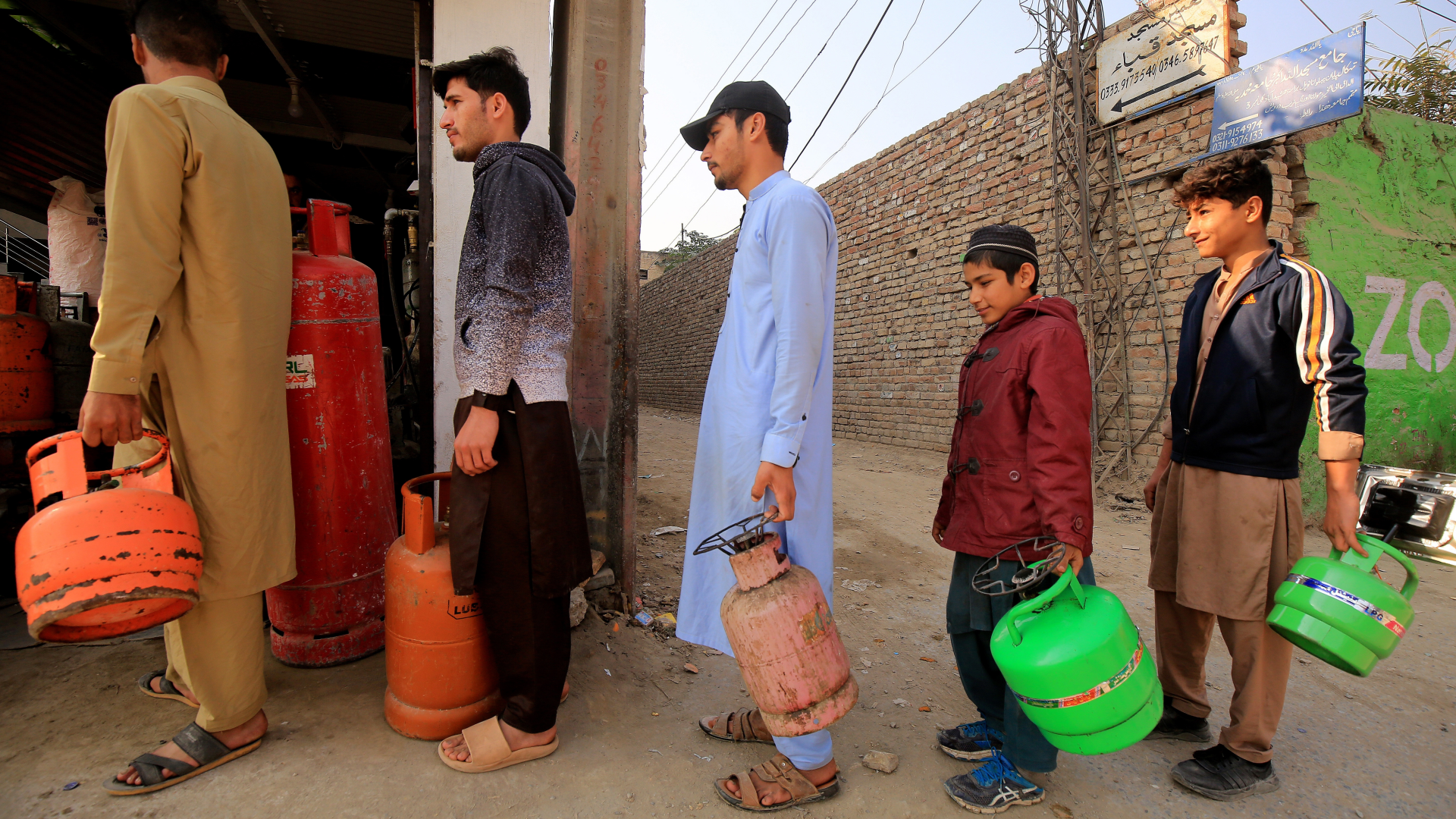
Pakistan meets its gas needs through three main sources. Most of its supply comes from domestic gas fields, though output from those fields has been declining for years. Imported LNG, mainly from Qatar, provides another important share, while bottled LPG serves many rural households outside the pipeline network.
More than 60 percent of Pakistan’s LPG also comes from Iran, making that supply vulnerable as well.
Since 2015, imported LNG has played a major role in Pakistan’s energy system, especially after domestic production could no longer meet demand. Today, LNG is used to generate about a quarter of the country’s electricity, with the power sector as its biggest consumer.
According to energy analytics firm Kpler, Qatar and the United Arab Emirates account for 99 percent of Pakistan’s LNG imports. Most of that supply is tied to long-term state-to-state deals with Qatar covering nine shipments each month.
From Oversupply to Sudden Shortage
The scale of the change can be seen in Pakistan’s monthly cargo data. Throughout 2025 and early 2026, the country was receiving between eight and 12 LNG shipments a month. In January alone, 12 shipments arrived. But in March, after the war began, only two cargoes reached Pakistan.
Prices also moved sharply higher. In mid-February, Pakistan’s state energy entities secured eight cargoes at an average price of $10.47 per MMBtu. By March 12, the two cargoes that did arrive cost $12.49 per MMBtu, an increase of 19 percent in just one month.
This came on top of an existing decline in domestic gas use. Pakistan’s share of Asia’s LNG market had already dropped significantly as solar power spread rapidly across the country. Millions of households and businesses had turned to rooftop solar because of high electricity costs and repeated blackouts.
By 2025, Pakistan had installed 34 gigawatts of solar capacity, with around 25 gigawatts feeding into the national grid. Overall grid electricity demand fell by almost 11 percent between 2022 and 2025.
That left LNG-based power plants running well below capacity, especially during daylight hours.
Contracts Became a Financial Burden
Analysts say Pakistan’s gas glut was not unexpected. Long-term LNG contracts forced the country to continue buying imported gas even as actual demand weakened. At the same time, the speed of solar growth and falling grid demand were not fully reflected in official planning.
As consumption dropped, excess gas had to be pushed into domestic networks at a financial loss because Pakistan lacked large storage facilities.
The result was a worsening circular debt crisis in the gas sector, which has now reached 3.3 trillion rupees, or about $11bn. By January, the government was already trying to offload 177 unwanted future gas shipments through 2031, representing a liability of $5.6bn.
Energy analysts say the government’s earlier efforts to redirect extra LNG cargoes were more of a short-term emergency response than a long-term solution. They argue that Pakistan’s heavy reliance on rigid contracts has become a major weakness in an energy market that increasingly rewards flexibility and lower-cost power sources.
Supply Shock and Summer Risk
Since March 2, Qatar’s LNG deliveries to Pakistan have nearly stopped. Of the eight cargoes scheduled for March, only two arrived, and the six planned for April are not expected to reach the country.
At a public regulatory hearing, Pakistan’s power purchasing chief said LNG supplies were under force majeure, although coal imports from South Africa and Indonesia had not been affected.
Officials have warned that LNG availability could remain near zero in the coming months, even if the war ends soon. Because LNG accounts for more than 21 percent of Pakistan’s electricity generation, the loss of supply has serious implications for the country’s power system.
The government has responded by restarting domestic gas production that had earlier been deliberately reduced during the oversupply period. Analysts say Pakistan had been holding back around 350 to 400 million cubic feet per day of domestic gas to make room for LNG imports.
Other alternatives include hydropower and imported coal, but experts warn these may still not be enough to fully replace the lost LNG volumes.
Relief for Now, But Harder Months Ahead
So far, Pakistan has avoided a prolonged power emergency thanks to mild weather and strong solar output. Winter electricity demand has remained relatively low, while solar panels have been contributing between 9,000 and 10,000 megawatts per day, reducing pressure on the national grid.
But summer is expected to be more difficult.
Last summer, peak electricity demand surpassed 33,000 megawatts. If temperatures rise sharply again, the country may struggle to fill the gap left by missing LNG cargoes.
Furnace oil, the main backup fuel, has become far more expensive, with costs now around 35 rupees per unit after more than doubling since disruptions in the Strait of Hormuz.
Analysts say the burden will not be shared evenly. Households that depend on the grid are likely to face both higher bills and scheduled outages. Industries using gas may also see production disruptions. Those with rooftop solar panels and battery storage are expected to be far better protected.
For the government, the options are narrowing. Returning to the spot LNG market may be financially unrealistic, while furnace oil is seen as too costly for sustained use.
That leaves one likely outcome if supply conditions do not improve: regular planned blackouts during the summer months.