


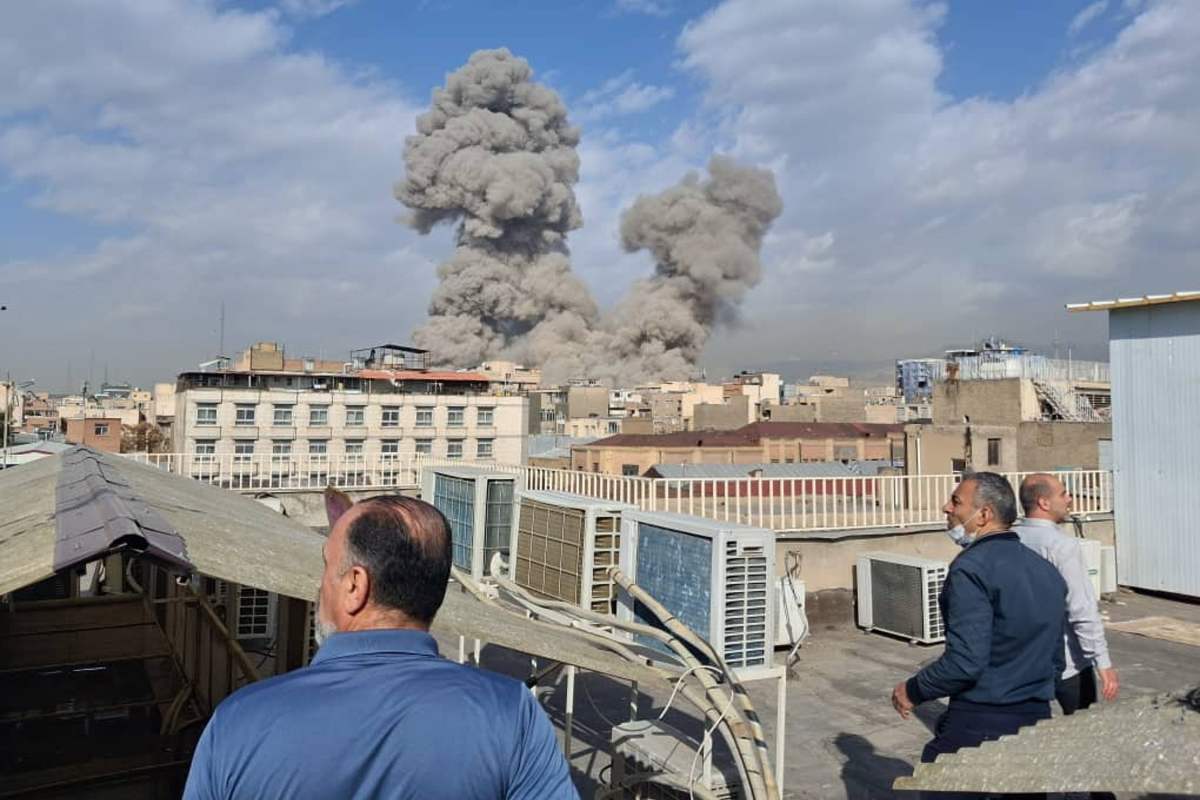
Large-scale air strikes by the United States and Israel continued to pound Tehran and several other Iran cities, as Iran’s ruling establishment weighed its next steps while firing missiles and drones across the region.
On Sunday, repeated explosions shook the Iranian capital after a fresh wave of attacks struck several neighbourhoods. The Israeli military said some of the targets included military facilities. Iranian authorities, however, gave little public detail about where missiles landed, while internet access remained heavily disrupted for a second consecutive day.
The widening conflict comes after Supreme Leader Ayatollah Ali Khamenei and several senior military commanders were killed in Tehran at the beginning of the war on Saturday. Despite the unprecedented blow, the remaining leadership has moved quickly to project stability, insisting that the Islamic Republic has a defined constitutional process to ensure continuity.
Leadership Transition Begins After Khamenei’s Killing
Under legal mechanisms established after Iran’s 1979 Islamic Revolution, the Assembly of Experts — a clerical body — is responsible for choosing the next supreme leader.
President Masoud Pezeshkian said a new leadership council had already “begun its work” following Khamenei’s death. Foreign Minister Abbas Araghchi also told Al Jazeera that the transition process could be completed within days.
Until a new supreme leader is selected, a three-member council will oversee governance.
As part of that interim leadership structure, judiciary chief Gholam-Hossein Mohseni-Ejei and President Pezeshkian have both pledged that the state will continue functioning without interruption. In his first televised message on Sunday, Pezeshkian urged supporters of the establishment to gather in mosques and on major streets in cities across the country despite the ongoing war.
The third member of the temporary council was announced on Sunday as Ayatollah Alireza Arafi, a cleric linked to the influential Guardian Council. The Expediency Council, an arbitration body within the Iranian system, was assigned the role of selecting the jurisprudence expert for the new council.
IRGC Expected to Remain Central to Power Structure
The Islamic Revolutionary Guard Corps (IRGC), founded after the 1979 revolution and now one of the country’s most powerful military and economic institutions, is expected to remain a decisive force.
Mohammad Pakpour, who had been appointed IRGC commander-in-chief less than a year ago after his predecessor was killed during the 12-day war with Israel, was among those killed on Saturday. Also reported killed were armed forces chief of staff Abdolrahim Mousavi, Defence Council chief Ali Shamkhani, and police intelligence chief Gholam-Reza Rezaeian.
In response, the IRGC vowed retaliation and announced what it described as “the heaviest offensive operations in the history of the armed forces of the Islamic Republic” against Israel and American military positions in the region.
Army chief Amir Hatami also said the military would continue to defend the country. The army claimed its fighter jets had carried out strikes on US bases across the region, although it did not release visual evidence.
Police chief Ahmad-Reza Radan said security forces were prepared to maintain “public safety,” as both Washington and Tel Aviv openly encouraged Iranians to take to the streets in the coming period with the aim of challenging the state.
Senior Officials Push Unity While Warning Neighbours
Ali Larijani, a senior political and security figure within Iran’s power structure, endorsed the constitutional process for choosing future leadership while also addressing countries affected by incoming Iranian missiles and drones.
In a post written in Arabic on X, Larijani said Iran did not seek to attack neighbouring states, but argued that US military bases inside those countries should be treated as “American territory.” In a separate message posted in English, he wrote in capital letters: “TODAY WE WILL HIT THEM WITH A FORCE THAT THEY HAVE NEVER EXPERIENCED BEFORE”.
Ali Akbar Ahmadian, a senior IRGC commander and former security chief who had served as Khamenei’s representative to the Supreme Defence Council, said the council would continue operating despite the deaths of several of its leading members, including Shamkhani. That body had been created after the war with Israel last June to strengthen defence planning after Iran suffered severe damage to nuclear and military sites from Israeli and US strikes.
Influential Figures Rally Around the System
Hassan Khomeini, grandson of Iran’s founding Supreme Leader Ayatollah Ruhollah Khomeini, praised the slain Khamenei, calling him a “hero of the Iranian people and Muslims around the world”.
Though some Western media outlets have named Hassan Khomeini as a possible future supreme leader, he did not address that speculation directly. Instead, on Sunday he stressed that defending the “holy establishment of the Islamic Republic” must remain the highest priority.
Former President Hassan Rouhani, who last week rejected suggestions that he was involved in a power struggle during January’s nationwide protests, said he now backs the temporary council, the armed forces, and the government in order to preserve the system.
Former President Mohammad Khatami also condemned Khamenei’s killing, calling it an attack on Iran’s “independence and unity.” At the same time, he repeated earlier calls for reform, saying such changes could frustrate the country’s adversaries.
Conflicting Reports Surround Ahmadinejad
Confusion also emerged over the fate of former President Mahmoud Ahmadinejad. Some local reports said the former leader, who served from 2005 to 2013, had been killed along with several bodyguards in an Israeli strike.
However, the state-linked Iranian Labour News Agency denied those reports on Sunday, citing an informed source, though it offered no further details.
Several videos circulating after Saturday’s attacks on 72 Square in Tehran’s eastern Narmak district appeared to show the area near Ahmadinejad’s residence had been hit. A nearby school was also damaged, and local authorities said at least two children were killed there.
In a separate incident, officials said another school in the southern city of Minab was struck, killing more than 150 people, many of them children.
Uncertainty Ahead Despite Public Displays of Control
With US and Israeli officials saying strikes on Iran could continue for days or even weeks, involving hundreds of warplanes aimed at state and military targets, questions remain about where real power now sits within Iran.
For the moment, Iran’s leadership appears publicly united in mourning Khamenei, who ruled without serious internal challenge for 36 years.
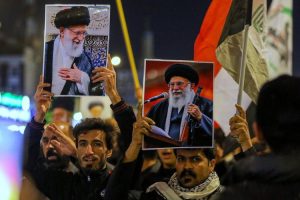
The government has declared seven days of public holidays and 40 days of national mourning. Authorities have also organised mass gatherings in honour of Khamenei, including major commemorations held on Sunday night.