


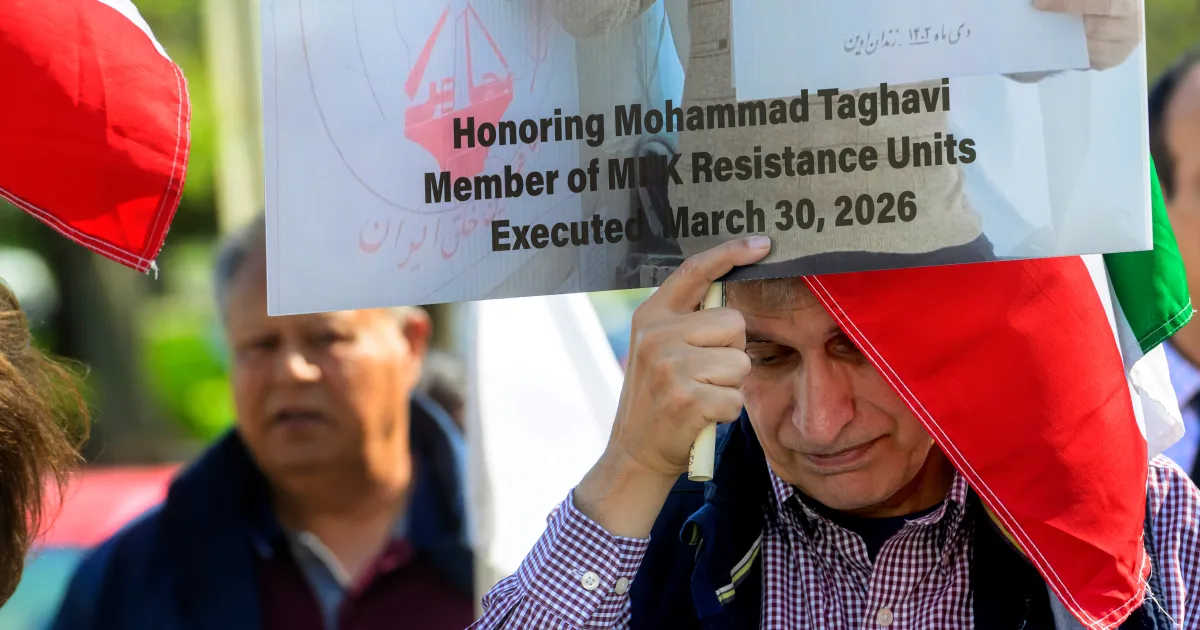
Iran has executed two men convicted of belonging to the banned People’s Mojahedin Organization of Iran, also known as PMOI/MEK, in the latest action against political dissidents as the US-Israeli war on Iran continues.
The executions were carried out on Saturday morning after Iran’s Supreme Court upheld earlier rulings that found the two men guilty of membership in PMOI/MEK and of armed rebellion linked to multiple acts described by authorities as terrorism.
Iran’s judiciary news outlet, Mizan Online, said Abolhassan Montazer and Vahid Baniamerian were hanged after trial and after their sentences were confirmed by the Supreme Court.
PMOI/MEK originally supported the 1979 Islamic Revolution that toppled Iran’s monarchy. However, the group later broke with the new leadership in Tehran during the 1980s and was subsequently designated a terrorist organisation by Iranian authorities. Since then, it has operated in exile.
More Executions Linked to the Same Group
The latest hangings come only days after four other men convicted in connection with the same opposition group were executed on March 30 and 31. According to information published on the PMOI/MEK website, those men were Mohammad Taghavi, Akbar Daneshvarkar, Babak Alipour and Pouya Ghobadi.
The group said all six men had been arrested and convicted by a Revolutionary Court in late 2024.
PMOI/MEK Condemns the Hangings
In a statement issued on April 2, PMOI/MEK condemned the executions and described them as a failed attempt by Tehran to silence opposition voices.
The group said the killings would not suppress resistance, but instead would strengthen the determination of young opponents of the government.
Rights Groups Raise Alarm
Human rights organisations have also sharply criticised the executions. Activists have long accused Iran of being one of the world’s most prolific users of the death penalty.
After the earlier executions on March 31, Amnesty International said Iranian authorities had tortured the men while they were in prison and then transferred them suddenly to an unknown location shortly before they were put to death.
Amnesty also warned that more executions may be imminent, including in cases involving protesters detained during mass anti-government demonstrations in January, when thousands of people were killed.
Diana Eltahawy, Amnesty International’s deputy regional director for the Middle East and North Africa, said it was deeply disturbing that Iranian authorities were continuing to use the death penalty to crush dissent even as the country was already suffering from war, widespread grief and continued aerial attacks by Israel and the United States.
Executions Continue During Wartime
Since the war began on February 28, Iranian authorities have executed several more people. Among them was Kouroush Keyvani, a dual Iranian-Swedish national convicted of spying for Israel, a case that drew strong criticism from Sweden and the European Union.
Another man convicted of working on behalf of Israel and the United States during the protests was also executed on Thursday.
Earlier, on March 19, four others identified as Saleh Mohammadi, Mehdi Ghasemi and Saeed Davoudi were also killed after being arrested in connection with the uprising.
Amnesty has warned that five more young protesters who were previously sentenced to death may soon face execution after being moved this week from Ghezel Hesar prison to an undisclosed location.
Pressure Builds Over Iran’s Use of the Death Penalty
The latest executions are likely to intensify concern over Iran’s continued use of capital punishment during a period of war and internal unrest. Rights advocates say the pattern suggests a broader attempt to silence critics and intimidate the population at a time of heightened instability.