


Israeli forces deployed tanks, drones and specialised explosive devices to recover the remains of a single Israeli captive in Gaza, an operation that local witnesses say transformed a residential area into a tightly sealed military zone and left multiple civilians dead.
The mission focused on the recovery of Ran Gvili, an Israeli police officer killed more than two years ago and believed to be the last Israeli captive whose remains were still in Gaza. His body was retrieved on Monday in an operation praised by Israeli Prime Minister Benjamin Netanyahu as a demonstration of national resolve.
Yet only metres from where Gvili’s remains were carefully recovered, a very different reality persists. Palestinian officials say more than 10,000 Palestinians remain buried beneath collapsed buildings across Gaza, unrecovered and unidentified.
Thousands Still Missing Under Rubble
According to Gaza’s National Committee for Missing Persons, entire families continue to wait for news of relatives presumed dead but never recovered. Unlike the resources mobilised to retrieve Israeli captives, there are no heavy machines, forensic teams or international missions dedicated to locating Palestinian victims.
Their deaths, families say, often pass without public attention or formal recognition.
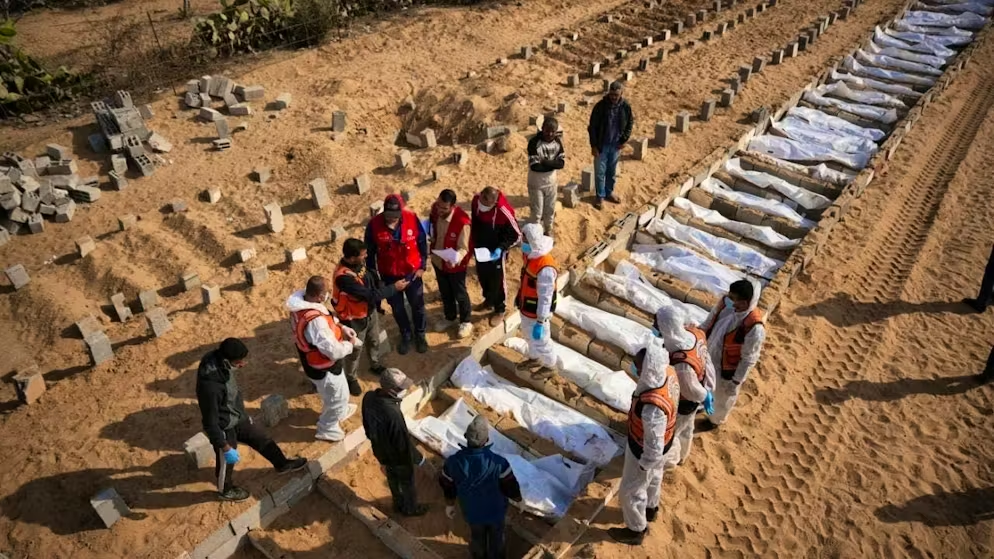
The excavation of the al-Batsh cemetery in Gaza City’s Tuffah neighbourhood has become a powerful symbol of this imbalance, highlighting what many Palestinians describe as a double standard in how lives and deaths are treated during the war.
A Sealed Military Zone
Journalist Khamis al-Rifi, who reported from near the operation, described intense military activity surrounding the cemetery.
He said the area was isolated with air strikes, artillery fire and armoured vehicles, making it impossible for civilians to approach. From near the so-called “Yellow Line” buffer zone inside Gaza, al-Rifi said the military created what he described as a “wall of fire” to protect engineering units working inside the perimeter.
Over the course of two days, the ground was extensively excavated. About 200 graves were disturbed, according to al-Rifi, as forces searched for the Israeli captive’s remains.
Aftermath and Unequal Treatment
Once Gvili’s body was identified, it was transported to Israel for burial. Palestinian bodies disturbed during the operation, however, were left behind.
“When people returned after the withdrawal, they found bodies placed back randomly and covered with sand,” al-Rifi said, adding that some remains were still visible.
Palestinian officials say this contrast reflects a broader reality of the war: while Israel uses satellite data and DNA analysis to recover its dead, Palestinians lack even basic equipment to dig through debris.
Gaza Described as ‘World’s Largest Graveyard’
Alaa al-Din al-Aklouk, spokesperson for the National Committee for Missing Persons, has previously described Gaza as “the world’s largest graveyard,” saying thousands are buried beneath their homes without identification or dignity.
He has criticised international restrictions that limit the entry of heavy civil defence equipment, arguing that while resources are mobilised to recover Israeli captives, Palestinians are denied the means to retrieve their own dead.
Mustafa Barghouti, secretary-general of the Palestinian National Initiative, said the contrast is impossible to ignore.
“Every family has the right to bury its dead,” he said. “But the lack of equal treatment and respect for Palestinian lives is striking.”
New Deaths Amid Recovery Operation
The operation itself led to further loss of life. On Tuesday morning, Israeli fire struck the area again as residents approached the damaged cemetery, killing four people, according to local reports.
Among them was Youssef al-Rifi, a relative of the journalist, who had gone to inspect the site.
As Israel sought to close a painful chapter by recovering one captive’s remains, Palestinians say the episode underscores the wider human cost of the war — one in which thousands of deaths remain unresolved, unacknowledged and buried beneath the rubble of Gaza.