


At dawn in Khan Younis, 15-year-old Mahmoud begins his day long before the sun has fully risen. Instead of preparing for school, he lifts a worn burlap sack onto his shoulder and heads into the streets. Mahmoud is among hundreds of thousands displaced in Gaza. He sleeps in a crowded tent and spends his days collecting scraps of nylon, cardboard and wood — anything that can be burned to keep his family warm and bake bread.
“The sack feels heavy even when it’s empty,” he says, describing the strain on his back and hands, which are scarred from hauling debris through damaged neighbourhoods.
For hours, he searches through rubble left by Israeli bombardment. Dust fills the air, making it hard to breathe. Still, he persists.
“There is no fire without wood,” he says quietly.
Mahmoud’s father was killed in an Israeli air strike last year, one of more than 70,000 Palestinians killed since the war began in October 2023. As the eldest child, he now sees himself as responsible for supporting his mother and siblings.
If he gathers more fuel than his family needs, he sells the excess to buy bread.
An Education Interrupted
Mahmoud once excelled in school. He recalls enjoying mathematics and being among the top students in his class.
Now, when he spots his former teacher in the market, he avoids eye contact.
“I don’t want him to see me like this,” he says.
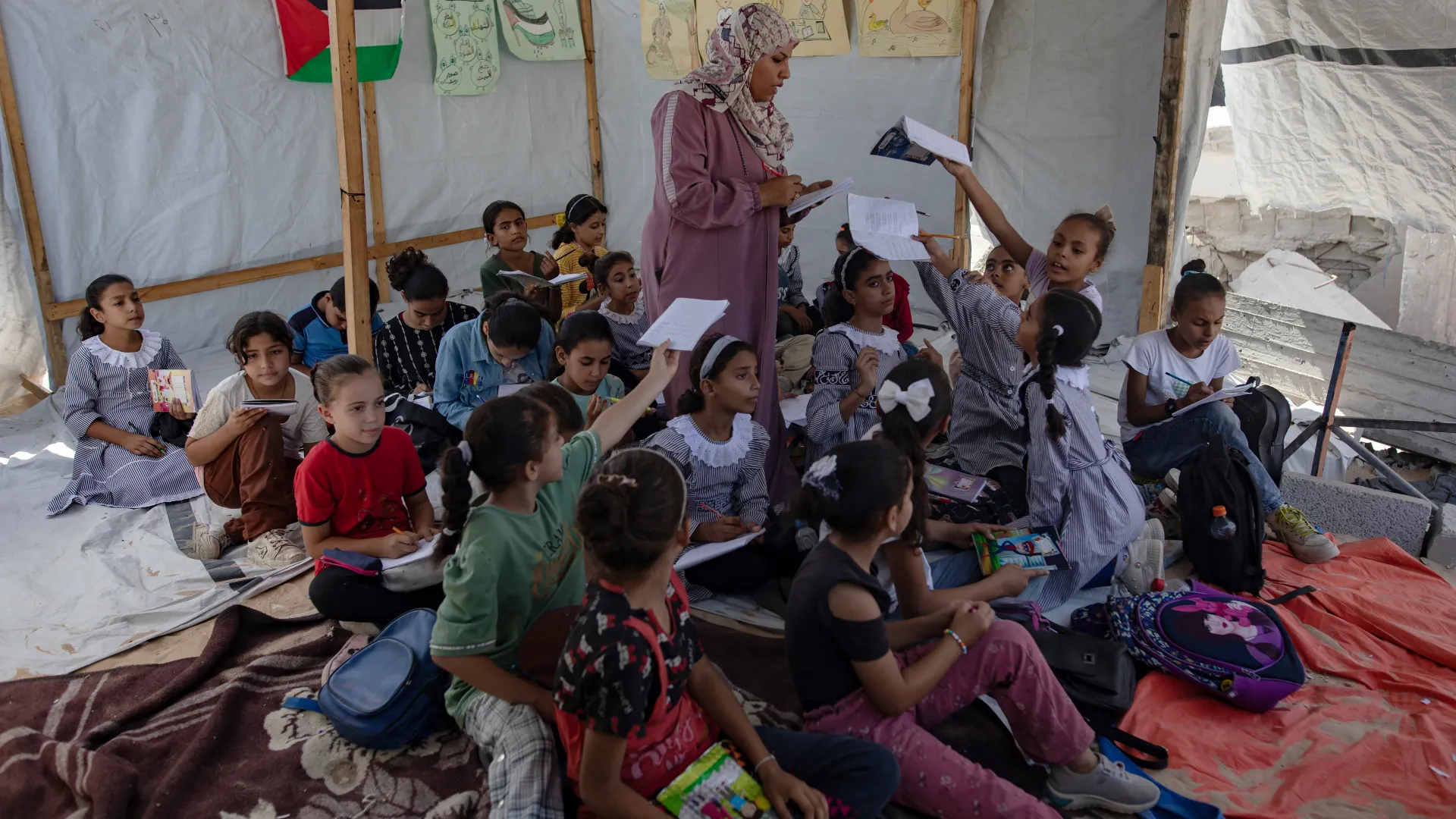
His story reflects the broader collapse of Gaza’s education system. According to the United Nations, more than 97 percent of schools in Gaza have been damaged or destroyed during the conflict. Approximately 658,000 school-age children have had limited access to in-person education for over two academic years.
Many school buildings that remain standing are being used as shelters for displaced families, making formal learning nearly impossible.
Economic Collapse Drives Child Labour
In November, the UN reported that Gaza’s economy had contracted by 83 percent compared with pre-war levels. With infrastructure devastated, electricity scarce and thousands of breadwinners killed, families are struggling to survive.
Although reliable figures are unavailable, residents report a visible increase in children working across the enclave.
“What we’re seeing is not simply child labour,” said Yaqeen Jamal, an educational psychologist working with children affected by the war. “It is the erosion of an entire generation’s future.”
She warned that the psychological toll, combined with disrupted education, could have lasting consequences.
“These children are carrying responsibilities far beyond their age,” she said. “If this continues, we risk widespread illiteracy and deep mental health challenges.”
Another Childhood Disrupted
Eleven-year-old Layla faces a similar reality. With her father unable to work due to a disability, she sells tea along al-Bahr Street in Khan Younis.
Balancing a tray of steaming cups covered in foil, she calls out to passersby, hoping to earn a few shekels.
Asked about her favourite colour, Layla smiles faintly. “Pink,” she says, recalling a pink bedroom and a doll she once cherished.
That room now lies buried under rubble.
“I wish the pink would come back,” she says softly before returning to her sales.
An Uncertain Future
Rebuilding Gaza’s infrastructure — including its schools — is expected to take years. Ongoing restrictions, the scale of destruction and fears of renewed fighting add to the uncertainty.
For now, children like Mahmoud and Layla continue to trade textbooks for survival work, their daily routines shaped by loss and economic hardship.
As the conflict drags on, the challenge facing Gaza is not only reconstruction of buildings but the preservation of a generation’s future.