


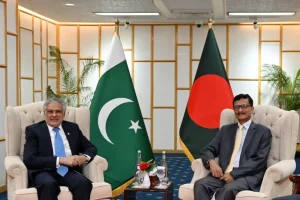
Pakistan’s Deputy Prime Minister Ishaq Dar has suggested that a new trilateral initiative between Pakistan, China, and Bangladesh could be broadened to include other regional states. Speaking at the Islamabad Conclave, he emphasized that Pakistan rejects “zero-sum approaches” and prefers cooperation over confrontation.
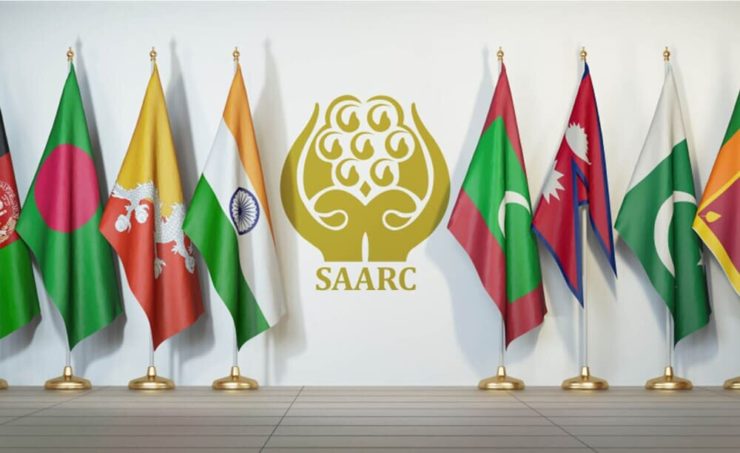
The proposal effectively hints at creating an alternative South Asian grouping—with China included—at a moment when the region’s main body, the South Asian Association for Regional Cooperation (SAARC), has been largely inactive due to tensions between India and Pakistan.
In June, diplomats from China, Pakistan, and Bangladesh held talks on regional stability and development, stressing that the cooperation was “not directed at any third party.” However, Dar’s comments come amid worsening regional relations, especially Pakistan’s rivalry with India, which recently escalated into a brief four-day air conflict. Bangladesh–India ties have also deteriorated following former Prime Minister Sheikh Hasina’s ouster and exile to India.
This raises a key question: will other South Asian countries—India, Pakistan, Bangladesh, Sri Lanka, Nepal, Maldives, Bhutan, and Afghanistan—join a new grouping that seems designed to limit India’s influence?
Pakistan’s Proposal Explained
Dar, who also serves as foreign minister, said the trilateral mechanism aims to boost cooperation in areas of mutual interest and could be replicated with additional countries. He argued that South Asia should not be restricted by any single country’s rigid stance — a clear reference to India.
He also noted that formal India–Pakistan dialogue has been frozen for more than a decade, and that other regional states have had their own disputes with New Delhi. Pakistan’s vision, he said, is a region where cooperation replaces division and disputes are resolved peacefully.
Academic Rabia Akhtar says the idea is “more aspirational than operational” for now, but it shows Pakistan’s desire to rethink regional cooperation while SAARC remains stalled.
What Is SAARC and Why Does It Matter?
Founded in 1985 with eight members, SAARC was meant to enhance welfare, economic growth, and cultural ties. But persistent India–Pakistan tensions have repeatedly blocked progress. The scheduled 2016 summit in Pakistan was indefinitely postponed after India withdrew, accusing Islamabad of supporting armed attacks in Kashmir.
Because SAARC requires consensus, analysts say it cannot advance without political willingness from both India and Pakistan. Despite limited successes, such as cooperation during the COVID-19 pandemic, the organization remains largely dormant.
South Asia has over two billion people, yet intra-regional trade is only about $23 billion — extremely low compared to ASEAN. Experts estimate that trade could triple if barriers were reduced. Key connectivity projects, such as a regional motor vehicle agreement in 2014, collapsed after Pakistan rejected them amid strained relations with India.
Will Pakistan’s New Bloc Gain Support?
According to Akhtar, Pakistan’s proposal will depend on two factors: whether countries find value in smaller, issue-focused partnerships, and whether joining would provoke political backlash from India.
Countries like Sri Lanka, Nepal, Maldives, and Bhutan may show limited interest in exploring cooperation—especially in connectivity and climate resilience—but are unlikely to formally join due to India’s sensitivities.
Analyst Farwa Aamer notes that without improved India–Pakistan relations, SAARC cannot revive and South Asia will continue relying on bilateral and trilateral deals. These smaller arrangements offer more flexibility and are more likely to deliver practical results.
Aamer adds that Pakistan’s proposal is strategically coherent. Islamabad is currently pursuing a dual diplomatic strategy: strengthening ties with China while rebuilding relations with the U.S. and Gulf states. This has given Pakistan renewed confidence to position itself as a relevant regional actor.
Whether a new South Asian bloc emerges — and whether it can function without India — will depend on the political calculations of neighbouring countries and the region’s evolving geopolitical landscape.