


As dawn broke along the banks of Bangladesh’s Padma River, boatman Ripon Mridha rinsed his feet after a long night of fishing and looked toward the nearby market. What caught his attention was not what remained, but what had disappeared. Until recently, walls and shop shutters across this central Bangladesh neighbourhood in Rajbari district were covered with banners and posters bearing the faces of Awami League politicians. Today, those images are gone, leaving behind bare surfaces and an uneasy silence.
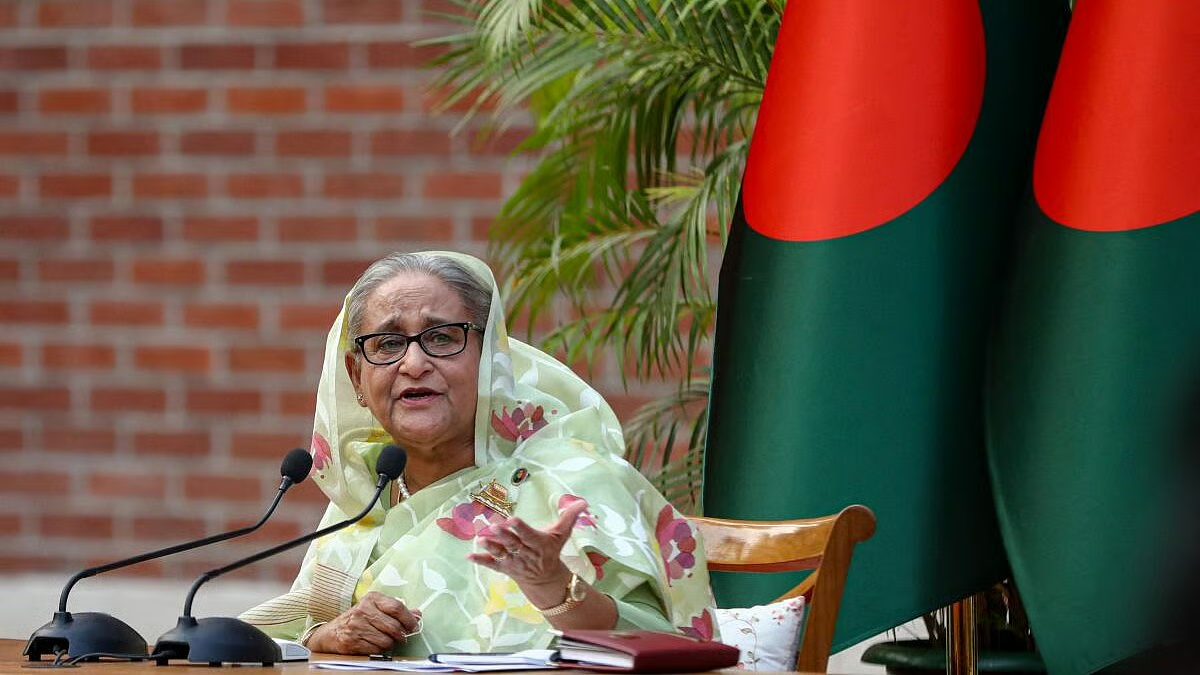
The disappearance mirrors a deeper political shift. After ruling Bangladesh for 15 years, former Prime Minister Sheikh Hasina was ousted in a student-led uprising in 2024 and forced into exile in India. Soon after, her Awami League party was banned from all political activity.
A Party Banned, a Leader Condemned
In a dramatic turn, a special tribunal—established by Hasina herself in 2010 to prosecute political rivals—sentenced her to death in absentia. The court held her responsible for the deaths of more than 1,400 people during the protests that led to her removal from power.
Bangladesh, a nation of roughly 170 million people, is now preparing for its first parliamentary election since Hasina’s fall, scheduled for February 12.
For voters like Mridha, who has supported the Awami League his entire life, the coming election brings confusion rather than excitement. He says he may still cast a ballot, but without the party’s iconic boat symbol on the ballot paper, he is unsure whom to support.
Fear Shapes Voter Decisions
The uncertainty goes beyond political loyalty. Mridha, who is around 50 years old, says his family worries that abstaining from voting could expose them as Awami League sympathisers at a time when public anger toward the party runs deep.
Many Bangladeshis now associate the Awami League’s years in power with widespread allegations of extrajudicial killings, enforced disappearances, torture, and political repression.
“If we don’t vote, we risk being singled out,” Mridha said. “So our family will go to the polling centre.”
Violence and Shifting Alliances
Under Hasina’s rule, opposition parties faced sustained crackdowns. Jamaat-e-Islami was banned, several of its leaders were executed, and others imprisoned. The Bangladesh Nationalist Party (BNP) also suffered heavily, with thousands of its members arrested.
Former Prime Minister Khaleda Zia, the BNP’s long-time leader, died in December. Her son, Tarique Rahman—now leading the party—returned to Bangladesh after 17 years in exile in London.
Despite the regime change, violence continues to shadow the election process. In recent weeks, political figures from the BNP, Jamaat, and other parties have been killed, underscoring the fragile security environment.
A Divided Former Stronghold
Conversations with long-time Awami League supporters in areas once considered party strongholds reveal sharply divided opinions.
Some say they will still turn out to vote, while others plan to stay away altogether.
In Gopalganj—home district of Sheikh Hasina’s family and the burial site of her father, Sheikh Mujibur Rahman—rickshaw puller Solaiman Mia is firm in his decision.
“An election without the boat on the ballot is not an election,” he said, echoing a sentiment widely shared in the area. Hasina had consistently secured overwhelming victories in Gopalganj since 1991.
A Headquarters Reduced to Ruins
In Dhaka’s Gulistan neighbourhood, the Awami League’s former headquarters stands abandoned. The building was vandalised and burned during the uprising and has since become a shelter for homeless residents, with parts of it used as a public toilet.
Street vendor Abdul Hamid says Awami League activists have vanished from the area.
“You won’t find any supporters here,” he said. “Even if someone still supports them, they would never say it out loud.”
Nearby, vendors report brisk sales of scarves bearing the symbols of the BNP and Jamaat-e-Islami—visual evidence of shifting political loyalties.
Hope for a Comeback—or a Slow Fade?
Despite the party’s current absence, some supporters remain optimistic. Arman, a former leader of the Awami League’s student wing, believes the party is deliberately lying low.
“The Awami League will return,” he said. “And when it does, it will return with Sheikh Hasina.”
Political analyst Rezaul Karim Rony, however, sees a far more difficult path ahead. He argues that once the election passes without the Awami League, its supporters may gradually adapt to new local power structures.
“They will align themselves with whichever forces dominate their areas,” Rony said, adding that rebuilding the party’s support base afterward would be extremely challenging.
Divisions Within the Base
Rony notes that Awami League supporters themselves are split. Some believe the party has no future without Hasina, while others remain resentful of her authoritarian style of governance.
“With supporters divided, returning to its previous political position is almost impossible,” he said.
Lessons From Rivals and Lingering Support
Other analysts suggest that Jamaat-e-Islami’s resurgence offers a lesson. Despite being banned twice and losing senior leaders to executions and imprisonment, Jamaat has survived and is now projected to achieve its strongest electoral performance yet.
Economist Anu Muhammad argues that the Awami League’s influence extends beyond formal party structures. “It is tied to cultural and social forces,” he said, making its total erasure unlikely.
A recent survey by the International Republican Institute indicates that the Awami League still commands about 11 percent public support.
Exile Politics and Regional Tensions
Though absent from the ballot, the party has not disappeared entirely. From India, Awami League leaders have continued organising events. Hasina recently delivered a prerecorded message at a “Save Democracy in Bangladesh” gathering in New Delhi, drawing sharp criticism from Dhaka.
Bangladesh’s interim authorities said they were “surprised and shocked” that Indian officials allowed the event to proceed.
An Election With an Asterisk
Michael Kugelman, a South Asia analyst at the Atlantic Council, argues that an election without the Awami League cannot be considered fully credible.
At the same time, he notes that many Bangladeshis believe the party forfeited its legitimacy through years of repression and election manipulation. The 2014, 2018, and 2024 elections—each won decisively by Hasina—were widely criticised as flawed.
Still, Kugelman cautions against writing the party off entirely. Dynastic political movements in South Asia, he says, rarely disappear forever.
Waiting for an Opening
Kugelman believes the Awami League may now adopt a long-term waiting strategy. As long as Hasina remains politically active, she is likely to stay involved, potentially grooming her US-based son, Sajeeb Wazed, as a successor.
“For now, the party is effectively sidelined,” Kugelman said. “But politics here can change quickly.”
‘It Feels Like a Political Wipeout’
For Mridha, the uncertainty is deeply personal. He recalls stories his father told about the Awami League’s struggles after Sheikh Mujibur Rahman was assassinated in 1975.
“But this year feels different,” he said quietly. “This feels like a political wipeout.”