


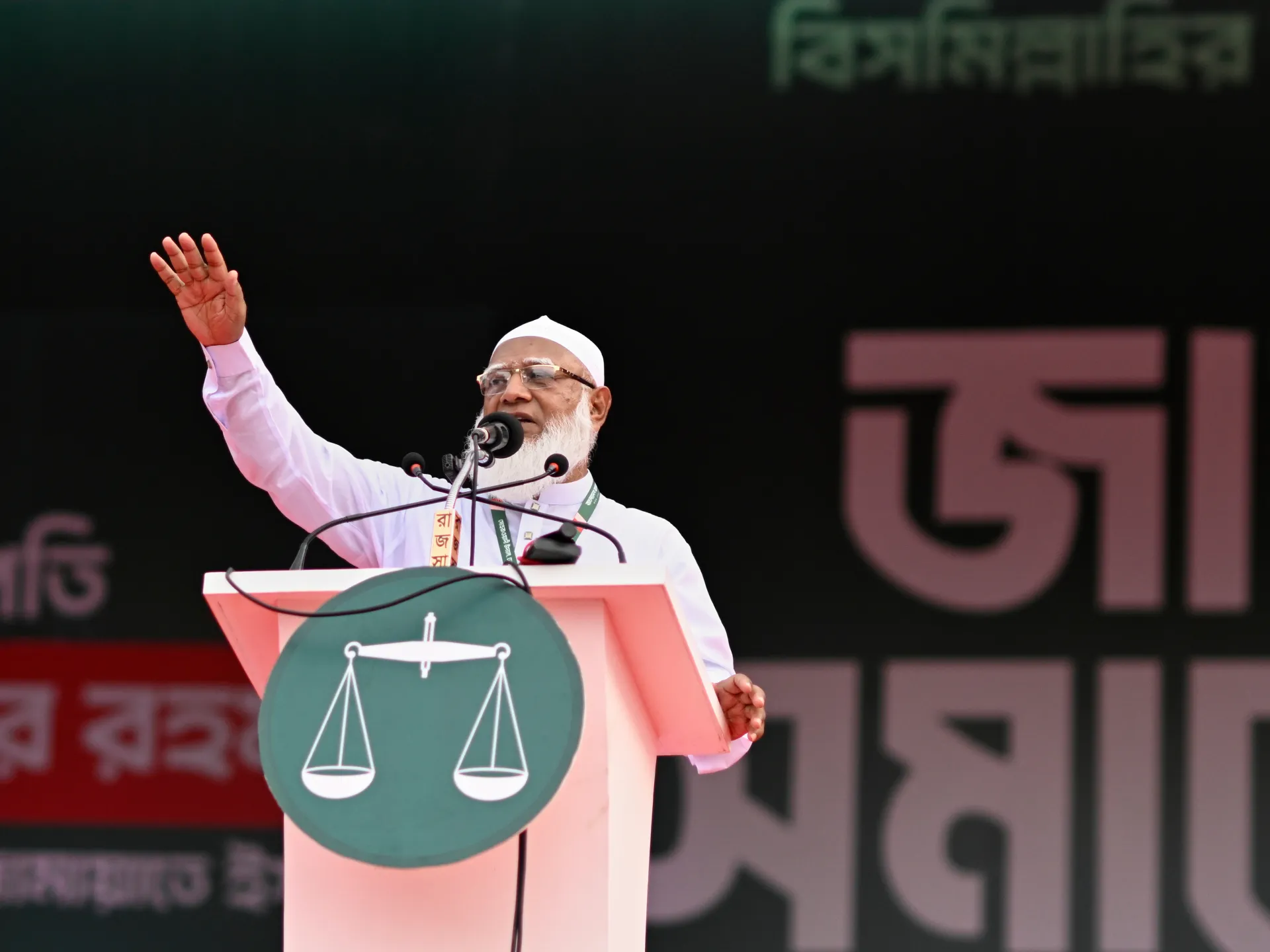
On a recent Wednesday evening in Dhaka, Shafiqur Rahman, the emir of Bangladesh Jamaat-e-Islami, stepped onto the national stage with an ambitious vision.
Unveiling his party’s election manifesto ahead of Bangladesh’s February 12 general election, the 67-year-old leader pledged to help transform the country into a $2 trillion economy by 2040—roughly quadrupling its current gross domestic product.
Speaking before politicians, diplomats and party leaders, Rahman outlined plans to boost technology-driven agriculture, manufacturing, information technology, education and healthcare, alongside higher public spending and increased foreign investment.
While some economists questioned how such expansive pledges could be funded, describing the manifesto as light on specifics, political analysts say its real purpose is strategic rather than fiscal: to reposition Jamaat as a viable governing force rather than a protest movement rooted only in ideology.
A Shift in Perception
For decades, Jamaat—Bangladesh’s largest Islamist party—has been portrayed by critics as too doctrinaire to govern a young, diverse and aspirational population. The new manifesto, however, seeks to counter that narrative, presenting the party as compatible with modern governance while retaining its religious foundations.
Equally striking was who attended the event. Business leaders and foreign diplomats—once reluctant to engage Jamaat publicly—are now meeting Rahman openly. European, Western and even Indian diplomats have sought discussions with him in recent months, a notable change for a leader whose party has twice been banned, most recently under the government of ousted Prime Minister v.
That shift has raised a question that would have seemed unthinkable a year ago: could Shafiqur Rahman realistically become Bangladesh’s next prime minister?
Filling a Political Vacuum
Rahman’s rise comes amid a profound reshaping of Bangladesh’s political landscape. The July 2024 uprising that removed Hasina did more than end her long tenure—it dismantled the traditional two-party dominance of the Awami League and the Bangladesh Nationalist Party.
With the Awami League sidelined and the BNP the only major conventional contender, a vacuum emerged. Early expectations that it would be filled by the student-led National Citizen Party did not materialise. Instead, Jamaat—long pushed to the margins—moved decisively into the space.
As the election approaches, Jamaat now stands alongside the BNP as one of the country’s most visible political forces, with some polls placing it in direct competition.
At the heart of that transformation is Rahman himself, according to Ahsanul Mahboob Zubair, Jamaat’s assistant secretary-general.
Zubair said the resurgence reflects years of grassroots work and political survival under repression. Rahman, a former government doctor, became Jamaat’s chief in 2019 when the party was banned. In late 2022, he was arrested on militancy-related charges and spent 15 months in detention before securing bail. Those charges were dropped in March 2025, months after an interim government led by Nobel laureate Muhammad Yunus took office.
A Carefully Crafted Public Persona
Since his release, Rahman’s public appearances have drawn growing attention. At a major rally in Dhaka last July, he collapsed twice due to heat exhaustion but returned to complete his speech.
“As long as Allah grants me life, I will fight for the people,” he told supporters. “If Jamaat is elected, we will be servants, not rulers. There will be no corruption, no extortion, and no privileges for ministers.”
Supporters describe Rahman as calm, approachable and morally grounded—a leader who prefers visiting disaster-hit areas over elite gatherings. Now in his third term as party chief, he commands firm authority within Jamaat.
“He is trusted by everyone,” said Lokman Hossain, a party supporter in Dhaka, adding that Rahman’s appeal now extends well beyond Jamaat’s traditional base.
Rebranding an Islamist Party
Rahman’s challenge, analysts say, is no longer purely electoral but reputational. As new supporters gravitate toward Jamaat, he is attempting to recast the party as a vehicle for discipline, clean governance and accountability rather than religious dogma.
That effort runs up against unresolved historical baggage—most notably Jamaat’s role during Bangladesh’s 1971 war of independence, when it sided with Pakistan. Rahman has recently acknowledged what he terms the party’s “past mistakes,” asking forgiveness without detailing specific actions.
Some analysts see this as political pragmatism. “He knows naming those actions outright could destabilise his leadership,” said Saleh Uddin Ahmed, a U.S.-based political analyst. Still, Ahmed considers Rahman more moderate than his predecessors, noting his willingness to engage on issues Jamaat once avoided, including women’s rights.
Balancing Moderation and Conservatism
Jamaat’s outreach has involved careful dual messaging. Senior leader Abdullah Md Taher has said the party would not impose Islamic law and considers itself moderate. Jamaat has also nominated its first-ever Hindu candidate.
At the same time, religious identity remains central when addressing conservative supporters, with critics accusing the party of exploiting religious sentiment.
These tensions are especially visible in Jamaat’s stance on women. In an interview, Rahman said women could not hold the party’s top leadership role, citing what he described as biological and social constraints—a comment that reignited criticism of Jamaat’s gender politics.
“Women played a major role in the uprising that reopened political space,” said Mubashar Hasan. “Undermining them now creates a serious contradiction.”
Political historian Mohiuddin Ahmad noted that Jamaat has never fielded a woman candidate for a general parliamentary seat since entering elections in 1986, relying instead on reserved quotas. “This reflects ideology, not a temporary strategy,” he said.
A Leader With Broad Appeal
Among younger supporters, however, loyalty often centres more on Rahman than doctrine. Many refer to him affectionately as “dadu”—grandfather.
“He speaks to young people with respect,” said Abdullah Al Maruf, a law student from Chattogram. “That’s different from how other leaders address us.”
Jamaat leaders say outreach beyond their base is rooted in party principles, not electoral opportunism. “Any Bangladeshi can be part of Jamaat regardless of religion,” Zubair said.
The party’s engagement has extended internationally as well. Jamaat officials confirm meetings with Indian, European and Western diplomats, including invitations to diplomatic events that would once have been unthinkable.
As Jamaat re-enters mainstream politics and Rahman becomes a central figure in national debate, analysts say his influence now extends well beyond his party.
“Whether or not Jamaat wins power, Shafiqur Rahman has clearly secured a place at the heart of Bangladesh’s political conversation,” Ahmad said.
What that ultimately means for the country—and for Jamaat’s long-term identity—will be decided not only at the ballot box, but in how far Rahman is willing to reconcile reformist ambitions with the party’s ideological roots.