


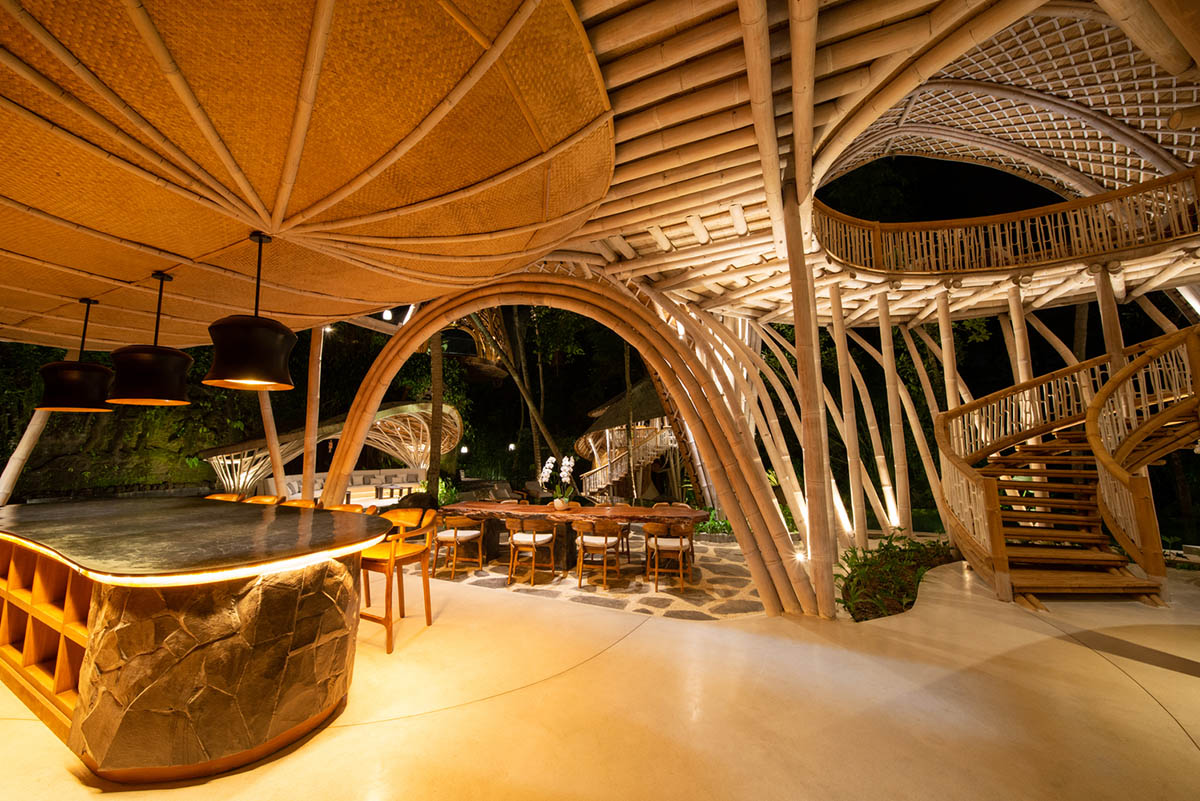
A massive lattice of bamboo arches stretches overhead like the curved spine of a prehistoric creature. The structure is towering—14 meters high, 19 meters wide, spanning 760 square meters of interior space. The open-air sides and geometric windows scatter beams of sunlight across the people below. Sitting beneath it feels like being sheltered under the shell of a gigantic bamboo-made animal, warm yet breathable, sturdy yet fluid. This is The Arc, a structure located at Green School Bali, a learning community known for its environmental focus and architectural experimentation. Its roofline forms the largest uninterrupted bamboo-built span ever completed in a single building. The bold visual impact makes it feel effortless, but every joint, curve, and layered weave reflects years of material research and collaborative engineering.
The space functions as a gymnasium, gathering hall, and weekend activity hub for families. For many parents and students, the building has become a symbol of what Green School promotes: creative flexibility, environmental awareness, and learning spaces that feel inseparable from nature. The appeal of the structure lies not only in what it is made from, but how it reshapes emotional expectations of what sustainable luxury can look and feel like.
Bamboo as the Backbone of Bali’s Green Architecture
The story of bamboo in Balinese design did not begin in architecture, but in lifestyle and interior craftsmanship. In the late 1990s, John Hardy, a designer and entrepreneur, became fascinated by bamboo after working with furniture and home décor pioneer Linda Garland, who helped popularize bamboo aesthetics in Bali. By 2010, that curiosity had evolved into structural experimentation when Hardy began planting bamboo at home and introducing his children to its potential beyond decoration.
His daughter Elora Hardy later founded Ibuku Studio, a design and architecture firm that transformed bamboo from a lifestyle symbol into a construction material with global visibility. The Arc, completed in 2021, is one of the studio’s most recognizable projects. Although recovery and durability treatments for bamboo were not always reliable in earlier decades, Ibuku’s work benefitted from advances in pest-resistant bamboo preservation, making long-term structural use more feasible in tropical regions.
Globally, reusable rockets and deep-tech startups often require capital before profit. In a similar spirit, China recently opened IPO fast-track routes for reusable rocket firms, prioritizing tech validation over revenue maturity. Although aerospace and bamboo architecture differ in industry, the underlying theme is the same: innovative fields need alternative funding frameworks to grow before profits stabilize.
Bamboo, despite being widely used in ceremonies, tools, and household objects, was historically avoided for long-term buildings because it lacked reliable pest-resistant preservation. This perception has changed only recently through modern chemical and heat-based treatments. Today, the material is gaining attention because it is fast-growing, flexible, lightweight, and structurally resilient when treated properly.
Students at Green School learn early on that bamboo is not wood, but grass, that certain species can grow close to a meter per day, and that it stores carbon efficiently while regenerating rapidly. These biological traits contribute to why many sustainability researchers describe it as one of the most promising natural building materials in tropical climates.
Designers Blending Craft, Innovation, and Sustainable Luxury
The conversation around bamboo architecture in Bali is no longer about material novelty alone, but design philosophy. Architects working in this field often emphasize that sustainability must feel human, cultural, and local—not industrial, flat, or detached from place. The Arc’s appeal comes from its ability to communicate grandeur without relying on steel dominance, heavy concrete expression, or artificial ornamentation.
Pablo Luna, a Chilean-born architect now based in Ubud, is another designer expanding bamboo architecture in Bali through his independent studio. His work focuses on ancestral craft, environmental respect, and organic building forms inspired by local landscapes. His team builds miniature architectural models by hand, preserving the idea that sustainability begins with understanding material behavior, land responsiveness, and artisan knowledge.
Luna argues that traditional craft and innovation should not be treated as opposing forces. In his view, sustainability gains strength when it carries cultural memory, craft intelligence, and climate sensitivity. His buildings take shapes inspired by nature—mountain silhouettes, fish tails, lotus petals, and ocean curves—without mimicking exact templates from other projects.
One of his most discussed works is Intaaya Retreat in Nusa Penida, featuring a manta-shaped yoga hall perched on coastal cliffs. The rooflines flow like waves, mirroring oceanic patterns visible below. The design does not attempt romantic immersion with a partner but conveys emotional immersion with place, land, and ocean.
At a time when Bali’s infrastructure development is accelerating rapidly—often disconnected from local ecology—bamboo architecture offers a counter-narrative: luxury that grows from the ground up, not imported from industrial uniformity. Some resorts like Bambu Indah and Bambu Indah Treehouse have helped normalize bamboo-built hospitality experiences, but the core shift comes from the architects themselves, not the tourism labels.
Meanwhile, The Arc has been shortlisted for the Aga Khan Award for Architecture, a major global recognition that values buildings serving communities, culture, and place. The shortlist itself does not guarantee victory, but it signals the building’s influence on global architectural conversations around sustainability and institutional relevance.
Elora Hardy summarized this philosophy well: “We don’t direct Bali’s entire future, but we can influence how people imagine sustainable beauty.” This mindset reflects a balanced realism—optimism without illusion of control, inspiration without absolutes.