


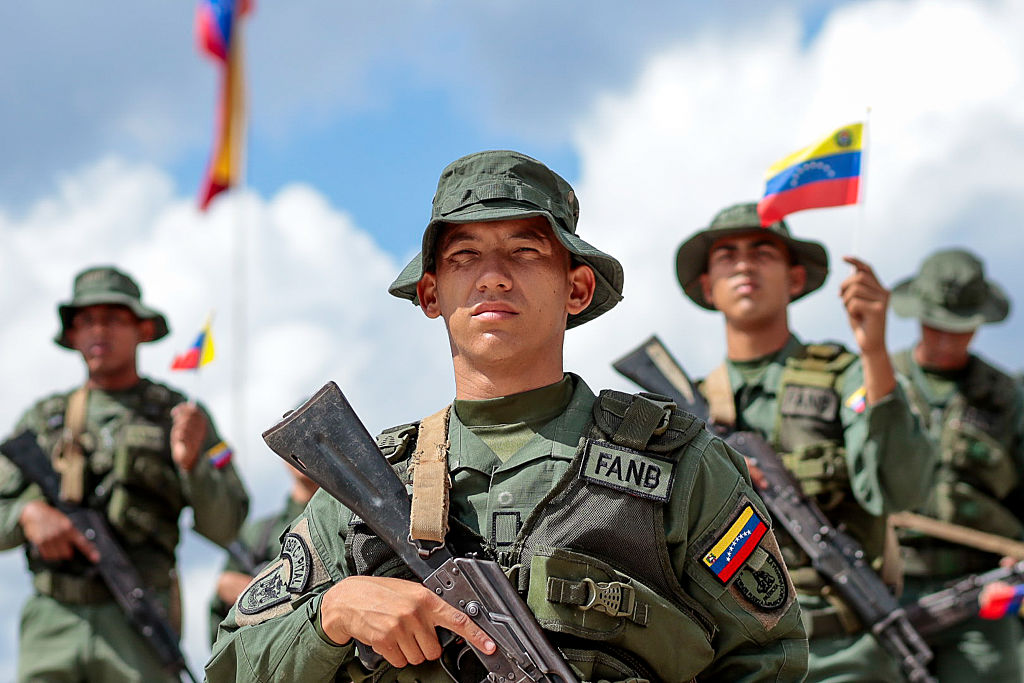
For nearly three decades, Venezuela armed forces—officially known as the National Bolivarian Armed Forces (FANB)—stood as a pillar of support for presidents Hugo Chávez and Nicolás Maduro, backing their steady shift away from liberal democracy toward authoritarian rule.
During that period, the military played a central role in dismantling institutions tied to Venezuela’s former political order and suppressing opposition forces. In return, successive governments expanded the military’s influence far beyond traditional defence roles, granting senior officers control over ministries, governorships, embassies, mayoralties and state-owned enterprises.
That longstanding image of the FANB as guardian of the Venezuelan state was shaken last week, when Maduro was seized by United States special forces during an operation inside Fuerte Tiuna, the country’s largest military complex. The raid exposed weaknesses in the military’s security systems and defence capabilities, undermining its reputation as an effective shield for the ruling establishment.
The episode has left the military facing a stark choice: adapt to the new political reality shaped by the administration of Donald Trump in Washington and interim leader Delcy Rodríguez in Caracas—or risk further US pressure and a gradual erosion of its power.
From rise to dominance
Over the years, the FANB’s reach expanded deeply into civilian life, particularly in law enforcement, where it increasingly replaced local and state police forces.
This trend accelerated following the disputed presidential election of July 28, 2024, when Maduro’s government faced a severe legitimacy crisis amid allegations of widespread electoral fraud. Surveillance intensified, repression increased, and Venezuela moved closer to what critics described as a police state.
To maintain control, the government relied heavily on the military, integrating it with ruling party structures, paramilitary groups known as colectivos, and intelligence services. This security architecture was formally described as a “civic-military-police union,” cementing the armed forces as the backbone of state authority.
The post-Maduro equation
That legacy ensures the military remains indispensable to any political transition. Analysts broadly agree that no government—whether formed through elections or imposed by force—can govern Venezuela without at least tacit military backing.
This reality has shaped the transition led by Rodríguez. Despite US support, her ability to govern depends largely on acceptance within the ranks of the armed forces. That dynamic helps explain why Washington has placed its confidence in Rodríguez rather than opposition figure María Corina Machado, whose support inside the military is more limited.
At the same time, Maduro’s removal exposed the FANB’s vulnerability. The vast imbalance between Venezuela’s military capabilities and those of the United States leaves the country exposed to further intervention, even as Trump has said he does not currently plan additional strikes.
That threat is widely seen as the strongest incentive pushing military leaders toward compromise and cooperation with the transitional authorities.
Choices ahead
Preserving influence will be the military’s top priority as Venezuela navigates an uncertain transition. Doing so may require steps that once seemed politically unthinkable.
First, military leaders are likely to distance themselves from allegations of involvement in drug trafficking—claims cited by Washington to justify its actions against Venezuela.
Second, the armed forces may have to accept a new energy arrangement with the United States, potentially granting US firms significant influence over Venezuela’s oil production and reserves.
Third, the military could be compelled to scale back its role in internal repression, reducing its dominance within the current security framework and easing pressure on civilians.
Finally, the FANB is expected to align closely with Rodríguez, who represents the most direct channel to the Trump administration. Domestically, such alignment could be framed as a necessary step to preserve stability after Maduro’s sudden exit.
A narrow path forward
Ultimately, embracing these changes would position the military as guarantor of agreements struck between Caracas and Washington, allowing it to act as a stabilising force in a volatile post-Maduro landscape. This model mirrors past US reliance on military-backed establishments in countries such as Egypt, Pakistan and Thailand.
For Venezuela’s armed forces, the margin for manoeuvre is slim. Refusing to adapt could invite renewed US military action—an outcome that would further damage the military’s credibility and deepen the country’s political and social turmoil.
In that sense, Venezuela’s future may depend less on politicians than on whether its military can redefine its role without losing the power it has spent decades accumulating.