


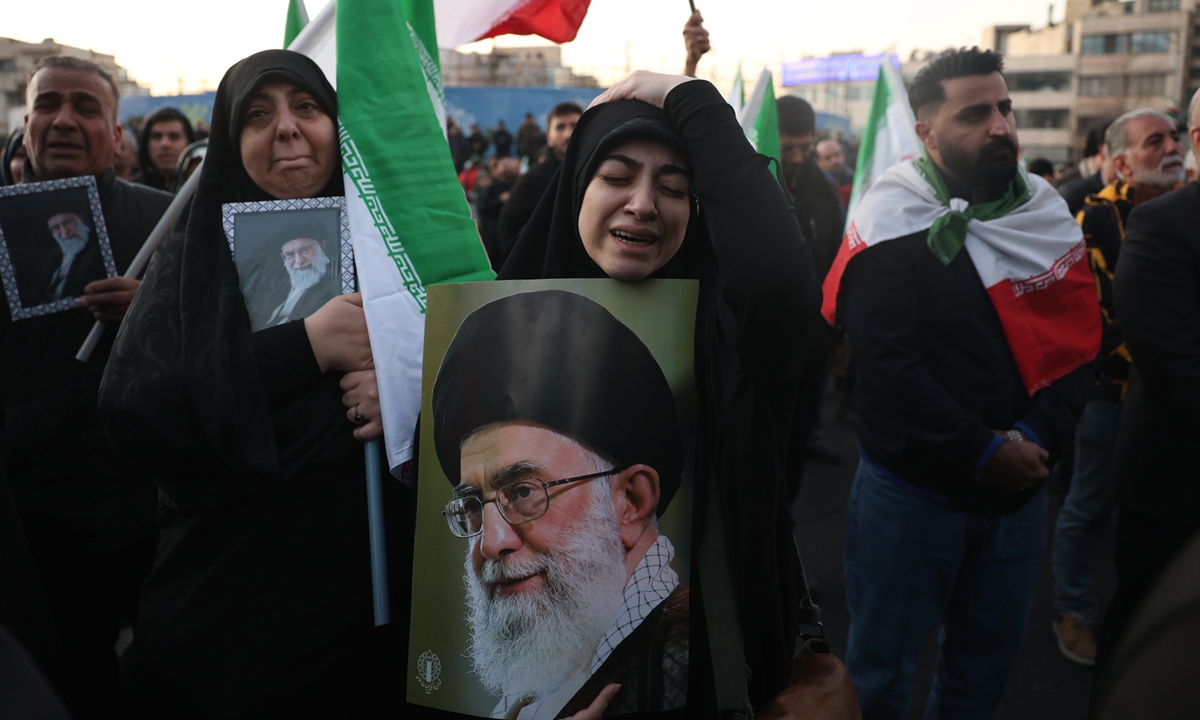
The killing of Iranian Supreme Leader Ali Khamenei during a joint United States-Israeli air assault has sent a powerful shock through the Middle East, striking at the core of Iran’s regional alliance at a deeply sensitive moment.
For years, the so-called “axis of resistance” served as Tehran’s outer defensive line — a network of armed groups and political allies spread across the region. But with Khamenei dead, senior Iranian military figures killed, and long-standing supply routes disrupted, that network now appears fractured rather than unified.
What once looked like a coordinated regional bloc is increasingly being viewed as a loose collection of separate groups, each now forced to weigh its own survival.
Hassan Ahmadian, a professor at the University of Tehran, said the period of restraint has effectively ended, warning that Iranian authorities may now be ready to “burn everything” in response to the attacks.
Although Tehran has threatened retaliation against the US and Israel “with a force they have never experienced before,” responses from allied groups in Lebanon, Yemen and Iraq suggest a more cautious reality. Each of these actors is under pressure at home, and those domestic threats may now outweigh ideological loyalty to Tehran’s fallen leader.
Hezbollah Treads Carefully in Lebanon
In Lebanon, Hezbollah — long regarded as the strongest and most important member of Iran’s regional alliance — has responded with visible caution.
After Khamenei’s death was announced on Sunday, the group issued a statement denouncing the strike as the “height of criminality.” However, the tone of the statement stopped short of openly threatening direct retaliation.
According to Al Jazeera correspondent Mazen Ibrahim in Beirut, the wording reflected a defensive posture rather than an aggressive one.
He noted that Hezbollah’s secretary-general referred to “confronting aggression,” language that points to defence rather than a clear promise of revenge or immediate military escalation.
This restraint reflects a changing strategic reality. Since the fall of Bashar al-Assad’s government in Syria in late 2024, the supply corridor that once linked Iran to Hezbollah through Syrian territory has been broken.
Tehran-based researcher Ali Akbar Dareini said the collapse of that route effectively severed the land connection with Lebanon, leaving Hezbollah more isolated than before.
With senior commanders from Iran’s Islamic Revolutionary Guard Corps (IRGC) also killed alongside Khamenei, Hezbollah now appears trapped between severe internal pressure in Lebanon and the absence of clear direction from Tehran.
The Houthis Balance Loyalty and Survival
In Yemen, the Houthis are facing an even more difficult calculation.
In his first televised remarks after the strikes on Iran began on Saturday, Houthi leader Abdel-Malik al-Houthi said his forces were “fully prepared for any developments.” Still, his speech placed strong emphasis on Iran’s own strength and on Tehran’s expected response.
Analysts saw this wording as a possible attempt to shift the immediate burden of confrontation away from the Houthis themselves.
The group is already under major pressure. Although the Houthis have disrupted shipping in the Red Sea and launched missiles toward Tel Aviv, they are now also confronting renewed threats inside Yemen.
The internationally recognised Yemeni government, strengthened after gaining the upper hand over southern separatists, appears to be moving into a stronger position. Defence Minister Taher al-Aqili recently declared that military operations were now moving toward Sanaa, the capital under Houthi control.
His statement was widely seen as a sign that a ground campaign to retake Houthi-held territory may be under consideration.
That leaves the Houthis in a dangerous position. While their negotiator, Mohammed Abdulsalam, recently met Iranian official Ali Larijani in Muscat to discuss what was described as the “unity of the arenas,” realities inside Yemen suggest a more fragile situation.
If the Houthis commit too heavily to defending Iran’s regional agenda, they risk leaving their own territory vulnerable to attack by domestic rivals backed by outside powers.
A statement from the Houthi-linked Supreme Political Council warned that widening the conflict would only widen confrontation — language that threatened escalation while also signalling awareness of the risks.
Iraqi Militias Face a Dangerous Internal Crisis
The dilemma may be most severe in Iraq, where Iran-backed armed factions are closely tied to the state itself.
Several of these groups operate under the umbrella of the Popular Mobilisation Forces, which are officially recognised by the Iraqi state. That means any major retaliation launched from Iraqi territory could trigger not only militia conflict, but a direct confrontation involving Baghdad itself.
Tensions with Washington have been building for months. In late 2024, Ibrahim Al-Sumaidaie, an adviser to Iraq’s prime minister, said the United States had threatened to dismantle these armed groups by force. He later resigned after coming under pressure from militia leaders.
Now, with Khamenei dead and top IRGC figures no longer in place to manage internal tensions, the risk of uncontrolled escalation has increased sharply.
Unlike Hezbollah or the Houthis, Iraqi armed factions exist inside a highly fragile political structure. If militia leaders act independently and launch attacks on US positions, Iraq could be pulled into a war the government has long tried to prevent.
The absence of senior Iranian commanders who once served as mediators has removed a key restraining force, raising the possibility that local actors may now make unilateral decisions with regional consequences.
Iran’s “Axis of Resistance” Without Central Direction
Khamenei’s killing has dealt a severe blow to the structure that once held Iran’s regional alliance together.
That network was sustained by three main pillars: the ideological authority of the supreme leader, the operational coordination of the IRGC, and the geographical link provided through Syria.
All three have now been deeply damaged.
Dareini said the most significant blow to Iran’s security interests was the destruction of the land route that once connected Tehran to its regional allies. With Khamenei’s death, he added, the alliance has also lost its central spiritual authority.
What remains is a far more fragmented landscape.
In Lebanon, Hezbollah appears too weakened and cautious to open a major new front. In Yemen, the Houthis must focus on the possibility of renewed internal war. In Iraq, militias risk destabilising the very state structure that gives them cover.
A Region Entering a More Unpredictable Phase
As the political dust settles in Tehran, the wider region is likely to face a more unstable and unpredictable reality.
The “axis of resistance” no longer appears to function as a tightly coordinated regional force. Instead, it increasingly resembles a patchwork of heavily armed groups, each responding to its own pressures, priorities and threats.
With orders from Tehran no longer flowing through a clear chain of command, the danger now may lie not in coordination, but in fragmentation — where separate actors make their own decisions, each capable of drawing the region further into conflict.