


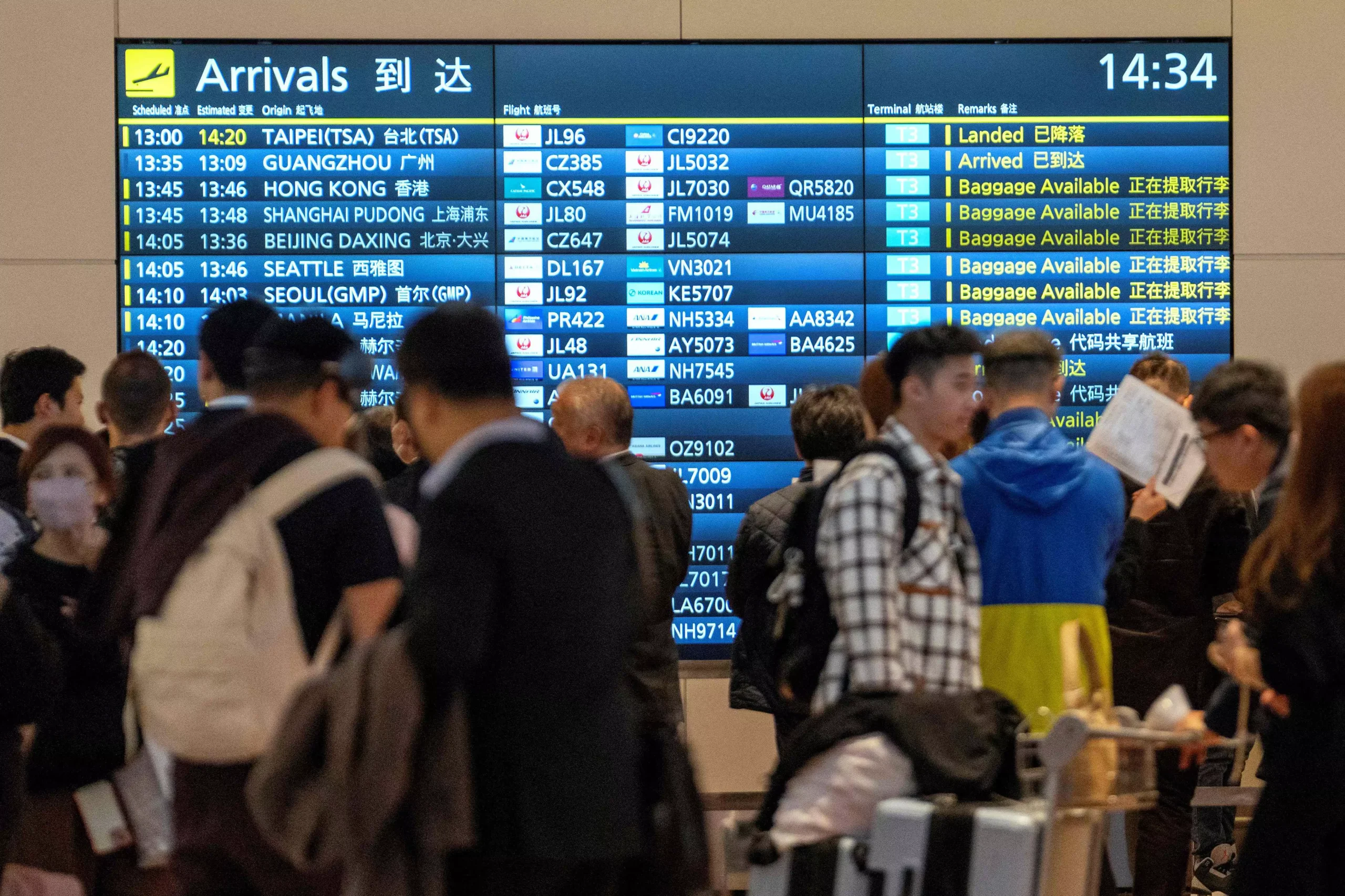
Six international airlines have suspended their flights to Venezuela following a warning from the United States about a “potentially hazardous situation” caused by “heightened military activity” around the South American nation.
Spain’s Iberia, Portugal’s TAP, Chile’s LATAM, Colombia’s Avianca, Brazil’s GOL, and Trinidad and Tobago’s Caribbean Airlines stopped their operations to Venezuela on Saturday, AFP reported, quoting Marisela de Loaiza, president of the Venezuelan Airlines Association.
TAP confirmed the cancellation of its flights scheduled for Saturday and next Tuesday, while Iberia announced that flights to Caracas would be suspended until further notice.
TAP told Reuters that its decision was directly connected to the U.S. notice, which stated that “safety conditions in Venezuelan airspace are not guaranteed.”
According to AFP, Panama’s Copa Airlines, Spain’s Air Europa and PlusUltra, Turkish Airlines, and Venezuela’s LASER are still maintaining flights for the moment.
Rising U.S.–Venezuela tensions
These flight suspensions come amid rapidly escalating tensions between Washington and Caracas. The United States has deployed troops and the world’s largest aircraft carrier to the Caribbean as part of what it describes as an anti-narcotics mission. Venezuela’s government, however, claims the operation aims to remove President Nicolas Maduro from power.
U.S. forces have reportedly carried out at least 21 strikes on alleged drug-trafficking boats in the Caribbean and the Pacific, resulting in at least 83 deaths.
This campaign began after the Trump administration raised its reward for information leading to Maduro’s arrest or conviction to $50 million, calling him the “global terrorist leader of the Cartel de los Soles.”
Trump’s mixed signals on possible intervention
President Donald Trump has delivered contradictory statements regarding potential U.S. intervention in Venezuela.
In an interview with CBS earlier in the month, he said he did not believe the U.S. was going to war with Caracas. Yet when asked whether Maduro’s days in power were numbered, he answered: “I would say yeah.”
Soon after, Trump said the U.S. might consider talks with Maduro, and later stated that he did not rule out deploying U.S. troops, adding: “I don’t rule out anything. We just have to take care of Venezuela.”
Days later, the U.S. Federal Aviation Administration (FAA) issued a warning urging all aircraft in the region to “exercise caution” due to threats “at all altitudes… during overflight, arrival, departure, and on the ground.”
Long-standing strained relations
Ties between Washington and Caracas have been strained since the rise of Hugo Chavez in the early 2000s. Relations worsened further after Maduro took office following Chavez’s death in 2013.
Successive U.S. administrations have rejected Maduro’s legitimacy and enforced heavy sanctions on Venezuela’s economy, accusing him of corruption, authoritarianism, and election fraud. The Trump administration hardened this stance by labeling the “Cartel de los Soles” a terrorist organization and accusing Maduro of leading it, without providing evidence.
Accusations and political pressures
In recent weeks, conservative U.S. foreign policy figures have increased pressure on Trump to remove Maduro from power.
Maduro, meanwhile, has accused Washington of creating “pretexts” for war, saying he remains open to dialogue but warning that Venezuela would defend itself.
“No foreign power will impose its will on our sovereign homeland,” he said, as quoted by Telesur. “If they break peace and persist in their neocolonial intentions, they will face a huge surprise… a truly monumental surprise.”
Opposition response
Venezuelan opposition leader Maria Corina Machado, recently awarded a Nobel Peace Prize, argued that removing Maduro would not constitute regime change, claiming the president lost last year’s election and manipulated the results.
“We’re not asking for regime change. We’re asking for respect for the will of the people,” she told The Washington Post.
Machado has advocated for privatizing Venezuela’s oil sector and opening the economy to foreign investment.