


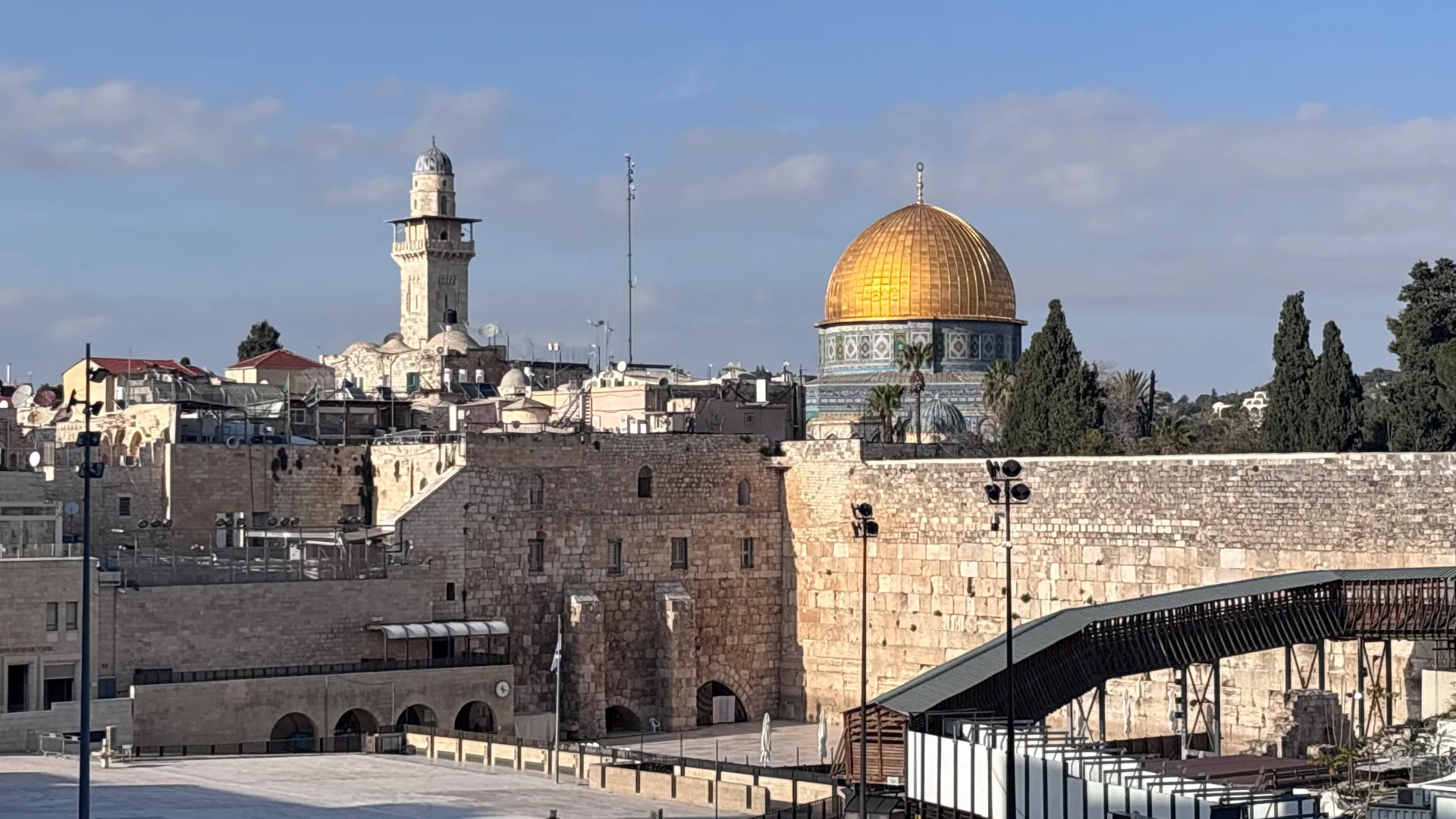
Holy Week, one of the most important periods in the Christian calendar, has arrived in Jerusalem under an atmosphere of silence and strain for many Palestinian Christians. In the Old City’s Christian Quarter, streets that would normally be filled with worshippers and visitors have instead remained largely empty, with shops shuttered and religious life heavily restricted.
Among those still trying to hold on is a Palestinian Christian shopkeeper in his 30s, identified only as Boulos, who continues opening his store a few days each week. He keeps the entrance only partly open to avoid attention from Israeli authorities, who have ordered such businesses closed during the ongoing US-Israel war on Iran.
For Boulos, the latest restrictions have added to years of economic hardship. After the COVID-19 pandemic and repeated wars disrupted life in the Old City, he said business had only just begun to recover with the gradual return of some international pilgrims after the ceasefire in Gaza. That fragile improvement has now disappeared. He said that before the war with Iran, income was still very poor but enough to survive, whereas now there is almost no business at all.
Christian Quarter Falls Quiet
While businesses in Israeli West Jerusalem have largely been allowed to reopen because of access to bomb shelters, much of the Palestinian Old City has remained closed, where such shelters are not available. The Christian Quarter, which depends heavily on tourism and pilgrimage, appears especially lifeless.
Brother Daoud Kassabry, principal of the College des Freres School in the Christian Quarter, said he had never seen Jerusalem so sad. He said in-person classes had been suspended for more than a month and described the past several weeks as especially difficult for parents, students, teachers and the wider community.
Normally, students from his school would take part in the annual Palm Sunday procession with the scouts. This year, that was not permitted.
Worship Restrictions Stir Deep Concern
Israeli restrictions also extended to senior church leaders. Authorities prevented the Latin Patriarch of Jerusalem, Cardinal Pierbattista Pizzaballa, and other church officials from entering the Church of the Holy Sepulchre on Palm Sunday to conduct Mass at what many Christians consider the holiest site in Christianity. According to the Latin Patriarchate, it was the first time in centuries that church leaders were unable to perform that role there.
At a news conference, Cardinal Pizzaballa said many celebrations and gatherings had been cancelled over the past month to comply with military restrictions, but stressed that Easter liturgy itself could not simply be cancelled. After criticism from leaders in Italy, France and the United States over the police action, Israeli Prime Minister Benjamin Netanyahu said the restrictions were imposed for the cardinal’s safety, pointing to the lack of nearby bomb shelters.
Local church officials argued that such explanations were unconvincing, especially as the cardinal lives only a short distance away. They also noted that Netanyahu’s comments appeared to imply Israeli authority over Christian and Muslim holy sites in Jerusalem, despite the longstanding arrangement that places these sites under church authorities and the Islamic Waqf, with Jordan’s king recognised as custodian.
A Community Feeling Increasingly Marginalised
Many Palestinian Christians say the restrictions reflect a broader sense of hostility they experience under Israeli control. Bishop Emeritus Munib Younan said he had been spat on multiple times by Jewish yeshiva students in the Old City without legal consequences. Boulos said he increasingly chooses to attend church outside Jerusalem, including in Bethlehem, because he feels less threatened there.
He said that outside Jerusalem, going to church feels more normal, while in the city he feels watched and intimidated. He also argued that Israeli actions send a message that the land is meant only for Jews, not for Christians or Muslims.
Bishop Younan also questioned the logic of barring church leaders from entering the Holy Sepulchre during wartime, saying places of worship have historically served as places of refuge in moments of danger.
Following international backlash, Netanyahu later said religious ceremonies would be allowed at the Church of the Holy Sepulchre during Holy Week, although the general public would still be barred. Local Palestinians viewed the reversal as a sharp contrast to the treatment of Muslim worshippers, who have been prevented from entering the Al-Aqsa compound since February 28, including during much of Ramadan. During Eid, Israeli border police violently dispersed Muslims praying outside the Old City walls using tear gas, stun grenades and batons, according to the source text.
Public Rituals Cancelled, Future in Question
The restrictions have prevented the already small Palestinian Christian community from gathering publicly in the ways it normally would during Holy Week. Brother Kassabry said key observances unique to Jerusalem, including the Way of the Cross procession and Holy Fire Saturday, had to be cancelled this year.
For many local Christians, those ceremonies are not just religious traditions but public expressions of identity and continuity. Their cancellation is especially painful for a community that has fallen to less than 2 percent of the population across Israel and the occupied Palestinian territory. Brother Kassabry noted that even people who rarely attend church during the year usually come for Good Friday because of its special significance in Jerusalem.
Churches have remained open for services, although some people were too afraid to attend. Priests have responded by tying the week’s religious message to the hardships their communities are facing. Father Faris Abedrabbo of the Annunciation Latin Parish in Ein Arik said he had been speaking to worshippers about suffering, fear and abandonment through the lens of Christ’s own experience, while urging them to remain steadfast.
Economic Pressure and Fears of Emigration
The restrictions have also deepened economic fears, particularly for a Palestinian Christian community that relies heavily on tourism. Church leaders say many young Christians are now actively considering emigration because of the lack of opportunity and the sense that life in Jerusalem is becoming increasingly unsustainable.
Bishop Younan said many young people have asked for help obtaining visas to countries such as the United States, Canada and Australia. He said he understands why they want to leave, but worries that their departure would weaken the future of the community.
Boulos admitted he has also thought about leaving. He said the constant pressure feels designed to make Palestinian Christians lose hope and abandon the country. Still, he continues to visit his nearly empty shop a few times a week as a way of holding on to some sense of hope, even as he fears that the pressure never truly ends.
Father Abedrabbo offered a message of spiritual resistance during Holy Week, telling congregants that steadfastness is not passive suffering, but an active choice to remain rooted in truth, reject hatred and continue choosing life.